
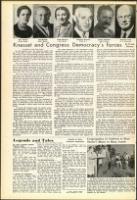

Reba Idelson
Ada Maimon
Golda Myerson
Knesset Member
Knesset Member
Israel Minister
Emanuel Shinwell
rttish M. P.
Joseph Sprinzak
Emanuel Celler
Knesset Speaker
U. S. Congressman
Knesset and, Congress: Democracy's Forces
An American Jewish Press Feature
In this political year, the American people will
go to the polls to select a President who will guide .
the destiny of our country. during a period which well
may prove to be one of the most crucial in the coun-
try's history. The election will be pointed out as an
example of democracy in action—the people electing
their choice of leaders.
Yet, there are other democratic elections and vari-
ous election procedures. And one of the most inter-
esting is that which is practiced in the state of Israel.
In an address before the House of Representatives in
Washington recently, Rep. Emanuel Celler, Congress-
man from New York, made this statement:
.
"We have taken pride and talked a lot about Is-
rael's army, her cultural advances, her achievements in
agriculture, her industrial potential and so forth. We
are so busy asserting Israel's democracy that we have
forgotten to mark for identification and place into
evidence its proudest exhibit of democracy at work.
How many know that prior to the establishthent of
the state of Israel, one of the most passionate centers
of interest among its leaders was the form its parlia-
ment would take when the free and indeAdent re-
public of Israel would come to be? Would Israel's
parliament be modeled after the American Congress,
the British or continental systems? . . . What finally
evolved was a synthesis of the systems of the Belgian,
French and British House of Commons."
The system of election which has developed to
elect this parliament—called the Knesset—is as demo-
cratic an institution as one could hope to find any-
where, although it differs vastly from the American
system.
In Israel, the citizenry votes for parties rather
than individuals. As Rep. Celler explains, "It is the
majority party in the Knesset which chooses its min-
isters, or shall I say, heads of the executive depart-
ment, which we in the U. S. all the Cabinet. The
responsibility ultimately focuses in the Knesset. The
people elect the Knesset; the Knesset forms the
go-vernment."
Mr. Celler goeS on to explain the difference by
stating that in this country, the President is elected
by the people and chooses his Cabinet independently,
needing only the advice and consent of the Senate.
The difference between the Congress here and
Israel's Knesset would make a fruitful study for stu-
dents of government, Mr. Celler believes. Some of
the basic differences he explains in the following
paragraphs.
The main departure is the unicameral system
adopted by Israel, which means that there is only
one law making body whereas here we have the
House and the Senate. There is also a change in the
makeup of the parties which comprise the govern-
ment. Fundamentally, in the United States, there is
a two-party system, while in Israel a multi-party
system holds sway,
The three principal groupings are the workers,
middle class and religious, with various parties formed
within these categories. This fact, in part, explains
the necessity of forming coalition governments in the
new state.
Committee referment also differs between the two
governments. Here, a bill can be referred by any
member of Congress to a committee. It is then acted
upon or discarded as the committee decides. In Israel,
a bill is first read before the Knesset as a body, then,
if necessary, referred to committee. A bill must have
three readings before it is passed.
Celler touches on the human aspects of the Knes-
set members. He states that during the first Knesset,
antagonism between members was so great that some
members, representing opposing parties, would not
speak to each other either on or off the Knesset floor.
Much of this personal animosity is now disappearing,
he adds.
Disagreement, however, is a natural course of
events in the formation of a new government. In
the early U. S. Congress, Celler states, "debate was
rough and burly and anything but polite, with
members hurling insults at each other about per-
sonal habits and ancestry."
Even today, in some of the larger government
bodies, such as the 625 member French National As-
sembly, there is much disorder. Celler tells the fol-
lowing system used by the French presiding officer:
"(He) does not use a gavel with which to call the
assembly to order. When it becomes unruly, he rings
a bell (situated over his head) once. If nothing hap,
pens, he rings twice and, if not successful, rings a
third time. If disorder still continues, he puts on his
hat as a symbol that he is about to leave and terminate
the proceedings. And if the disorder continues, he
walks out."
In the matter of decorum, Israel-has done better
than older and more famous parliaments. In France,
fistfights are common, and, even in the staid British
House of Commons, a member once slapped the
Compiled by Rabbi
Legends and Tales
NAPHTALI HOROWITZ
Copyright 1952, Seven Arts Feature Syndicate
AN OLD CUSTOM AMONG
FRENCH JEWS . .
Rabbenu Bechai, in his book
Shulchon shel Arba (Table for
Four), tells of an old custom
that was widespread among
well - to - do and charitable
French Jews.
The tables which were pre-
pared for indigent Jews for
special occasions, such as wed-
dings and holidays, would later
be turned into coffins for the
rich donors. The object of this
custom was to demonstrate that
nothing remains of a man's
work and deeds but the table of
kindness and charity.
* a
A WORD TO SMOKERS . .
The Chelmer Maggid, itiner-
ant preacher of Chelm, once
told the following parable:
"I once met a rather stout
man who smoked furiously.
Upon my query why he smoked
so much, he replied that he did
it in order better to digest the
rich foods he ate. A little later
I met a very lean man who also
smoked continuously. When I
asked him why he smoked so
much, he answered that he was
always hungry and when he
smoked his hunger was some-
what appeased. I therefore
thought to myself," the preach-
er concluded, "that if the stout
man would only give up some
of his fat to th6 lean man
neither would have to smoke."
a a a
NO DISCRIMINATION . . .
During the Su kkot Rabbi
Levi Isaac of Berditchev was
wont to invite to his Sukkah
the poorest neighbors who were
usually spurned by everyone
else. When he was asked why
he particularly makes friends
with such people, he replied:
"Well, you see, in the world
all the virtuous men and schol-
lars will be invited into the
Sukkah made out of the skin
of the Leviathan. I will surely
want to be • a guest there too,
but the angel will probably stop
me at the door and ask me
angrily: 'How does an ordinary
man like you dare to be among
such a distinguished gather-
ing?' I will then be able to re-
ply to him: Please excuse me,
By Frank
Simons
face of a political opponent. This was before World
War II when Jewish Labor member Emanuel Shin-
well slapped the face of a Conservative member,
"afflicted with a 'small' dose of anti-Semitism, who
had told him to go back to Poland whence his par-
ents came."
Unlike members of Congress here, who are pre-
dominantly lawyers, Knesset members represent a
greater variety of professions. In the words of Mr.
Celler, "There are men and women who were po-
litical prisoners in at least three continents, people
who could not walk the streets when the Union Jack
flew over Government House in Jerusalem, leaders
of the Jewish resistance and underground immigra-
tion movements, Zionist contemporaries of Dr. Theo-
dor Hertzl and old farmers who pioneered in the col-
lective and cooperative farm' movements. There are
economists and writers and, understandably, religious
representatives."
Very impressive in the statistics of the present
Knesset is the fact that there are 13 women in the
120 total membership. In Congress, there is one
woman senator, Mrs. Margaret Chase Smith, of
Maine, and only 10 -representatives out of a total
of 531.
The distaff side of the Knesset has representa-
tives from most of the major parties. They include
Golda Myerson, Ada Maimon, Beba Idelson, Sarah
Kafrit, Genia Twersky, Devorah Netzer and Rahel
Zabari, all of Mapai; Esther Raziel-Nao•, Herut;
Hannah Lamdan, L'Achduth Haavodah; Shoshanna
Persitz, Simha Beba and Bath-Sheva Katznelson,
General Zionist; and Esther Vilenska, a Communist
member.
This, says Mr. Celler, provides evidence that Israeli
women have taken a rightful place in government,
not as women, but as individuals. At the same time
it shows that Israel is making forward strides in eras-
ing the status of women as second rate citizens.
Mr. Celler concludes, "It is men, however, like
Joseph Sprinzak, chairman of the Knesset, and Ben-
jamin Mintz, Zeev Sheffer and Yosef Serlin, who are
vice-chairmen, who are showing by their statesman-
ship and their devotion to duty that are providing
Israel with very fortunate leadership — a leadership
that has translated the blueprint of government on
paper into a sturdy system of institutions dedicated to
the welfare . and the freedom of its citizenry. They
have done themselves—and us--proud."
Congregation in Uniform to Hear
Shofar's Blasts in Many Lands
but in my Sukkah I also in-
vited neighbors who were not
my equals."
*
GLAD HE CAME
Two rich men from the city
of Ger, both of • them hassidim,
agreed to giVe each other's
children in marriage. In the
Meantime, one of them became
impoverished. The other there-
upon wanted to cancel the
agreement. As was the custom
in those ,days, he went to the
rabbi to release him from the
promise.
After listening to the story,
the rabbi replied: "It's a good
thing that you came to ask me.
The hassid was greatly mysti-
fied by this cryptic reply and
asked the rabbi what he meant.
"It's all very simple," the
rabbi explained. "It is a good
thing that you came to me and
not the other one. If fortune
had been reversed and he re-
mained rich and you became
poor, he would have come to
me."
S—THE JEWISH NEWS
Friday, September 19, 1952
On Rosh Hashanah, the sound of the Shofar will be heard
throughout the world, not only in the many lands in which there is
a Jewish population, but in many areas which have never before
heard the blasts of the Ram's horn. Wherever there are Jewish boys
in the service of our country, there is a Congregation in Uniform—
in the snows of Alaska, behind the lines in Korea, in military
posts and in tents in scattered outposts. The National Jewish
Welfare Board again this year has assured services in these remote
sections by sending kosher foodstuffs, religious literature and
supplies for the holiday.