

As the Editor
Views the News
Spreading Democracy?
Russell Asks High Price
For End of Anti-Semitism
BIG Day Volunteers
Our community currently is engaged in
the important task of mobilizing volunteers
for city-wide coverage of Jewish families in
support of the Israel bond drive on BIG
(Bonds of the Israel Government) Day,
March 9.
Bond purchases are recognized among
the major obligations to Israel, in the in-
vestment field, supplementary to the free
dollar's we give through the Allied Jewish
Campaign for the settlement and integration
of newcomers in the Jewish state. In order
to make a success of BIG Day, it is impor-
tant that a large sales force should be re-
cruited for March 9.
We join with our community's Israel
bond leaders and with the many organiza-
tions which have joined forces in behalf of
BIG Day in urging all who are in position
to do so to enlist as volunteers for that day.
The success of BIG Day depends upon the
volunteers. It is sincerely to be hoped
that Detroit's working force on March 9
will be a very large one.
JWB-USO Services
Coordination of services for the armed
forces by local representatives of the Jew-
ish Welfare Board should serve to restore or-
der in the important task of providing hos-
pitality for our uniformed men and women.
Every Monday has been set aside as JWB
Day at the USO Center and at the Fort
Wayne Induction Center. Through coopera-
tion and proper clearance, it should be pos-
sible for all Jewish groups in Detroit to share
in this responsible work. Such cooperation
will prevent unnecessary duplication of ef-
fort and neglect in some areas.
This is one community project in which
it should be possible to enlist the coordin-
ated assistance of all groups. It is . sincerely
to be hoped that such cooperation will be
attained, under the JWB banner, without
hindrance or delay.
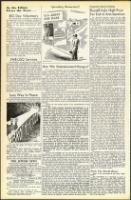
Sure Way to Peace
An old Chinese proverb states that one pic-
ture often has the value of a thousand words.
Here is a picture to illustrate the point.
The one sure way to peace is to unify all
creeds and all races to strive for true
brotherhood.
This is the most important message of
Brotherhood Week, now being observed
under sponsorship of the National Confer-
ence of Christians and Jews.
Let us strive to attain this end—true
brotherhood—and we shall have taken the
firmest step towards peace for all mankind.
THE JEWISH NEWS
Incorporating the Detroit Jewish Chronicle
commencing with issue of July 20,1951
Member: American Association of English-Jewish News-
papers, Michigan Press Association.
Published every Friday by The Jewish News Publisnmg
Co. ',88-10 David Stott Bldg., Detroit 26., Mich., W0.5-1155.
Subscription $4 a year; foreign $5.
Entered as second class matter Aug. 6, 1942 at Post Office,
Detroit, Mich., under Act of March 3. 1879.
PHILIP SLOMOVITZ, Editor
SIDNEY SHMARAK, Advertising Manager
FRANK SIMONS, City Editor
Vol. XX—No. 24
Page 4
February 22, 1952
Sabbath Scriptural Selections
This Sabbath, the twenty-seventh day of
Shevat, 5712, the following Scriptural selections
will be read in our synagogues:
Pentateuchal portion—Ex. 21:1-24:18; 30:11-
16.
Prophetical portion—II Kings 12:1-17.
Rosh Hodesh Adar Scriptural selections,
Tuesday and Wednesday, Num. 28:1-15.
. Licht Benshen, Friday, Feb. 22, 5:52 p.m.
Argument Against Tyranny
Are We Entertainment-Hungry?
It is sad commentary on our community life that our
major functions, our so-called cultural undertakings, our
leading organizations appear to be competing for flavors
with which to sugar-coat programs at our public meetings.
Not so very long ago—true, it was before TV—name-
speakers were able to draw large audiences. Men and women
who were held in high esteem in public life were sufficient
unto themselves as attractions to public affairs. The former
appeals have not vanished and there still are many brilliant
men and women who can continue to inspire us. But at-
tendance has fallen off because of the lure of glamor and
a competition for talent in which price seems to be no object.
"As lonc, as we get the crowd."
What is the result? Even the glamor of big stage names
is wearing off. People who can see the stars on their tele-
vision sets almost nightly do not have to brave inclement
weather to go to a public meeting. Attendance again is
threatened with reduction now that the lure is dwindling,
and the causes which we aim conscientiously and seriously
to assist in best fashion again are threatened with decreasing
interest.
There are two major points to be remembered in this
connection :
1. The swing towards big-name-entertainment is so
costly that even the initial resort to it was not only unwise
but represented a grave wrong in the handling of public
funds. In order to attract coveted crowds to the largest
halls, some organizations have spent more than $5,000 in
the hall's rental, to pay the entertainers and the cost of
mailing invitations to the meeting. This means that 'the
cost of bringing each person to such a rally is very ex-
pensive—and seldom is the capacity-audience goal at-
tained. We wonder whether the person thus drawn to such
a rally, if informed about the cost, would not say: "Give
that wasted expense to the cause we are helping and count
me out of the meeting." We might have less meetings of
that vast character—in the nature of pomp and glamor
and wit and song—but we would emerge with a clearer
conscience that the work we are dedicated to has not been
besmirched. Because an army of devoted workers already
will have attained a goal and the entertainment is only a
pay-off—think of it!—a pay-off for doing good!
2. Then there is the more important point, which may
carry with it a solution to the problem of non-attendance
at meetings: the fact that in emphasizing the glamor of
entertainment at public affairs we depreciate the cause
itself. Instead of placing emphasis on great movements,
we have been playing up names—stage names. Instead of
adhering firmly to the basic principles involved in the
movements we strive to advance, we have resorted to
ballyhoo.
We are not singling out any one person or any one or-
ganization or movement. We speak here of UJA and Israel
bonds, Yeshivah and Bnai Brith, PWO and JNF and Hadas-
sah, Allied Jewish Campaign and our schools and synagogues.
Any one of these sacred causes sinks into low strata when
it stops emphasizing Israel's great cultural heritage and turns
to worshipping false gods for the sake of providing the com-
munity with "more and better entertainment."
Perhaps those who have thus been misled—and we know
that they have been misled honestly—to make false ap-
proaches in search of notoriety in behalf of their movements
worked under the misconception that the community is
starved for entertainment. Therefore it is time to point out
to them that they are wrong, that our people know the way
to theaters and night clubs, that most Jews have access to
TV. But many Jews are losing access to the high values in
Jewish life, to the deep-rooted principles which have been
handed down to us by our sages, by our Prophets, by our
ancestors who gave us the Hebraic heritage. Those who lead
in Jewish life owe it to their people to return that heritage
to them by abandoning false programming and by returning
to fundamentals: by emphasizing the spiritual values inher-
ent in Israel's existence and by erasing from our current
history that chapter which has been filled with stagecraft.
Let there be a return to the planting of wisdom and skill
which gives Israel stature, which provides Jews with the
armor known as dignity, which assures us immortality.
Dr. Bertrand Russell, winner of the 1950
Nobel Prize for Literature, offers "an argument-
against the tyranny of fear and an affirmation
of faith in the good life and the life of reason"
in "New Hopes for a Changing World." (Simon
and Shuster.)
In the course of his argument, he maintains
that "one of the great dangers of our time is
nationalist and theological fanaticism" and he
refers to feelings of dispair produced by quarrels
of Jews and Arabs. He makes the amazing state-
ment about "anti-Semitic fanaticism" which had
"the inevitable response of Zionist fanaticism"
and offers this interesting explanation of fa-
naticism:
"Historically, the main causes of fanaticism
have been misfortune and poverty. Fanaticism
among Jews became common during the Baby-
lonian captivity; it was promoted by persecution
in the time of Antiochus IV and the Maccabees,
again after the destruction of Jerusalem; in our
time, the fanaticism of the Nazis has, as was
inevitable, generated a counter-fanaticism
among a certain number of Jews. In Moham-
medan countries, where Jews were well treated,
they were never fanatics."
It is questionable whether the latter point
can be developed to a logical conclusion. There
have been fanatics in eras of total freedom and
there has been a lack of fanaticism even in days
of oppression. Fanaticism, as in the instance of
Jews in Mohammedan lands, needs a clearer
evaluation.
Dr. Russell asks a big .price for an end to
prejudice towards Jews when he states: "Where
racially distinct populations have to live side by
side, the only real solution is complete inter-
mixture. This is objected to usually on one side,
and sometimes on both. Orthodox Jews have a
horror of marrying Gentiles, much stronger
than any Gentile prejudice against marrying
Jews (except among the Nazis). This is regret-
table. It would be much better if the separateness
of Jews came to an end, and people ceased to
notice whether a person was a Jew or not. There
is nothing against this except prejudice on both
sides. Just the same arguments apply to colored
people in the United States."
Discussing "abominable race inequalities, of
which the most noteworthy examples are the
treatment of Jews and Negroes," Dr. Russell
writes an interesting comment on "one of the
most singular, unfortunate, and beastly of race
prejudices—I mean, the hostility to Jews." Des-
cribing the tragedies in the days of the Crusades,
the expulsion of the Jews from England, in
Russia and under the Nazis, Prof. Russell makes
this analysis of racial antagonism towards Jews:
"If you ask a modern, anti-Semite why he
dislikes Jews, he will tell you that they are
unscrupulous and sharp in business a n d
merciless to their debtors; he will tell you that
they are always on the make, always intrigu-
ing, always supporting each other against
Gentile competitors. If you say you have
sometimes found similar characteristics among
Christians, the anti-Semite will say: 'Oh, of
course I don't deny there are ruffians who are
not Jews. And I have some very good friends
among Jews. But I am speaking of the aver-
age.' If you question him when he is off his
guard, you will find that whenever a Jew
engages in a bit of sharp practice he says, 'how
like a Jew,' but when a Gentile does likewise
he says `and, you know, the astonishing thing
is that he is not a Jew.' This is not a scientific
method of arriving at averages. The fact is
that attributing the traditional faults to Jews
is merely rationalizing. They are thought to
have these faults because they are disliked,
for having these faults. For my part, in the
course of very many dealings with Jews and
Gentiles, I have found Jews at least as honor-
able as Gentiles in adherence to undertakings.
"Why, then, are Jews disliked? Partly, no
doubt, because they are successful. They are
successful because they are industrious. But
when we are beaten by a competitor we do not
like to attribute our failure to his superior
merit, so we attribute it to his unscrupulous
methods, and thereby justify our hatred of
him."
Dr. Russell, in a lengthy discussion, also shows
that another reason for hatred of Jews "is the
fear of what is strange." "What is strange is
incalculable," and the anti-Semites consider
Jews "a sort of secret society." He adds that
"if Hitler had been a brave man he would not
have been an anti-Semite," to prove the part
played by irrational fear in anti-Semitism.
"New Hopes for a Changing World" provides
much food for thought, even if we disagree with
some of its arguments. It is excellent writing—
typical of its eminent' author.
Facts You Should Know:
What is the derivation of the term "Shid-
duch?"
The negotiation of a marriage is called a
"Shidduch." Technically the term "Shidduch"
signifies any type of negotiation, although it has
come to signify a marriage negotiation alone.
The term is said to be of Aramaic origin and
used to translate the Hebrew term "Shokat"
which means to "quiet down" or "settle." Years
ago the conclusion of an agreement for marriage
included bargaining on the part of both families.
Naturally, the final agreement 'quieted down"
the respective parties. The commentaries like
to claim that marriage brings "quiet" into the
life of an individual.