
The Civil War and Jewish Cha lainc
While the men in their commands
could now be commissioned and paid by
scrambled wildly over the side of the
the United States government under
sinking ship, four men of God put their
public law.
arms around each other, and in unison
When funds no longer could be raised,
chanted prayers in English, Latin and
however, Fischel's mission was conclud-
Hebrew. The scene was World War II.
ed, and he was not in Washington
By FRANK SIMONS
The incident—the sinking 'of the U.S.S.
when the bill was passed. On Sept. 18,
Dorchester, a United States troop trans- a skirmish, with nobody hurt, only
Wise's journal, of course, played an im- 1862, at the request of the Ministers of
port.
Moses, Aaron and Pharaoh, had to be
portant role, so also did the Philadelphia Hebrew Congregations oe Philadelphia,
Not havinc, enough life jackets for carried to the camp and left in the arms
publication of Rabbi Isaac Leeser and Rabbi Jacob Frankel became the first
the men on b board, the-se four United of Morpheus."
the New York paper of Samuel and American rabbi to become a military
States chaplains, two Protestant minis-
All, however, was not levity among
Meyer Isaacs.
chaplain. He was a hospital chaplain,
ters, a Catholic priest and a rabbi, gave Jewish troops in this period. They need-
The Presbyter, published in Cincin- and served York, Harrisburg, Chester
up their lifejackets to save the lives of ed spiritual comfort in the hospitals and
four younger men. They went down on the battlefields where many lay nati as spokesman for "fundamentalist and other towns not too remote from
Protestant groups," was typical of the Philadelphia, ministering wounded Jews
with the ship, each chanting the prayers wounded and some dying.
opposition:
in Union hospitals.
of his own denomination, asking for the
While the Confederate states recog-
"Our government has already gone a
The second hospital chaplain ap-
peace of the world and the brotherhood nized "all clergymen" for appointment
great length in this respect in appoint- pointed was Rev. Bernhard Gotthelf,
of man.
as chaplains, Dr. Korn points out that
ing Roman Catholic and Universalist who began service on May 6, 1863.
Going back only ninety years in Unit- the Union was not so liberal. In the
chaplains
to the army, but this proposal From Louisville, he was born in Bava-
ed States history, to the days preceding Volunteer Bill, passed at. the outset of
would lead to perhaps granting the pri- ria. Support was forthcoming from Ken-
the Civil War, such a joint expression the War, a clause called for the appoint-
vilege to Mormon debauchees, Chinese tucky Senator Robert Mallory, and was
of faith would have been impossible. ment of chaplains by regimental com-
priests and Indian conjurers."
given added impetus to pacify the bit-
Protestant chaplains had been commis- manders, stipulating further that he
Backing in the metropolitan press was ter feelings engendered by Gen. Grant's
sioned as early as • 1781; Catholic clergy- must be "a regularly ordained minister
more favorable, and papers in New infamous anti-semitic General Order
men were recognized during the Mexi- of some Christian denomination."
York, Philadelphia and Baltimore took No. 11.
can War; .but it took the Civil War and
strong sides with the Jews.
a major controversy before Jewish chap- Rabbi Wise Leads Debate
The only other Jew to become a, mili-
lains were commissioned into the serv-
tary chaplain, and the only regimental
Clement L. Vallandighath—notorious Rev. Fischel Sent to Capitol
ices.
for the references made to him 80 years
The most effective campaign was to chaplain (ministering to the wounded at
Dr. Bertram Korn, in "American later by Franklin D. Roosevelt—spoke
be waged by the Board of Delegates of the front lines) was Rev. Ferdinand L
Jewry and the Civil War," one_ of the for the Jewish rights. A non-Jewish American Israelites, a Conservative Sarner. The appointment of Sarner con-
finest volumes printed by the Jewish Senator from Ohio, he requested an
group of rabbis, who had unsuccessfully trasted ironically with the difficulties of
Publication Society, (222 N. 15th, Phil- amendment changing the wording
tried to unite American Jewry. Rev. Fischel an trying to obtain chaplaincy
adelphia 2), devotes a lengthy chapter "Christian denomination" to "religious Arnold Fischel was appointed to serve commissions.
to this controversy—how it started, society."
for the Board as civilian chaplain, being Sarner Wounded in Battle
what the people and the rabbis thought
The Volunteer Bill attracted little at-
paid 820 weekly. He was signed to the
Sarner had enlisted, and, not actually
and how the first Jewish chaplain was tention until Vallandighai-n proposed the
Washington area, and in addition to his seeking a chaplaincy, was appointed
commissioned into the United States change. Rabbi Isaac Mayer Wise, an
chaplaincy duties was to serve as lobby- "probably not because he was Jewish,
Army.
Ohio rabbi and editor, picked up the
ist for the Board in Washington, obtain- but because he was German," had a
Previous to the struggle which pitted controversy when the amendment was
ing hearings on the repeal of the dis- broad German education. and spoke the
brother against brother, there was little defeated in Congress. Three months la-
criminatory chaplaincy ruling.
language. He was commissioned Ap iril
necessity for a Jewish chaplain. How- ter, in September, 1861, the issue was
Letters of introduction paved the way 10, 1863 to serve the 54th New York
ever, a wave of immigration directly brought squarely to the populace.
to an ultimate visit with President'Lin- regiment. Sarner had his horse shot from
before the war resulted in a large num-
In a military camp in Virginia, a Jew-
coln,, who confessed he was unaware of under him at Gettysburg and was
ber of Jews fighting in the Civil War. ish • civilian chaplain, Michael Allen,
any such discrimination. -
wounded in the action, the wound forc-
ministered the, needs of a Pennsylvania After finding Fischel's
Troops Held Own Services
ing his discharge in October, 1864.
;,Cameron's
Dragoons."
Thor-
charges to be true, Lin-
Jewish troops were widely scattered
Of Fischel, the crusader for the right
coln was a backer of an
and it was often difficult to contact oughly versed in the Bible through
of Jewish rabbis to be given army chap-
training
obtained
from
rabbis,
-though
amendment c h a n ging
them in any number. The rabbis at
laincy commissions, there is a disappoint-
the Volunteer Bill.
home did the best they could, but in the not a rabbi himself, Allen conducted
ing ending. The man who had worked
non-denominational
services.
A
visiting
In spite of an attempt
main, the individual soldier worshipped
most for the rights of others, never him-
YMCA worker registered a protest, even
by a group of Reform
—or didn't—as he liked.
self became a chaplain. He had applied
though
most
of
the
men
and
the
regi-
rabbis
to
sabotage
the
Many soldiers preferred to remain un-
for a commision, but since the number
mental
commander,
Col.
Max
Friedman,
bill—so deep was their
known as Jews while in the Army. Ex-
of Jews in the Union Army were se
were
Jewish.
resentment
at
the
initi-
-
periencing much prejudice in Europe,
scattered there weren't enough in con-
Allen's
resignation
was
forced,
but
as
ative taken by the Con-
from where they had recently arrived,
centrated groups to warrant assigning
servative Board in claiming they had the another Jewish chaplain.
they feared renewed bigotry in Amer- Dr. Korn explains, "He was not a
`Christian'
it
is
true,
but
neither
was
he
backing of ,all Jewry—the resolution was
ica. However, many contrived means to
There was no need for a chaplaincy
passed on July 17, 1862, one year after controversy in the South because the
carry on religious services behind the a regularly 'ordained •clergyman." The
Jewish
press
played
up
this
aspect
of
Congressman Vallandigham's initial wording of their chaplaincy bill Was not
front lines.
amendment had been defeated. Jews discriminatory. However, there was not
Dr. Korn refers to one such incident the controversy prominently. Rabbi
in a letter by a J. A. Joel, telling how
much a Jewish chaplain might have
he and his buddies prepared a& makeshift
done since Confederate Jewish troops
seder. Joel describes how "Yankee inge-
were too few and too far extended.
nuity" prevailed in gathering the sacred
The Rev. M. J. Michelbacher, rabbi
objects, how not knowing which part
of Beth Ahabath Congregation in Rich-
of the Iamb was to be included in the
mond, Va., did the most useful thing,
seder,
they 'cooked the lamb in its en-
.
composing a prayer for Jewish Confed-
brety.
erate soldiers, which was circulated wide-
He continues to describe the seder:
ly throughout their ranks.
"The herb was very firery like pepper,
Jews have had their chaplains in
and excited our thirst to such a degree
abundant numbers since the Civil War,
that we forgot the law authoriiing only
and they have served benignly and wise-
four cups and drank up all the cider
ly to all troops despite denomination. It
(they had substituted for wine.) Those
was through the efforts of Rev: Arnold
who drank more freely became excited,
Fischel, however, that Jewish troops
and one thought he was Moses, another,
fighting for the United States now have
Aaron, and one had the audacity to, call
the comfort of a minister of their own
himself Pharaoh. The consequence was
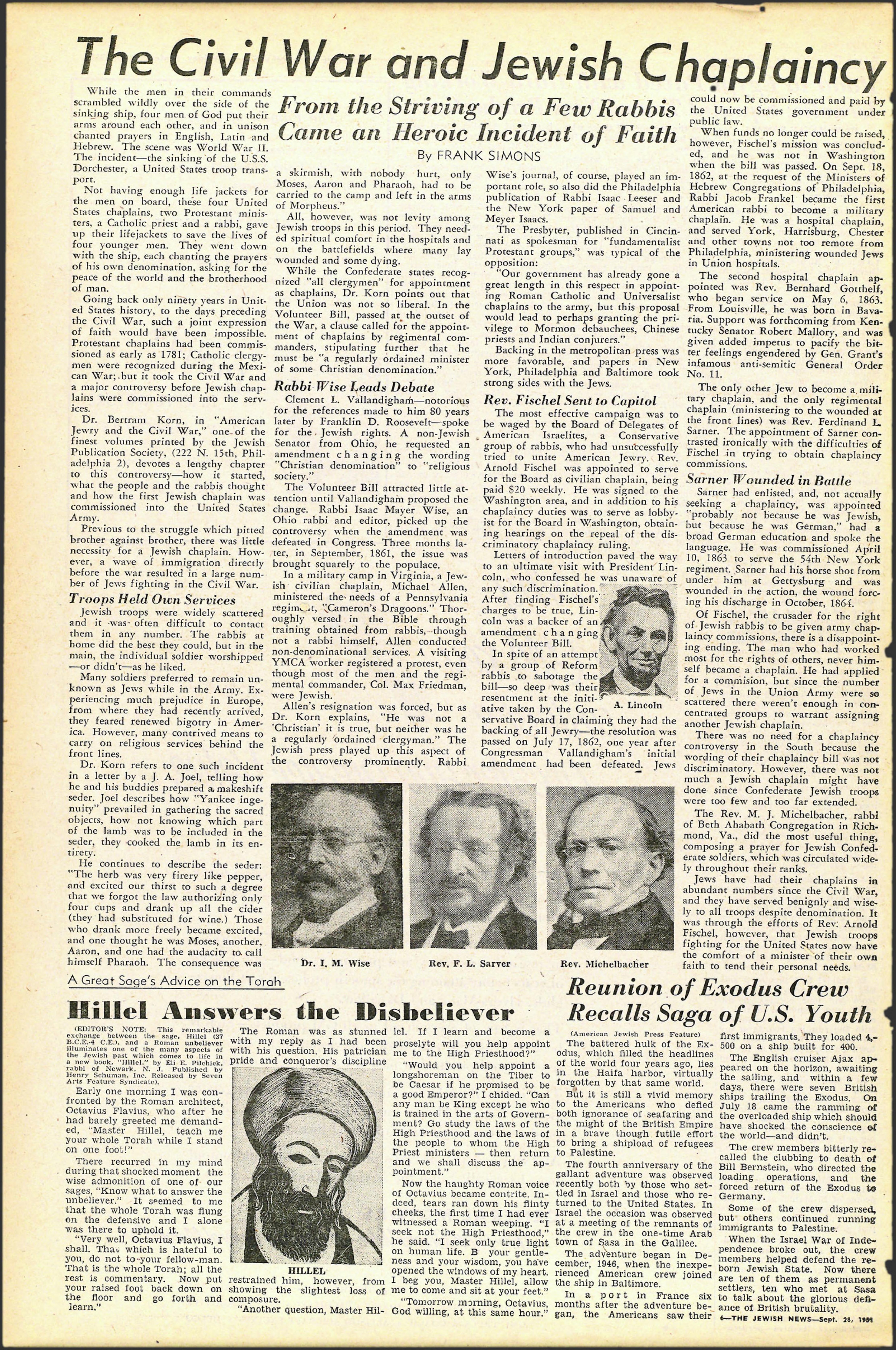
Dr. I. M. Wise
Rev. F. L. Sarver
Rev. Michelbaclier
faith to tend their personal needs.
From the Striving of a Few Rabbis
Came an Heroic Incident of Faith
•
A
Great Sage's Advice on the Torah
Willa Answers the Disbeliever
(EDITOR'S NOTE: This remarkable
exchange between the sage, Hillel (37
B.C.E.-4 C.E.), and a Roman unbeliever
illuminates one of the many aspects of
the Jewish past which comes to life in
a new book, "Hillel." by Eli E. Pilchick,
rabbi of Newark, N. J. Published by
Henry Schuman, Inc. Released by Seven
Arts Feature Syndicate).
Early one morning I was con-
fronted by the Roman architect,
Octavius Flavius, who after he
had barely greeted me demand-
ed, "Master Hillel, teach me
your whole Torah while I stand
on one foot!"
There recurred in my mind
during that shocked moment the
wise admonition of one of , our
sages, "Know what to answer the
unbeliever." It seemed to me
that the whole Torah was flung
on the defensive and I alone
was there to uphold it.
"Very well, Octavius Flavius, I
shall. Than which is hateful to
you, do not to-your fellow-man.
That is the whole Torah; all the
rest is commentary. Now put
your raised foot back down on
the floor and go forth and
learn."
The Roman was as stunned lel. If I learn and become a
with my reply as I had been proselyte will you help appoint
with his question. His patrician me to the High Priesthood?"
pride and conqueror's discipline
"Would you help appoint a
longshoreman on the Tiber to
be Caesar if he prpmised to be
a good Emperor?" I chided. "Can
any man be King except he who
is trained in the arts of Govern-
ment? Go study the laws of the
High Priesthood and the laws of
the people to whom the High
Priest ministers — then return
and we shall discuss the ap-
pointment."
Now the haughty Roman voice
of Octavius became contrite. In-
deed, tears ran down his flinty
cheeks, the first time I had ever
witnessed a Roman weeping. "I
seek not the High Priesthood,"
he said. "I seek only true light
on human life. B your gentle-
ness and your wisdom, you have
HILLEL .
opened the windows of my heart.
restrained him, however, from I beg you, Master Hillel, allow
showing the slightest loss of me to come and sit at your feet."
composure.
"Tomorrow morning, Octavius,
"Another question, Master Hil- God willing, at this same hour."
Reunion of Exodus Crew
Recalls Saga of U.S. Youth
(American Jewish Press Feature)
The battered hulk of the Ex-
odus, which filled the headlines
of the world four years ago, lies
in the Haifa harbor, virtually
forgotten by that same world.
Olt it is still a vivid memory
to the Americans who defied
both ignorance of seafaring and
the might of the British Empire
in a brave though futile effort
to bring a shipload of refugees
to Palestine.
The fourth anniversary of the
gallant adventure was observed
recently both by those who set-
tled in Israel and those who re-
turned to the United States. In
Israel the occasion was observed
at a meeting of the remnants of
the crew in the one-time Arab
town ofasa in the Galilee.
The adventure began in De-
cember, 1946, when the inexpe-
rienced American crew joined
the ship in Baltimore.
In a port in France six
months after the adventure be-
gan, the Americans saw their
first immigrants. They loaded 4,-
500 on a ship built for 4100.
The English cruiser Ajax ap-
peared on the horizon, awaiting
the sailing, and within a few
days, there were seven British
ships trailing the Exodus. On
July 18 came the ramming of
the overloaded ship which should
have shocked the conscience of
the world—and didn't.
The crew members bitterly re-
called the clubbing to death of
Bill Bernstein, who directed the
loading operations, and the
forced return of the Exodus to
Germany.
Some of the crew dispersed,
but others continued running
immigrants to Palestine-.
When the Israel War of Inde-
pendence broke out, the crew
members helped defend the re-
born Jewish State. Now there
are ten of them as permanent
settlers, ten who met at Sasa
to talk about the glorious defi-
ance of British brutality.
6—THE JEWISH NEWS—Sept. 28, MI