

As the Editor
Views the News ...
Purim Call
Music Bibliography Lists
Gabrilowitsch & Chajes
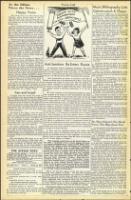
Happy Purim
The Purim story, as noted scholars hay
indicated, offers strong proof of the in
separable links that exist between the by
alties of Jews to the countries of which they
are citizens and to their faith and Hebraic
background.
Jews in Persia served their country well
They also battled for justice for their group
and (their heritage. The triumph they achiev-
ed in the defeat of the anti-Semite Haman
who sought the extermination of all Jews
was a victory for decency. It also was a
triumph for the idea that men have a right
to perpetuate their ideals and their cultures.
Purim's message is especially valuable to
our generation. Having witnessed the at-
tempt to exterminate our European kins-
men; having seen the rise of the Nazi-fascist
menace and its defeat--which, we pray, will
be permanent—we can judge the Shushan
story better. Purim admonishes all humani-
tarians to refuse to yield to blackmail, to
prevent attempts to push people around, to
defend the right of man to think freely and
to be ruled by his own mind.
We have seen the passing of Haman of
Shushan and many anti-Semites like him.
Others rise from time to time to plague us
and humanity. The Purim story as incor-
porated in the Book of Esther guides us
along paths of justice and libertarian ideals.
These principles will prevail if we wish them
to prevail. Our aspiration is to protect them.
We can achieve a great deal by keeping the
Purim story alive. Even the greggers (noise-
makers) used by children during the reading
of the Book of Esther and the Hamantaschen
served as part of our Purim meals serve a
purpose in retaining the story's strength.
In a spirit of jollity inspired by this fes-
tival and in the hope that tyranny, as it
was taught by the Hamans, will vanish from
the earth, we extend best wishes to the en-
tire community for a Happy Purim.
Iran and Israel
The labors of many years are represented in
Alfred Sendrey's "Bibliography of Jewish Music,"
published by Columbia University Press (2960'
B'way, NY 27). The author, who now is teach-
ing at Westlake College of Music in Los Angeles,
presents an important historical survey of litur-
gical and secular Jewish music. He began his
efforts in his native Hungary, continued them
in a number of European countries and in this
country, whose shores he reached in 1940.
The more than 10,000 titles recorded in this
bibliography will be treasured by musicians—
lay and professional—as invaluable references,
and guides the reader towards a thorough
knowledge of the vast subject.
In his explanation of his selections, of his
compilation of music written by Jews, Dr. Sen-
drey explains his reservation in omitting Yid-
dish "theater music"—the "hit" songs which he
describes as follows:
"They are sentimental, or melodramatic,
or humorous songs, which have been 'plugged'
by the clever and commercialized at the ex-
pense of an ill-educated public of little dis-
cernment. Composed largely by amateurs,
sometimes by commercialized professionals,
this music clings to a sort of primitiveness. It
creates a false impression of folksong naivete.
In reality it is poor and awkward in structure
and style."
He grants, however, the large role it played
Anti-Semitism Re-Enters Russia
in Jewish life, but asserts that it will interest
A happy note was struck last week in
the anti-Israel area surrounding the Jewish
state. Writing from Teheran, Francis Ofner,
Christian Science Monitor correspondent who
covered the scene in Israel for his paper for
a number of years, states that while Iran
still is unwilling to exchange diplomatic rep-
resentatives with the Jewish state it is fa-
cilitating the exit of Jews who seek, refuge
in their homeland.
According to Mr. Ofner, "since the new
Jewish state was established nearly three
years ago some 30,000 Jews have gone from
and via Teheran to ISrael. Two-thirds of
them were Jewish refugees - from Iraq, the
rest froin Afghanistan,. Iranian Kurdistan,
the Caspian Sea area, Iran's southern and
central province, and from Teheran."
We learn additionally that in 1949
'Iran's Shah, Mohammed Riza Pahlevi, while
on a visit to the United States, instructed
telegraphically his administration to treat
Jewish refugees from neighboring countries
as political emigres, and facilitate their move
to Israel,"
This encouraging news leads us to be-
lieve that in the course of time other ob-
"The campaign against Jews in the Soviet Union—on
stacles also may be hurdled more easily and
the
whole
a by-product of the crusade against all forms
we may eventually be blessed with peace
between Israel and all the Arab states— of 'rootless cosmopolitanism'—began in 1948. While osten-
and thenceforth with peace on all the earth. sibly directed against Jewish nationalism and 'bourgeois
Zionism,' the campaign took on undeniable anti-Semitic
overtones. Much of the Soviet Jewish intelligentsia was
purged. Many Jews in 'sensitive jobs' in the armed forces,
the foreign service and higher education were gradually
Member: American Association of English-Jewish News-
papers. Michigan Press Association.
weeded out. Jews were continually tagged with epithets
Published every Friday by The Jewish News Publishing
drawn from the traditional arsenal of anti-Semitism—
Co. 708-10 David Stott Bldg., Detroit 26, Mich., WO. 6-1155.
Subscription $9 a year; foreign $4.
they
were 'alien,' wandering,"rootless.' When they were
Entered as second class matter Aug. 6, 1942 at Post Office,
Detroit. Mich., under Act of March 8, 1879.
castigated in the press for, their 'cosmopolitan' - derelic-
tions, their Russian names or pseudonyms were invariably
PHILIP SLOMOVITZ, Editor
followed by their original 'Jewish' names—a practice
SIDNEY SHMARAK, Advertising Manager
which in former years would have brought a jail sentence
Vol. XIX—No 1
Page 4
March 16, 1951 to the editor. While hardly as blatant as the persecution
of Czarist days, there seems little doubt that anti-Semitism
has officially reentered Russian life."
Sabbath Scriptural Selections
THE JEWISH NEWS
`This Sabbath, the ninth day of Adar II, 5711,
the following Scriptural selections will be read
in our synagogues:
Pentateuchal portions—Lev. 1:1-5:26; Deut.
25:17-19.
Prophetical portion—I Sam. 15:2-34.
This is not the first expose of the new type of anti-
Semitism now rampant in Russia. The land that boasted
of having outlawed anti-Semitism has returned to Czarist
practices. The Iron Curtain stops exchange of information
about happenings in and out of Russia, but it has not inter-
fered completely with revelations about the new type of
horror imposed on any one who is sympathetic to Zionism,
Fast of Esther Selections, Wednesday
on those desiring to go to Israel, on people seeking to re-
Pentateuchal portion—Ex. 32:11-14; 34:1-10. introduce Jewish cultural ideas into the Russian vacuum.
r •
•
.1.111.1WAit • 'A k t." •
4,•11.,771; 'L
There are numerous bibliographical notes
which add value to this impressive 460-page book
whose price has been set, not without justifiCa-
tion, at $12,00.
The use of transliterations from Yiddish
and Hebrew also is interesting, the author -
having adopted the system used in the Jewish
Encyclopedia, New York 1901-06.
"Historical Survey of Bibliography of
Jewish Music" is an enlightening essay pre
facing the compilation. The survey, as out-
lined in this article, begins with the era of
1545-1640. and with the music of Conrad Gesner
(1516-1557). The . outstanding authorities .on,
the subject are quoted and used as guides.:
"The Communists are about as devoted to the Bill of
Rights as Hitler was to the Brotherhood of Man. They must
be exposed and fought at every turn. The true believer in
civil rights combats the Communists with one hand while
he shores up the Bill of Rights with the other. Both tasks
are equally crucial if American democracy is to be pre-
served."
Mr. Ross' analysis of the Communist position is espec-
ially valuable in its expose of the inconsistency and hypo-
crisy of the defenders of the Soviets who claim all the pri-
vileges under the Bill of Rights for themselves and are the
first to deny them to others. Recognizing that there are in-
nocent fellow-travelers who are duped by the Communists,
the author of this sound analysis of the Communist menace
has outlined a program to protect the position of the liberals
who "still murmur that to fight Communists is to play into
the hands of reaction'." Taking into view the "clear and
present danger" of Communists committing acts of espion-
age, while remaining on the alert against abuses of basic
human rights under acts like the McCarran measure adopted
by Congress last year, Mr. Ross proposes that 1. fundamental
civil rights be safeguarded; that 2. Communists should be
exposed and eliminated in private organizations; that 3. vig-
orous government action is necessary to counter Communist
intrigue, but such action should be selective and scrupulous
in its regard for basic. liberties.
If there still are skeptical persons who believe that
Russia alone fights anti-Semitism and that the Soviet idea
should be defended because it had originally o u t 1 a w e d
bigotry. Here is what we learn from Mr. Ross on the ques-
tion of "Jewish 'Rights' in Russia":
Prophetical portion—Is. 55:6-56:8.
On Purim, Thursday, the Book of Esther and
Ex. 17:8-16 will be read during morning serv-
ices. The Book of Esther will be read at serv-
ices Wednesday, Purim eve..
the historian and the sociologist, but empha-
sizes that it is "a deterrent in the development
of Jewish musical life."
An American Jewish Committee pamphlet, "The Com-
munists: Friends or Foes of Civil Liberties ?" written by Irwin
Ross, eminent magazine writer and author of "Strategy for
Liberals," makes the point that with Communists civil liber-
ties are "for US but not for YOU" and issues this warning:
The Russian menace is exposed in its true colors in the
Ross pamphlet; It admonishes us to be on guard against a
danger which affects the entire world. The claim that the
Communists are opposed to anti-Semitism. emerges as a
myth. From now omit xnust bg, treated as, such.
*10
* 4.1.; ►
N.., •
444=4
40. •
-
4•• tr.. - 10.
-
Three Detroiters are listed in this work::
Clara Clemens Gabrilowitsch (daughter of Mark
Twain), for her reminiscences about her famous •
husband; Ossip Salomonovich Gabrilowitsch and
Julius Chajes.
Gabrilowitsch is listed both in the section 'on.
musical literature and music. Chajes' numerous
compositions are recorded.
In the preparation of this work, Dr. Sendrey
had the assistance of the Jewish Welfare Board,
American Academy of Jewish Research, Jewish
Theological Seminary, Hebrew Union College,
American Council of Learned Societies and the
leading Jewish musicians. It is a noteworthy
work that serves as a monumental tribute to the
able bibliographer.
Dr. Max Schoen's New Book
Views 'The Man Jesus Was'
Dr. Max Schoen's "The Man Jesus Was," pub-
lished by Alfred A. Knopf, treats the subject of
the father of Christianity with great sympathy
and understanding.
The explanatory note appended to the title—
"out of rebellious Galilee came a hero of the
spirit who sought not to reform man, but to
transform him"—explains the kindly. tone of the
entire book.
Dr. Schoen's analyses of the Gospels add mer-
it to this book. Perhaps the chief message of
this book is contained in this statement:
"Jesus offended the good Jews of his day, and
he would likewise offend the good ChriStians of
today were he to appear in their midst with the
message he brought to his contemporaries. The
Jew forgets, because of what the Christian has
done to him in the name of Jesus, that Jesus
was a genius of the spirit, and the Christian
ignored, because Of what he claims the Jew did
to Jesus, that Jesus was a Jew. Between the two
warring camps the great Galilean is maligned
by one and distorted by the other; between them
the supreme religious mind of the ages 'has
nowhere to lay his head." But Jesus the Jew and
genius lives on, and will continue to live on, as
a reproach and a promise to his detractors and
distorters: a reproach to their blindness and a
promise for their enlightenment."
Jesus' ethical teachings are viewed by Dr.
Schoen as stemming from his "creative concep-
tion of the law." In his treatment of Pharisaism.
he states that "the Pharisees had a religion, while
Jesus was religious." He adds that "a religion is
something one accepts, and by virtue of having
accepted it one is said to have become religious."
Here Dr. Schoen invites controversy. But he
points out that Jesus was not interested in re-
forming but rather in transforming man, that
he was not the founder of a new religion, that
he merely wanted to infuse a new spirit into
society.
Dr. Schoen's book will be found most inter-
esting, as an addendum to the existing library
on the subject of Christianity and its founder.
•
'
- • ,.,14,4119e