
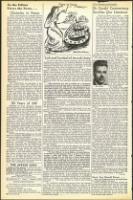

Viper at Large
As the Editor
Views the News . .
Dr. Gordis' Commentary
Enriches Our Literature
Obstacles to Peace
When representatives of Middle Eastern
countries were called in by the State Depart-
ment for briefing on American policy con-
cerning Korea and the Far East, the eight
Arab states were grouped together and
Israel was called in separately. The fact that
these two groups never are invited together
is an indication of existing obstacles to
peace. The Middle Eastern problems should
be considered as the common concern of all
countries in that area, yet there is a separa-
tion which spells trouble.
It is no wonder that the report on "Mid-
dle East Oil in U. S. Foreign Policy" which
was sent to members of Congress by the
Legislative Reference Service of the Library
of Congress is interpreted as an augury that
in the event of Communist aggression the
entire Middle East may be abandoned. The
report contains these significant passacres:
"Most of the Middle Eastern states, the Arab
states in particular, are not so well disposed
toward Britain or France or the United States
as to warrant any feeling of assurance that
they would resist Soviet advances at all times
and at all hazards. The equivocal conduct of
Britain in the administration of the Palestine
Mandate and memories of imperialistic poli-
ties (the Anglo-Egyptian contest over bases in
the Suez Canal Zone and the future of the
Sudan being current irritants), the ineptitude
of France in dealing with the Syrians and
Lebanese, and the American support given the
Zionists during the struggle from which the
state of Israel has emerged, all have greatly
dampened any enthusiasm which might other-
Wise be felt for the West."
"As long as various of the Arab states are
willing to deny themselves considerable sums
in royalties for the sake of denying oil to
Israel, the political situation in much of the
Middle East from the Allied point of view is
not healthy."
The complications are damaging to the
cause of world peace. They affect all the
Middle Eastern countries and while they
may not be considered serious by Arab poli-
ticians, they certainly point to a delay in
economic progress and cooperation. Worst
of all, they affect the peace aims of the
United States and the United Nations. A
delay in direct peace negotiations with the
Arabs, which Israel has been demanding, is
directly responsible for the difficulties.
50 Years of JNF
Fathered by Prof. Hermann Schapira
and initiated by Dr. Theodor Herzl, the Jew-
ish National Fund was established 50 years
ago to redeem the soil of Israel and to make
the land acquired through this fund the
property of the entire Jewish people.
A summary of the half century of ac-
complishments of the JNF shows that the
fund owns 2,100,000 dunams of land . (a
dunam is a quarter of an acre) ; that 250
settlements have been established on JNF
land, the present population of 250,000 in
these settlements being double that of 1947;
that 45,000,000 cubic meters of water are
being made available per annum through
the JNF; that the fund has planted 7,627,-
000 trees.
Of the $150,000,000 collected by the JNF
since its inception, $60,000,000 was secured
through traditional collections.
In this JNF Jubilee Year, activities for
which will be inaugurated at the 50th an-
niversary conference in Washington Jan.
19-21, the fund calls upon its supporters to
rededicate themselves to this cause with
increased efforts, in Israel's best interests.
Detroit has been among the best JNF
communities, thanks in great measure to
the efforts of the JNF Women's Organiza-
tion whose annual event is scheduled for
Jan. 28. In greeting the world JNF organ-
ization on its 50th anniversary, we also
honor the loyal Detroit workers whose un-
tiring efforts have achieved a great deal in
Israel land redemption activities.
},. THE JEWISH NEWS
Member: American Association of English-Jewish News-
papers. Michigan Press Association.
Published every Friday by The Jewish News Publishing
Co. 708-10 David Stott Bldg., Detroit 26, Mich., WO. 6-1166.
Subscription $3 a veer; foreign $4.
Entered as second claim matter Aug. 6, 1942 at Post Office,
Detroit. Mich., under Act of March 3, 1879.
PHILIP SLOMOVITZ, Editor
SIDNEY SHMARAK, Advertising Manager
Vol. XVIII—No. 17
Page 4
January 5, 1951
Sabbath Scriptural Selections
This Sabbath, the twenty-eighth day of Tebet,
5711, the following Scriptural selections will be
read in our synagogues:
Pentatetical portion—Ex. 6:29:35.
Prophetical portion—Ezek. 28:25-29:21.
.Rosh Hodesh Shvat Scriptural selection, Mon-
day: Num. 28:1-15.
'The Wisdom of Kohe!eth'
"Vanity of vanities, all is vanity ... What
has been will be, and what has been done
will be done again; there is nothing new
under the sun . . The more wisdom the
more grief, and increasing one's knowledge
means increasing one's pain . . . There is"
no greater good for man than eating and
drinking and giving himself joy in his labor
. .. There is a time to be born and a time
to die, a time to plant and a time to up-
root . . There is nothing better for man
than to rejoice in his works, for that is his
lot, and no one can permit him to see what
shall be afterwards . . . I saw that all hard
work and skill are merely one man's rival-
ry with his neighbor . . . He who loves money
will never have enough of it and he who
loves wealth will never attain it—this is
indeed vanity . . . Better a good name thari
good oil, and .so the day of death rather
than the day of one's birth . . . Do not curse
the king even in your thoughts, nor the ricot
even in your bed-chamber, for a bird of the
air may carry your voice and a feathered,
creature betray the matter."
-
C,dKY vct.v.seArom.
Marco I .
'Link and Symbol of Jewish Unity'
In one of the most stirring addresses heard by Jewish
audiences in recent years, Dr. Solomon Goldman of Chicago
offered timely defense of the status of American Jewry and
expressed optimism over the future, in the light of Jewish
experiences in other lands throughout the ages.
His address, which was delivered at the recent Wash-
ington convention of the United Synagogue of America,
failed to get mention in the press, but was so deeply mov-
ing that it sunk deep into the hearts of all who heard it.
He was convincing in his analyses of existing conditions and
in repudiating the prevailing view that American Jewry's
cultural standards are on a lower level than were those in
European lands. He was especially emphatic in his assertion
that—
"The American Jew who is waiting for a Sanhedrin
in Jerusalem to provide him with a new code, for Yeshivot
abroad to present him with Torah, and immigrants to re-
store him to piety is an adolescent, a bench warmer, shirk-
er, and coward, rapidly sinking into do-nothingness and
dissolution. Simultaneously, with special attention to Is-
rael, concern for Jews everywhere, we must aspire to take
the initiative in matters intellectual, aesthetic, and spiritual
as eagerly as we have done in philanthropy and in fighting
anti-Semitism."
The point he made is that "America is not for the Jew a
boarding-house. It is home. We have dug deep roots here
and harvested fruit aplenty . . . I make bold to predict that
the grandchildren of your grandchildren will be known as
Americans and Jews."
Dr. Goldman, emphasizing that "the reality of our peo-
plehood is ineradicable," expressed faith in American prin-
ciples by declaring:
"We refuse to equate patriotism with isolationism and
Americanism with narrow nationalism. We refuse to be-
lieve that it ever was the intention of the United States
to extend the privilege of citizenship only to those who
deny or distort the nature of their being or background.
We are satisfied that our desire to be linked to our people
has the understanding and sympathy of America."
It was a timely message which accomplished the impor-
tant task of restoring faith in our position in this great land
and which rejected self-negation by American Jews as un-
warranted and unsubstantiated by existing factual proof of
genuine contributions made by our communities to Jewish
cultural values. Dr. Goldman was positive in his approach
and in urging us "to make peace with the idea that Ameri-
can mores and folkways of today are playing a significant role
in moulding the Judaism of tomorrow, that Judaism in this
land is destined to be no less American than was Judaism
in Moorish Spain, Arabic, that the Declaration of Indepen-
dence and Lincoln's Second Inaugural might find their way
into our liturgy."
His strongest plea was for the weapon—for the quad-
rupling of our efforts "in behalf of Jewish education, learn-
ing, and every form of cultural expression." His concluding
words deserve to be engraved in Jewish memories:
"To learn Hebrew, to learn Hebrew, to learn Hebrew,
to cherish it as the language that is a quiver full of steel
arrows, a cable with strong coils, a trumpet of brass
crashing through the air with two or three sharp notes,
that pours floods of anger and utters cries of rage against
the abuses of the world, that was heard above Sinai's peels
of thunder, that bewailed Zion's destruction and .celebrates
its rebirth, that trumpeted forth liberty, and called upon
the nations to beat their swords into plowshares. Hebrew,
friends, that might well be the trebled cord of world Jewry
—the link, embodiment and symbol of its unity."
The influence of the Prophets and Sages of Israel is in-
herent in this powerful plea for self-respect and for the era-
dication of self-abnegation. It is a dynamic portrayal of a
position that must not be under-estimated, of a people's
idealism which must be defended through action and positive
efforts to strengthen our values and, above all, the major
instrument — "the language that is a quiver full of steel
arrows."
Dr. Goldman's admonitions should revive the courage
and vision that have been visibly waning in some of our
ranks. He has provided the stimulus that was needed to re-
emphasize the "reality of our peoplehood." The service he
has rendered once again focuses upon him the light of recog-
nition as one of the ablest interpreters of Jewish values and
teraditions, not only in his own Conservative ranks but in
all American Jewry.
Those who know the Bible and Koheleth-
the book of Ecclesiastes—will recognize these
sayings. But how many know the Bible?
Dr. Robert Gordis poses this question again
in his preface to "The
Wisd6m of Koheleth: A
New Translation with a
Commentary and an Intro-
ductory Essay," published
by East and West Library,
114 E. 32nd St., New York
16. The new translation
occupies 30 pages and the
preface and essay an• ad-
ditional 16 pages. Yet, the
scholarship that is inher-
ent in every comment, the
perfection of language, the
fascinating commentaries,
combine to offer the read-
er 10 times the value of
$1.25 the publishers ask
for this little book.
Dr. Gordis
Dr. Gordis, whom many
of us recognize as one of the country's outstand-
ing Jewish scholars, has performed a splendid
task with this little (in size) but great (in merit)'
volume. It was quite proper, to our way of
thinking, for Dr. Gordis to open his preface
with the comment: "Nearly two centuries ago
Voltaire mockingly complained that 'the Bible is
more celebrated than known.' The situation has
surely not improved with time." This attitude,
Dr. Gordis indicates, is "fatal for the book of
Ecclesiastes, which is the most unconventional
book in that rich library of ancient Hebrew lit-
erature."
His essay explains the composition of Kohel-
eth, "aptly called the most modern book in the
Bible." The startling contradictions in this little
book, the scepticism of one passage f011owed by
"the unimpeachable orthodox sentiments of the
next," the elusiveness of the author (or auth-
ors?)—these and a score of other problems at-
tendant to the subject are outlined in a fashion
that holds the attention of the reader glued to
the pages of "The Wisdom of Koheleth."
Dr. Gordis' personal view is that "if the book
(Koheleth) is approached sympathetically, with
a grasp of the social and cultural environment
out of which it arose, it reveals itself as a liter-
ary unity . . Properly understood, the book re-
fleets an interesting personality highly sympa-
thetic to the temper of our own age. "Koheleth's
sceptical temper ," the distinguished scholar
points out, "was rooted in his personality, but it
was nurtured by his upper-class origin and
bias." But Dr. Gordis also ascribes to this sceptic
"a psychological inability to modify conditions."
"Koheleth," Dr. Gordis writes, "has enduring
value, for he offers the consolation of a sensi-
tive spirit and a melloW wisdom. Renan, indeed,
called the book of Koheleth 'the only charming
book ever written by a Jew.' "
The changes in style that have been made in
the book, the original continuous Hebrew text
without punctuations and conjunctions also are
outlined, and Dr. Gordis' essay. is a perfect eval-
uation of the contents, style and spirit of this
book. "Above all," he states, "we have - tried to
avoid 'modernizing' Koheleth by distorting hie
views,. or by departing from the original mean-
ing of the text. Our sole purpose has been to
make an ancient sage- intelligible to the present-
day reader, letting him speak for himself. If, as
we hope, Koheleth emerges as a 'modern,' it is
only because the immortals are always our
contemporaries."
Dr. Gordis has succeeded in his task. He has
presented us with a magnificent commentary
and he has enriched our literature wtih the
treasure called "The Wisdom of Koheleth."
— P. 5.
Facts You Should Know ..
Why is the bridegroom led to the Chupah firSt
in a Jewish wedding ceremony?
Jewish marriages are generally symbolic of
the marriage between Adam and Eve. •egarding
this union the Bible writes: "And He (the Lord),
brought her unto the man" (Genesis 2:22). This
is why the bride is brought to the groom under
the canopy, to remind us that it is the Lord who
predestines the marriage of two people and
that the bride and groom should feel that the
Lord brought theio together.