
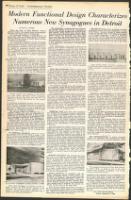

House of God — Contemporary Version
Modern Functional Design Characterizes
Numerous New Synagogues in Detroit
By RUTH L. CASSEL
From the days of King Solomon, Jewry's
glamour builder, the temple, later the synagogue,
has been the focal point of Jewish life.
Its three-fold function is described by its
three titles—Beth ha Tefillah, House of Worship;
Beth ha Midrash, House of Study, Beth ha Knes-
set, House of Assembly.
The continuing importance of the synagogue
in the contemporary Jewish community is amply .
demonstrated in Detroit, where the erection of
new synagogue structures has come to be a ma-
jor theme of communal activity since World
War II. Although the many buildings which have
been completed or are now in process of construction
vary widely in size, they have in common the beauty
and utility characteristic of modern institutional
architecture.
*
*
*
THE NEW SYNAGOGUES, whether for Orthodox,
• Conservative or Reform congregations, all show a
blending of tradition with modernity. For example,
it has been traditional that the synagogue be built
on high ground and, that it be the most imposing
structure in the community. Since that is, obviously,
impossible in this city, a compromise has been reached,
wherein the majority of the new synagogues, although
largely one, sometimes two-story buildings, are set
back on larger plots of land and are distinguished
Temple Israel's new building, in the Palmer
Park area, which will house 1,300 worshippers
beginning with the High Holy Days this fall, was
inspired by Biblical descriptions of the original
tabernacle.
by beautifying landscaping. Gardens, enclosed court-
yards and other landscaping features are reminiscent
of the Temple of Solomon. The rule of placing the
Ark on, the Eastern wall, so that worshippers face
Jerusalem, is sometimes inconvenient, and is rigidly
enforced only in Orthodox buildings.
The one-story trend is an indication that con-
gregation officers and rabbis are realistically ac-
cepting the unfortunate fact that a large worship
auditorium for year-round use is impractical, since
most worshippers concentrate their synagogue at-
tendance within a few weeks at the fall holidays.
Therefore, they are approving the construction of
a moderate-sized auditorium and adjoining social
hall, with folding doors or some other easily removed
separation. For the High Holy Days, the two rooms
may be combined into a worship auditorium of major
proportions. And throughout the year, the congrega-
tion has an easily accessible hall for meetings, wed-
' -imieltigs and other events.
*
*
*
IN ORTHODOX BUILDINGS, where the women
are separated from the men while at prayer, a low
grill or curtain is now prevalent, instead of the gallery
common to two-story synagogues. Many congregations
have found it advisable to use their main auditorium
for more than one purpose and, therefore, use seat-
ing arrangements which can easily be removed. In
these instances, the Ark is shielded by a curtain
when the room is used for non-religious events.
....................
Bnai Israel Synagogue in Pontiac, as well as
others designed by noted Detroit architect Louis
Redstone, has attracted national attention as "a
model of sensible functionalism combined with a
cheerful and inspiring atmosphere."
This adaptability is probably the most outstand-
ing common feature of the newer synagogues in
Detroit, which include buildings now hi use by Cong.
Beth Shmuel, Young Israel, Cong. Nusach Harie,
Cong. Ezras Achim, Northwest Hebrew Cong., Carmel
Hebrew School and Synagogue and Cong. Beth
Aaron, and those now being constructed by Temple
Israel, Cong. Beth Moses and Cong. Ahavas Achim.
The latter three are expected to be ready for use
by Rosh Hashanah. There are also new synagogues
in the neighboring communities of Pontiac, Flint
and Jackson.
Some congregations, whose building ideals do not
conform with budgetary limitations, have chosen to
build their synagogues a section at a time. Northwest
Congregation built its basement social hall (also used
as a worship auditorium seating 1800) in 1944, its two-
story school in 1948, and has just announced plans
for construction of its large auditorium above the
social hall. Temple Israel's new building includes its
1,300-seat main auditorium and a number of offices
and meeting rooms, but eventually it plans to con-
struct a 22-room school, small auditorium and large
social hall. Beth Aaron synagogue has served as a
combination worship and social hall for five years,
and the congregation has just revealed expansion
plans.
*
*
*
SINCE THE SYNAGOGUE serves so many needs
in the community, it is natural that it should include
a variety of rooms. A kitchen or pantry, library, con-
gregation offices, the rabbi's study, check and storage
rooms, an adequate lobby and lounge facilities are
all necessities. Congregations which sponsor religious
school usually try to include classrooms and school
offices, although Temple Israel, Beth Aaron, Bnai
David and, until two years ago, Northwest Cong., take
advantage of nearby public schools until they can
provide their own facilities.
It is possible to include many other facilities in
the synagogue. Young Israel's Center features club
and hobby rooms. The new Temple Beth El in Flint
has a nursery. Detroit's Temple Beth El offers a
complete gymnasipm.
Other buildings have special lounges and reception
rooms, dressing rooms for brides, stage facilities, sew-
ing rooms for women's groups. Reform and sothe
conservative congregations, notably Shaarey Zedek,
make sure that parking space is available adjacent to
the synagogue. The increasing importance of land-
scaping permits the permanent existence of such
religious symbols as an outdoor Sukkah. Temple Israel
plans, for the future, an enclosed outdoor garden
and pond, comforming to the injunction that the
synagogue stand near running water.
*
*
*
WHEREVER JEWS have lived, their synagogues
have followed the architectural pattern of that coun-
try. In Spain, the synagogue showed a Moorish in-
fluence; Polish Jews built wooden and stone syn-
agogues; some Gothic structures have been found in
South Germany and France. American synagogues,
until recent years, have been adapted from European
or Near Eastern stylings or, in some instances, have
picked up the characteristics of American Colonial
architecture.
The newer houses of worship, however, have been
designed to fulfill the functional requirements of the
present-day community. Prominent Detroit architect
Louis Redstone (who supplied a large part of the
information for this article) who is noted as an
authority on synagogue building, in an article in the
American Technion Year book for 1948, described, for
example, his exterior design of Bnai Israel Synagogue
in Pontiac as "strong, simple unbroken masses (which)
would create the feeling of dignity and security that
is associated with a House of God. The slightly curved
front wall of the synagogue auditorium is oroken only
by a horizontal band of stone inscribed with a proverb
from the Hebrew prophets: 'Behold How Wonderful
and Pleasant It Is for Brethren to Dwell Together'."
Detroit's Cong. Beth Shmuel follows this design
closely, and the unbroken mass, with little exterior
decoration, is found in many of the other new syn-
agogues.
*
BUILDING MATERIALS vary, although light brick
seems to be most popular. Temple Israel's imposing
new edifice is of white Indiana limestone. Its major
exterior embellishments will be two huge stone col-
umns, surmounted by miniature tabernacles, and
flanking a seven-foot wide bronze Menorah. North-
west's building plans call for a domed entrance which
will be surmounted by a tablet bearing the Ten Com-
mandments. Young Israel's exterior is distinguished
by a copper triangle bearing the symbols of nation,
religion and culture—the Star of David, the Menorah
and the Ten Commandments.
Interior decorations, in accordance with the
Biblical adjuration against "graven images" are
simple and symbolic—the Star of David, the Lion
of Judah, the Menorah, embroidered curtains for
the Ark, illuminated Yahrzeit tablets. A few syna-
gogues' have stained glass windows, although these,
too are designed without use of the human figure.
Color schemes tend to simplicity also, usually em-
ploying varying tones of the same color.
Since the Ark, housing the Scrolls of the Law, is
the most important single feature of any synagogue,
most congregations devote much care to its construc-
tiop Many are of intricately carved wood, some with
sliding doors, others with rich curtains.
THE ARS OF Temple Israel, according to advance
descriptions, should rival the magnificence of Solo-
mon's Temple. Architect William E. Kapp designed
it after an intensive study of the Biblical description
of the original tabernacle. It will be a horizontal
case of wood, 12 feet high, overlaid with 23-carat
gold leaf, and will be reached only by mounting seven
steps above the pulpit platform of marble and ebony.
Marble pillars will flank the Ark and a fine white
Cong. Ahavas Achim, formerly a landmark of
the East Side Jewish Community, is completing this
modern structure in the far northwest section of
the city.
curtain will serve as background. A handsome Ner
Tamid (Perpetual Light) will hang over the folding
doors, which will open to reveal the Torahs. The
Ark, unlike those in most synagogues, will be entirely
separated from the rear wall. -
Kapp, 'incidentallY. spent months in research be-
fore designing Temple Israel, which is intended to be
a modern interpretation of the Biblical injunction's
for a house of worship and of Solomon's Temple. It
is interesting to note that he is the only non-Jew
nationally accredited by the Union of American He-
brew Congregations as qualified to design a Liberal
Jewish Temple.
*
*
*
TECHNICAL DEVELOPMENTS have helped insure
economy, along with functionalism in the modern
synagogue. Better ventilation has been provided . in
all the new buildings, with air conditioning by re-
frigeration a feature of the Young Israel Center. Mod-
ern lighting installations will help the worshipper as
he reads his prayer book. Temple Israel's ceiling is
dominated by an immense Star of David which has
within it both lighting and ventilating equipment.
Gas and oil heating help keep the synagogue clean
and, in many cases, have done away with the neces-
sity for a basement.
Detroit is not alone in having so many beautiful
modern synagogues. Photographs of the newer
houses of worship and religious schools throughout
the country show the same trends to functional de-
sign and modern motif.
Some are rich and elaborate, such as the Park
Synagogue of the Cleveland Jewish Center, extending
over acres of ground and providing many types of
recreational facility, as well as serving the functions
of worship, study and assembly. Others are more
practical, and some are completely unusual, as is the
Quonset-type building of the Nassau Community
Temple of West Hempstead, Long Island. However,
a number of the newer Detroit synagogues, particu-
larly those designed by Redstone, have attracted na-
tional attention.
*
*
*
THE PROGRESSIVENESS of modern synagogue
design is an indication that congregational leaders ,
not only are aware of the physical importance of the
LUIMoo.
'
.. • ....
.
The handsome structure of Cong. Beth Shmuel,
on Dexter Blvd., is noted as one of the most
modern local Orthodox synagogues, and houses
numerous community events.
synagogue in the community, but are employing every
type of up-to-date device to make the building, and
the religious, educational, cultural and social activi-
ties that it houses, important in the lives of continu-
ingly larger segments of the Jewish population.
A modern building in itself cannot bring renewed
life to Judaism in America, but it can serve as a
healthy shot in the arm. There can be no question
but that the beautiful new synagogues which dot the
Detroit community are going a long way in achieving
that end.
30
—
THE JEWISH NEWS
Friday, September 8, 1950