

Reunion at the Seder Table . • •
A Modern Story of Deliverance
By ANNA KAUFMAN
(Copyright, 1950, Jewish Telegraphic Agency, Inc.)
There was a simple Seder in the Klein household in a mid-
Western town. Only four persons were there, yet for each one
the unleavened bread and bitter herb will have a special flavor.
The tranquil voice of Isaac Klein gave the traditional an-
swers to the traditional four questions. The lighted candles in
the candelabra softened the strong face molded in courage and
travail.
". . . And thou shalt relate to thy son that day .. ." the
voice continues as Isaac Klein looks up affectionately for a
moment at the one who asked the questions of him. It is a
21-year-old girl, for no son of Isaac's has lived through the
Nazi terrors to share this ceremony with him, nor is this girl
even remotely related to him by blood. Raya, pretty Raya,
is daughter to Isaac and his wife through the blood of others;
the rivers of blood drawn from the Jews of Europe.
Isaac and his wife, Esther, were lucky enough to escape
before the worst came for all the Jews of Europe. They had
survived the worst when they accepted the news that of the two
sons, one had died in a Gestapo prison, the other from a storm
trooper's bullet.
They could get to America. It was possible in 1937. With
the advice and aid of the National Coordinating Committee to
Aid Refugees they reached America and settled in Milwaukee.
The Kleins prospered. Nothing notable financially, just well
enough to manage payments on the small home, stock the larder
comfortably, welcome their friends, old and new, with warm
hospitality. But the grief of parents bereft would always be for
them the bitter herb. The Seder is remembrance without joy
when one voice alone gives question and reply.
Esther and Isaac Klein accepted a new voice in their
household in early 1941, when 13-year-old, orphaned Raya
was brought to America by the Coordinating Committee's
successor, the National Refugee Service. Smuggled out of Ger-
many, NRS had arranged for her, and thousands of other un-
attached children, to live in this country with foster parents.
When the Kleins read of the NRS work, they had offered their
home to a child and Raya was chosen.
Politics, Religion
Tangle Israel's
School System
By ADA OREN
The first Seder for Raya was strange and too exciting.
(Copyright, 1550, Jewish Telegraphic
Memories buried by misery and the grim task of survival for
Agency, Inc.)
a child alone came unbidden to the feast. Memories of a Seder
TEL AVIV—The adminis-
solemn and joyful to a young child who had known only safety tration of the Jewish educa-
and love with her family opened the door for the nightmare tion system in Israel, by now
of family scattered and gone. Raya could not taste the bitter creaking under the burden of
herb on this first Seder, but there on the table before them, a recently doubled school
it was a bond between the girl and her foster parents.
The wounds of the body and the spirit heal quickly in young
flesh and by the time several more Seders had been celebrated,
Raya was a gay, quick, American teen-ager.
In 1946, United Service for New Americans, an agency of
the United Jewish Appeal, was formed to take over the task
of resettling all those survivors of the war who were eligible
for immigration to. America. A part of that task is the
checking of names, names and more names, in an effort to
bring scattered families togethe r.
In early 1949, the sole survivor of her family in a DP Camp
in Germany learned that miraculously one child was left to her
and that this child, Raya, was safe and settled in Mid-West
U. S. A. When Raya heard that ,her mother was actually alive
she was afraid to believe it at first. Perhaps it was a mistake.
But the facts were all put together and they fitted exactly so.
United Service started the machinery to move Raya's mother
from DP Camp to staging area, to ship board, to port of entry,
to home. Raya worked nights and overtime at her secretarial
job to make extra money and save every penny. "I shall bring
my mother home. I must pay every penny myself," she told the
agency representative. "I am the man of the family in this new
land."
The Kleins rejoiced with Raya. "You are our child too,"
they told Raya, "and your mother will not begrudge us some of
your love. Indeed, she is our sister, and together we will be a
family again."
"Wherefore is this night distinguished from all other
nights? .....Raya asks, her mother's -hand enfolded in one
of hers and Esther Klein's in the other. The age-old story of
deliverance is simply the story of their own lives.
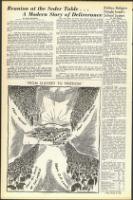
"FROM SLAVERY TO FREEDOM"
.
I
population, is greatly com-
plicated by the fact that the
public has never been able to
agree on a common secular syl-
labus. Consequently four main
types of schools—general, labor,
Mizrachi and Agudah, not to
mention other splinters—are in
existence.
Parents are free to choose the
type they prefer, and the com-
minutes concerned must pro-
vide separate schools for all if
there is a sufficient number of
pupils. This provision created
a wide field for waste of scarce
manpower and equipment and
created a good deal of con-
troversy.
* * *
THE WHOLE ISSUE is further
complicated by the large num-
ber of religious new immigrants
from the Near East, many of
whom insist that their children
be educated only in their spe-
cific tradition, • often arguing
that teaching of the Torah
comes before arithmetic.
Lately the rather sketchy ed-
ucation system in transit camps,
which teaches almost exclusively
Hebrew and the three R's and
can thus serve hardly more than
40 percent of the 12,000 children
in camps, has become the ma-
jor battleground between Ortho
dox and non-Orthodox educa-
tion leaders.
* * *
- ALTHOUGH THE
education
law empowers the responsible
minister to recognize and set up
so-called "non-trend" schools,
he has not been permitted to
do so except in the case of
juvenile delinquents and other
social work cases, which are still
under the welfare, ministry. The
Orthodox leaders — and Marx-
ists — argue that they agreed
to the escape clause only on the
understanding that it should
cover non-Jewish schools alone.
The education minister did
attempt to introduce a "non-
trend" school system for chil-
dren in transit schools but was
challenged by the Orthodox
parties who threatened to re-
sign from the government. This
plan was dropped.
* * *
A NUMBER OF compromise
solutions were vetoed by either
the Orthodox or labor groups.
The religious parties , have al-
ways opposed all forms of state
rather than partly controlled
schools, and may now succeed
in setting up instead a common
system of religious schools in
the camps controlled by a board
representing all or thodox
groups.
Throughout the laborites and
the Orthodox—mainly the Miz-
rachi—continue to weaken. the
formerly most important gener-
al, non partisan and secular
system of education. In spite of:
much agitation, however, they
did not succeed *in introducing
considerable changes in the ed-
ucational pattern of a city like.
Tel Aviv, where the population
is too well established to be
pressured and whose workers
still prefer the general schools,
although they now have the_
alternative of Histadrut institu-
tions.
* * *
AS OF NOW, the country has
some 6,000 classes with 7,000
teachers benefitting from the
general education budget. The
percentage of students in the
various "trends" is as follows:
General Labor
Kindergarten 37 38
Elementary grades.... 40.5 30.5
Secondary schools 72.5 17
Trade schools
51
30
Teachers seminars
35
36.5
Average:
43.5 25
Mizrachi Agudah
Kindergarten
Elementary grades.
Secondary schools
Trade schools
Teachers seminars
Average:
16
8
22.5 6.5
9
1.5
17
....
19
8.5
21.5 5
12 — THE JEWISH NEWS
Friday, March 31, 1950