

As die Editor
Views the News ...
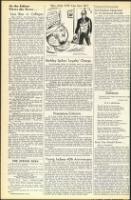
`Doc, Only YOU Can Save Me!'
Anti-Semitism Interpreted
As An Emotional Disorder
Less -Bias in Colleges
Bnai Brith's Anti-Defamation League
has disclosed some interesting facts about
anti-Jewish prejudice in American colleges.
Basing its report on a survey of students'
attitudes made by the Elmo Roper organiza-
tion, ADL discloses that college youth are
overwhelmingly opposed to quota systems
and other discriminatory policies in colleges
and that one one out of every 10 students
approves of colleges which discriminate, as
contrasted by a third of the adult population
which is inclined to approve of prejudice.
Some of the questions posed in the sur-
vey throw light on the problem of prejudice.
An interesting point is made of the fact
that, as a result of the study made on 50
campuses during the early part of the 1949
fall term, the incidence of prejudice was the
same for seniors as for freshmen. The con-
same for seniors as for freshmen. There-
fore, we are told, "we must face the con-
clusion that a college education today does
not appreciably change entrenched attitudes
toward minority groups."
Is it possible that the high schools are
more liberal than the home where it has
been registered that a third of our popula-
tion is biased against Jews ? The ADL re-
port assumes that "idealism is a function
-of youth." The prejudiced, the report points
out, "are bitter-enders with whom educa-
tion has already proved ineffective." But
the ADL survey makes this frank admis-
sion: "The attitudes of today's college stu-
dents may be considerably more narrow
and prejudiced 10 or 20 years from now.
Our past studies show that when we sepa-
rate college graduates from the general
adult population and compare the two
groups, anti-Semitism and minority bias is
more prevalent among the college-educated."
How do the attitudes of college seniors
compare with American adults on specific
questions ? Here are some of the results of
the Roper-ADL survey:
Do you think Jews are getting too much
economic power in the United States? Thirty-
per cent of the general adult population said
"yes"; among seniors, 23 per cent,
. • . too much political power? Adults, 19
per cent; seniors, 6 per cent.
Would you prefer not to. work side by side
with Jews? Only 5 per cent of the seniors re-
plied "yes". Adults, 14 per cent.
Would you prefer not to have Jews move
into your neighborhood? A.dults, 22 per cent;
seniors, 10 per cent.
Would you prefer not to have Jews as
guests in your home? Adults, 15 per cent; sen-
iors, 3 per cent.
"Suppose six of the 11 best football players
in college happened to be Jews. Do you think
it would be a good idea to have them all play
on the. varsity?" Yes-49 per cent; Doesn't
matter (a volunteered answer) — 41 per cent;
No — '7 per cent.
These are most interesting revelations.
They offer definite indications that, given
proper training alOng democratic lines in
the high schools, the youth of the nations
can be directed away from prejudice and in
support of the basic democratic American
principles.
The ADL survey report points out that
a breakdown of college sub-groups shows
that there is greater bias among fraternity
and sorority members than others. Appar-
ently, the more democratic the background
and affiliation of the student, the more
unprejudiced is his reaction to his fellow
men and therefore to Jews.
The college survey should serve as a
guide for action in dealing with the youth
of the land. Let us strengthen our demo-
cratic teachings in the elementary and high
schools, and we shall have less to fear from
prejudice when the well-trained assume their
places as adult citizens.
THE JEWISH NEWS
Member: American Association of English-Jewish News-
rowers, Michigan Press Association.
Services: Jewish Telegraphic Agency, Seven Arts Feature
Syndicate, King Features, Central Press Association.
Published every Friday by The Jewish News Publishing%
Co. 703-10 David Stott Bldg., Detroit 26, Mich., WO. 5-1155.
Subscription $3 a year; foreign $4.
Entered as second class matter Aug. 6, 1992 at Post Office,
Detroit. Mich., under Act of March 3, 1879.
PHILIP SLOMOV1TZ. Editor
SIDNEY SHMARAK Advertising Manager
RUTH L. CASSEL, City Editor
Vol. XV1—No. 23
Pae 4
February 17, 1950
Sabbath Rosh Ifodesh Scriptural Selections
This Sabbath, the first day of Adar, 5710,
the following Scriptural selections will be read
in our synagogues:
Pentateuchal portions—Ex. 21:1-24:18; Num.
28:9-15.
FrOphetical portion—is. 66.
Prejudice Psychoanalyzed
Barkley Spikes 'Loyalty' Charge
Vice-President Alben W. Barkley made an important
contribution to proper evaluation of Jewry's association with
Israel in an address in St. Louis in behalf of the United
Jewish Appeal. He lashed vigorously at those who raised
the question of double allegiance and said it was "preposter-
ous to believe that anyone contributing to the development
of Israel was disloyal to the United States." He supplement-
ed his appeal for the UJA with the declaration that Israel
"held out the one great opportunity for world peace at a
time when the forces of destruction are rising in the world
and the armaments race has reached a new peak," and added:
"Nobody, Jew or Gentile, can truthfully say that it
is disloyal for any American to try to help a little coun-
try which is being helped by the very government of the
united States."
This is a point deserving of emphasis in view of the
Vice-President's reminder to those whom he urged to go-
al]. out in support of the UJA that Congress and "every
President from Wilson to Truman" had endorsed the es-
tablishment• of the Jewish state. It would be "the greatest -
tragedy in the world," he said, "if that small new state could
not survive the economic and social problems that now con-
front her as a result of a record flow of immigrants."
Mr. Barkley served two purposes with his speech: he
deflated those who raise the false cry of dual allegiance and
emphasized the importance of the UJA. Now it is up to all
American Jewish communities to fulfill their responsibilities
to the fund that aims to accomplish the important task of
making the little state of Israel secure and self-sustaining.
Premature Criticism
It is now evident that the president of the American
Jewish Congress was premature in his criticism of John J.
McCloy, American High Commissioner in Germany, whom
he accused of a Nazi appeasement policy. Upon his return
to Germany last week, Mr, McCloy made two important
statements. He gave assurances that execution of the death
sentences imposed at the Nuremberg trials 26 months ago
on Nazi war criminals will be carried out soon in view of
the findings of the U. S. Senate Investigation Committee;
and that it is American policy that persons and organiza-
tions deprived of property as a result of Nazi racial and
political discrimination shall have their property returned
to them or be given adequate compensation.
Mr. McCloy has made it clear that victims of Nazi per-
secutions will receive indemnification for their sufferings.
He called on Germans not to deny responsibility of the Nazis
for war crimes and added that the wrongs suffered by the
persecutees could not be completely redressed "but in all de-
cency they must be faced and dealt with without evasion and
subterfuge."
These are franks words and it is to be expected that Mr.
McCloy will henceforth act firmly with pro-Nazis in Ger-
many. Untimely criticisms leveled at him are to be regretted
and it is encouraging to know that the U. S. spokesman in
Germany is taking a determined stand against pro-Nazis.
Young Judaea 40th Anniversary
The 40th anniversary of Young Judaea, the American
Zionist youth movement, to be observed in New York on
Sunday, invites the interest of Young Juda.eans throughout
the land in the opportunities that are afforded them to
participate in educational and productive efforts in Ameri-
can Jewish life and in behalf of Israel.
Our youth have a great Opportunity through work for
Israel to share in the effort to end the problem of Jewish
homelessness which has. plagued our people during the last
20 centuries and at the same time to advance the cultural
activities of our people in this country. Young Judaea and
other Zionist youth movements—Habonim, Hashomer Hat-
zair, Mizrachi Youth—should increase rather than dimin-
ish their efforts in the present historic hour. The call that
has gone forth to former Detroit Young Judaeans'," who are
counted in the many hundreds, to participate in a roll call
aimed at a reunion in our community, should meet • with a
prompt response. Detroit Young Judaea is 32 years old. A
reunion of former affiliates of the movement should serve
to inspire the present members of the movement to greater
activity and to deeper interest in basic Jewish causes.
Another in the Studies in Prejudice Series
sponsored by the American Jewish Committee
has just been published by Harper. It is: •"Anti-
Semitism and Emotional Disorder: A Psychoan-
alytic Interpretation," by Drs. Nathan W. Acker-
man and Marie Jahoda.
In an introduction to. this -volume, Dr. Carl
Binger, the noted psychiatrist, states: "They
(the authors) consider anti-Semitism an evil, a
symptom of social illness. They are courageous
enough to do battle with evil, using the com-
bined weapons of their combined sciences (psy-
choanalysis and social psychology). Since the
application of psychoanalytic theory to social
phenomena is at its beginning this is pioneer
work. It is important,. however, not only for that,
but also because in bringing reason to bear on
certain irrational attitudes the authors of this
book. have struck a blow at once for freedom and
for mental health. The day is now past when the
true scientist can be indifferent to ethical values
and moral judgments."
Drs. Ackerman and Jahoda base their study
on 40 specific cases which are incorporated as
an appendix to the book. They took into con-
sideration two views: the arguments of 'those
who claim that the less said about anti-Semitism
the better, and the fear that their investigation
might detract from the More fundamental social
and economic causes of anti-Semitism. The
authors point out that "conceptual clarification
became both more difficult and more important
once the readiness for cooperation had been es-
tablished. The need for it was convincingly
demonstrated by the great range .of views
among psychoanalysts concerning the frequency -
of anti-Semitism."
An interesting conclusion is reached by the
two authors. They point out that, seen in the
context of a cultural struggle, "the fight against
anti-Semitism is more than a fight for the rights
of Jews, or of Negroes, Catholics, Mexicans, Jap-
anese-Americans and others who with benefits
to none often replace the Jewish victim. It is
more than a fight- for the liberation of the pre-
judiced person whose thwarted personality
makes him insensitive to the joys of life. It is a
fight for the very survival of civilized mankind."
This value enriches the series of studies
which,. in their totality, mark an important col-
lection of works on the subject of anti-Semitism
and the fight for justice.
Defiance
"Reproach hath broken my heart and I am
full of heaviness . . ."
—Psalms 69:20.
By N. E. ARONSTAM
My life was not a. bed of roses,
Thorns pierced my quivering flesh;
Within the brief and calming pauses,
Lurked a danger new and fresh.
Nor was I to the manner born,
Toil and worry were my lot;
By ever changing conflicts torn
Was my soul—a -blot, a clot .
Upon the maelstrom of existence,
For the sport of forces blind,
That taunt and grin at my persistence,
At my vain and futile grind.
On my escutcheon are gleaming.
Words, emblazoned, grim and grey;
"For thee is not the world of dreaming,
Fight and suffer in the fray."
Aye, I shall fight and suffer ever,
Undaunted, staunch, and strong and brave,
I challenge Fate's envenomed quiver.
And bid defiance to the grave.
Facts You Should Know .
What is "Chalitzah?"
"Chalitzah" is the name given to the cere-
mony prescribed in the Bible whereby the broth-
er-in-law of a childless widow refuses to marry
his brother's wife to establish an heir for his
deceased brother. The ceremony is described in
the Bible and entails a situation where the
widow comes before the elders of the city who
summon her brother-in-law before them. After
establishing his refusal to marry her, the widow
takes off her brother-in-law's shoe, emits her
sputum in his presence and pronounces, "So shall
it be done unto the man that does not build up
his brother's house."
The removal of the shoe is an ancient method
of transferring property or property rights, men-
tioned for example in the Book of Ruth. It logi-
cally symbolizes the "stripping" of the basis of
one's claim upon a certain item. In the case of
the "Chalitzah" ceremony, some writers consider
it a means of stripping the brother of any
rights to his deceased brother's property inas-
much as he refused to marry. the widow.
Others consider it a means of actually "strip-
ping" him of his rights to claim her as his wife,
which was originally his privilege. The excretion
of the sputum may originally have been a sym-
bol of casting shame upon the brother who re-
fused to "raise his brother's name in Israel." Th.
"Sefer Hachinuch" explains that the widow is
released of the obligation of respecting him at
having a claim of kinship upon her, especially
the claim of ,marriage afforded him through the
levirate commandment in the Bible. She shows
that she henceforth regards him as a stranger.