
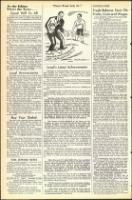

`That's Weak Soil, Sir !'
As the Editor
Views the :News .
Trade Balance: Facts On
Profits Costs and Wages
Good Will To All
A new era of mutual good will between
Christians and Jews is more noticeably in
evidence since the establishment of the State
of Israel.
Contrary to the unfortunate statements
that have been circulating in some quarters
with reference to the Jewish position, Chris-
tians in Israel have been on the friendliest
terms with the Jewish state and Christian
places have been give full protection in the
Holy Land.
The only Christian Holy Place in the New
Jerusalem, the Dormition Church on Mourit
Zion, was reconsecrated and is being re-
paired with funds provided by Israel.
In Tiberias, the Scottish Mission Hos-
pital has been returned to its owners by
Israel.
Protestant leaders have been sending
messages to Israel leaders commending them
for their cooperation and for making pos-
sibre freedom of expression by all faiths in
Israel, and all Christian churches continue
to conduCt religious activities in an atmos-
phere of complete freedom and equality.
These are truths which defy the spread
of damaging rumors about Israel.
The situation in. Israel corresponds with
the friendly relations that exist between
Jews and Christians in the United States.
These are the symbols of genuine good
will, in the spirit of which we extend heart-
iest greetings to all our neighbors on the
occasion of the Christmas of 1949.
Local Anniversaries
The 50th anniversary of the United Jew-
ish Charities, to be observed on Jan. 4, and
the 10th anniversary of the dedication of the
Jewish Community Center, which was
marked on Wednesday with a dinner in
honor of Mrs. Aaron DeRoy whose large gift
in memory of her husband made the erec-
tion of the present building possible, stand
out as landmarks in our community.
The Center's activities, which date back
many years prior to the completion of the
Aaron DeRoy memorial building, are too
well known to need re-evaluation. Its new
branch, on Davison Ave., and its activities
in the 12th and Dexter areas enhance the
work of this recreational agency.
The United Jewish Charities, the philan-
thropic organization that preceded the Jew-
ish Welfare Federation as the social service
and charity-dispensing agency of Detroit
Jewry, now is the property-holding corpora-
tion of the Federation and continues to per-
form an important function here.
We congratulate both agencies. on their
anniversaries.
Buy Your Shekel
The new crisis affecting Zionist thinking,
created by the United Nations decision to
internationalize Jerusalem, proves that Is-
rael still needs political support from Jewish
communities throughout the world.
Only the Zionist movement is equipped
to mobilize such support, and it is advisable
that every effort should be made to retain
the strength that emanates from Zionism in
behalf of the struggling Jewish community
in Israel.
The forthcoming. World Zionist Congress
has necessitated the launching of another
drive for the sale of Shekolim as a symbol of
Jewry's backing for the Zionist idea. The
larger the traditional sale of Shekolim, the
more effectiVe will be the influence of the
Zionist movement.
Those not officially affiliated with Zion-
ist parties whose members automatically
pay the Shekel fee, should make it a point
to purchase the Shekel from the groups of
their preference.
THE JEWISH NEWS
Member: American Association of English-Jewish News-
papers, Michigan Press Association.
Services: Jewish Telegraphic Agency, Seven Arts Feature
Syndicate. King Features, Central Press Association, Palcor
News Agency.
Published every Friday by The Jewish News Publishing
Co. 708-10 David Stott Bldg., Detroit 26, Mich., WO. 5-1155.
Subscription $3 a year; foreign $4.
Entered as second class matter Aug. 6, 1942 at Post Office,
Detroit. Mich., under Act of March 3, 1879.
PHILIP SLOMOVITZ. Editor
SIDNEY SHMARAK Advertising Manager
RUTH L. CASSEL, City Editor
Vol. XVI—No. 15 Page 4 - December 23, 1949
Sabbath Scriptural Selections
This Sabbath, the fourth day of Tebet, 5710,
the following Scriptural selections will be read
in our synagogues:
Pentateuchal portion—Gen. 41:1-44:17.
Prophetical portion—I Kings 3:15-4:1.
Scriptural Selections for Fast of Tebet, Friday
Pentateuchal portion—Ex. 32:11-14; 34:1-10.
Prophetical portion—Is. 55:6-56:8.
Investin9 in Israel
,
This is the fourth of a series on Israel's economy based
on facts gathered by the Economic Department of tit*
Jewish Agency for Palestine.
By P. BERNARD NORTMAN
44.
0 ,0 0el e ri""
I/0 7-46-
/N
JEW
5.1: Z /*/
-relt.GRAPAR.
i \
No
O4 t4
Israel's Latest Achievements
Attempts to internationalize Jerusalem and its environs
have brought one positive result : the Jewish area, which
until recently was a vacuum in the Jewish state, is being
industrialized and the rooting of newcomers into Israel's
economy is being speeded.
The famous Road of Courage (Kvish Hagevurah) from
Tel Aviv to Jerusalem will be shortened by a new connecting
link from Ramle and by spring is expected to be reduced
to 70 kilometers-46 miles.
The Tel Aviv-Lydda-Jerusalem railroad is resuming op-
erations.
A Jerusalem fund of $750,000 has been set up by the
Anglo-Palestine Bank, which is controlled by the Jewish
Agency, for the development of industries in the Jerusalem
area.
Transfer of the offices of Prime Minister David Ben-
Gurion and President Chaim Weizmann to Jerusalem spear-
headed the determined effort of the state of Israel to
prevent the isolation of 100,000 Jerusalem Jews from the
state to which they have pledged allegiance. Actually,
these moves are the fulfillment of aspirations which were
in evidence since the establishment of the state of Israel
through the sole efforts of Israel's heroic citizens. Three
government departments were established in Jerusalem
many months ago, three more were moved last week and
the line,sset will commence its meetings in the re-establish-
ed capit41 of Israel—in Jerusalem—on Dec. 26, at the
Orion Cinema which will be rebuilt for that purpose.
-
The former German Hospital on the Street of the
Prophets has been converted into Ben-Gurion's office. All
available facilities are being utilized to strengthen the
government, whose leaders—headed by Ben-Gurion—have
won the respect and admiration of Israel and the world.
Progress in Israel is not limited to the physical aspects
of the government's transfer to new quarters. In the field
of immigration and resettleMent, the Jewish state sends us
good tidings. The number of people in the reception camps
has been reduced to less than 80,000 and it is expected that
another 20,000 or more will be integrated in agricultural
settlements and industries this month. The completion of
6,000 new housing units in November, the construction of
18,265 new homes in the last six months and the leasing of
contracts for more housing units are indications that the
new state is not standing still.
The 54th settlement established near the Beersheba
road in the last 18 months, the 28th kibutz in the Negev, the
creation of a settlement for Jews from India to be named
for Mahatma Ghandi, the rise of the number of settlements,
as of Dec. 1, to 557, prove the point that Israel is marching
on.
Abba Eban and Dr. Abba Mel Silver have predicted
that the UN will reconsider its hasty decision for Jeru-
salem's internationalization. Senator Herbert H. Lehman
of New York called UN's action a "grievous mistake."
Many Protestants concur with the Jewish viewpoint on
Jerusalem. Israel Minister to Britain Dr. Mordecai Eliash
stated that "Jerusalem will not be a separate corpse but
a living part of Israel forever."
The Jewish position is firm, in spite of pressure from
the Vatican, the Arab states and from Soviet Russia. The
state of Israel has the support of all Jews who endorse the
final declaration made to the United Nations by Israel For,
eig,n Minister Moshe Sharett:
"At this moment of decision over Jerusalem's destiny,
the people of Israel recall the words uttered in Jerusalem
at another solemn moment in its history in antiquity:
" 'For Zion's sake will I not hold my peace, and for
Jerusalem's sake I will not rest, until the righteousness
theraid go forth as brightness, and the salvation thereof
as a lamp that shineth.' " (Is. 62:1).
The industrialization of Israel has brought
about a change in the composition of imports.
In 1926, 58% of all imports consisted of manu-
factured goods, 27% of food and tobacco, 8% of
raw materials and 7% of miscellaneous imports.
Twenty years later, the import, of manufactured
articles had dropped to 40% of total imports;
the amount of food imported was about the same
(27%); while raw material imports jumped to
31% of the total.
Palestinian exports have increased constantly
and their composition has become more and
more diversified. Oranges, potash, diamonds,
some textiles, olive oils are Israel's chief exports.
Since 1939, exports of manufactured and indus-
trial articles, especially to neighboring countries,
have risen from 15% of the total value of ex-
ports to 36% in 1947; exports of raw materials
rose from 3% in 1939 to 32% in 1947; while food
and tobacco dropped from 82% in 1939 to 32%
in 1947.
Modern Palestine has always had a deficit
in its balance of trade; the value of her ex-
ports rarely amounted to more than 20-40%
of her imports. Such a deficit, however, does
not necessarily reflect on the "solvency" of a
country's economy.
Though a country may have an adverse trade
balance, it can pay for the excess of imports over
exports with funds secured from non-merchan-
dise transactions consisting of its "invisible" ex-
ports of services (such as receipts from tourists),
, capital income from foreign investments, and
inflow of foreign-owned capital in the form of
investments, loans, immigrant transfers of
wealth, etc.
For instance, the United States had, with
very few exceptions, an annual trade deficit for
almost a century, beginning in 1790 and ending
'in 1875. During this period the United States
was able to import more than it exported main-
ly because foreign investors, particularly the
British and the Dutch, helped underwrite Ameri-
ca's economic- development.
With the aid of foreign investments, the
United States was able, by the beginning of
World War I, to increase its "visible" exports
to the point where it became a creditor in-
stead of a debtor nation. It has remained a
creditor nation ever since.
Israel today is at the stage in which the
U. S. found itself in the early part of the 19th
century—very young in its industrial and agri-
cultural development, but holding out great
promise for the future.
In the past, Jewish Palestine's trade deficit
was made up in large part by the personal re-
sources of Jewish immigrants. Immigrant funds
constituted no less than $300 million of a total
capital inflow of $488 million in the period
1922-39. Jewish national funds, as well as other
remittances and contributions. provided addi-
tional capital funds. Sales of securities and
other types of investments, in contrast with the
experience of other debtor countries, accounted
for only a very small portion , of the total in-
vestment. The important role played by immi-
grant funds explains in large part why Jewish
Palestine never had to run up a sizeable foreign
debt.
In 1947, the last year for which data are
available, the excess of imports over exports for
Palestine was estimated at more than $200 mil-
lion. This excess was paid for by a combina-
tion of receipts of Jewish national institutions,
drawings against sterling assets, and transfers
of private capital—aggregating about $150 mil-
lion—while receipts from services, tourism and
other sources provided the balance of the funds
to pay for the imports.
Israel's balance of payments in 1948 and in
1949 is likely to follow the 1947 pattern. It should
be pointed out, however, that Israel has and will
continue to have an excess of imports over ex,-
ports, because the country imports capital and
capital goods. Without this capital, the country
*would not have the purchasing power to buy
abroad the large volume of machinery and the
basic industrial materials required for rapid
economic development. With these capital im-
ports, Israel will be able not only to meet do-
mestic needs but also to sell more extensively
in the export market and to repay borrowed
capital.
No comprehensive data on profits of Israel
industry are available. Such data as are obtain-
able to indicate that profits have been good.
Israel has been plagued by inflation, like
every other country in the world involved in
the war. But the Israel Government has
brought a halt to inflation in recent months
and is now reversing the trend.
From 1939 until the beginning of 1949, the
cost of raw materials, both domestic and im-
ported, went up steadily; construction costs
kept advancing and wages increasing.
Since the inauguration in April, 1949, of
Israel's Austerity Program, the prices of nu-
merous commodities and services have come
down, some more than others.
Cost-of-living figures since April, 1949, reflect
the success of the Austerity Program. From a
record high of 371 in March and April (August
1939=100) the index had dropped to 337 by the
end of August. This reduction in the cost of liv-
ing is the first important decline in the unin-
terrupted month-by-month increase since the
index was first established ten years ago.
(The fifth article in this series will discuss Costs of Produp.
tion, Banking, and Commerce in Israel.)
r