

20—THE JEWISH NEWS
Friday, November 11, 1949
Purely Commentary: A Tourist in Israel
Where earded Men, Women With Sheitels
Ride Bi es, Jeeps; and Dogs Learn Hebrew
Envoy McDonald
Receives Editor
At U. S. Embassy
TEL AVIV — The American
Embassy on Rothschild Bldv.
and Nachlat Binyam, , is in un-
kibutz are unmarried and therefore were spared anxiety over comfortable quarters, typical of
By PHILIP SLOMOVITZ
their families.
Israel's own position. But the
(By Direct Air Express via Air France to The Jewish News)
At Mekoroth, near Nir-Am, begin the water pipes which are U. S. Ambassador, Dr. James G.
to dot the Negev. The water from Mekoroth is expected
TEL AVIV—Only in Israel is it possible to see an elder- beginning
to make many spots in the desert fruitful.
a
bicycle
at
fast
speed,
,
ly man, with a grey beard, paddlinc
Beer Sheba itself, not so long ago an Arab city of 11,000,
heavy packages hanging from each handle, apparently on a now has 1,500 Jews who are planning the community's recon-
struction. Everyone here insists that this is the city of the future. -'
business mission.
Where else can one hope to see an elderly woman, wear-
Carries on As an Experimental Station
ing a shekel, either on a bicycle or driving a jeep?
The farthest spot we reached on the difficult Negev road is
Revivim. No one, in his wildest imagination, can possibly begin
to visualize the difficulties that are encountered here.
Away from civilization—if that term can in any sense be
applied to the Negev; devoid of roads, lacking in water and sup
plies, its settlers had to establish a supplementary point closer
to Nir-Am where some of the Kibutz members work to earn
additional income.
But Revivim carries on—as an experimental station where
the settlers are testing means of making something grow in the
sand, of attempting to gather rain water in. a vast reservoir, of
paving the way to a new life under a hot sun. These are the
toughest frontiersmen of all. Those who pioneered' to build
America were in a paradise compared with the conditions that
face the Israeli frontiersmen.
Between Beer Sheba and Revivim—the most difficult road we
covered in Israeli—we saw many Arabs with the camels, a gazelle
and a silver fox.
In Beer Sheba, we found Aryeh Rosenbaum, hero of the
Russian and Polish campaigns in World War II, who was chosen
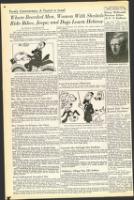
ONE MODE OF TRANSPORTATION IN TEL AVIV
by the Polish authorities to hang Arthur Greiser, Hitler's Gau-
Every home has a story to tell of the war, of the days leiter who was responsible for the mass murders in Auschwitz,
when to reach that home it was necessary to crawl in sand, Maidanek, Treblinka and Dachau. Rosenbaum is proud that he
waste-deep. But in every heart there is a love for the land was the executioner of one of the arch-criminals of our time.
and its people—allowing even for those who would run to
America at the first opportunity because—as the stalwarts
say—"the fleshpots of the galuth" are beckoning to them.
There is something bewitching about the language of the
land and the manner in which it has taken root. Yiddish-
speaking grandmothers, people of French, Bulgarian, Yugo-
slav, German descent— (we could go down the line of na-
tionalities ad infinitum)—are, compelled to speak Hebrew.
How else will they understand their neighbors, their rela-
tives, their friends—their grandchildren?
Gem Riley 'Living the Life of Cohn Here
Name changing is common. The galuth names are being
abandoned. Speaking of names, there is a good story about Brig.
Gen. William Riley, of the U. S. UN delegation, chief UN military
observer. To the question how Riley is getting along in Israel is
given the answer: "He lives the life of Cohn here."
AMBASSADOR McDONALD
McDonald, is as genial as if he
were in the Pentagon Building.
Handsome, well-groomed, our
ambassador was as kindly as
when he came to speak at the
Bnai Moshe or the Shaarey Ze-
dek. He was as democratic as he
was the last time we were with
him at the soccer game at the
U. of D Stadium two years ago.
He gave us a splendid recep-
tion, was rather upset that we
Arabs Fled Strategic Hilltop Spot
did not have enough time to
SAFED, Israel—Arabs occupied most strategic spots on the visit with him at his home at
hills overlooking this ancient city, on the Syrian border. They Ramat Gan, the section known
as Tel Binyamin.
McDonald spoke with pride of
life in Israel. He was happy to
be able to say that the children
love him and we, in turn, were
pleased to report to him that
the orthodox 'Jews love him. He
said he knew only enough He-
brew to get along with the chil-
dren but was proud of the fact
his daughter is mastering the
language.—Philip Slomovitz,
An important industry in Israel is the training of dogs. At
(name of village censored) Mrs. Slomovitz and I spoke with
farmers who work by day and make use of the guns readily
. available in their living quarters as watchmen at night. Arabs
have been coming over the hills, across the border, to steal cattle
and chickens.
It is proposed that watchdogs be trained to solve the problem.
There is a thrill in watching dogs here who respond to calls in
Hebrew and whose tricks find responses only in the language of
the Scriptures.
New Centers for Refugees Like Oases
BEER SHEBA—By the time the visitor reaches this ancient
Abrahamitic city, with its many wells which were the cause of
Abraham's stay here—the availability of water in a parched land—
he should start discarding all accumulated notes.
It is useless to gather the names of settlements in the area
north of here.
Nearly every mile of territory in Israel, above Rehoboth, is
dotted with new centers for olim (immigrants). In the hilly areas
of Gallilee and the Emek, the new settlements are like oases in the
desert. Green patches are visible everywhere.
It is different here. The Negev desert begins here—and it is
a bleak picture whose immense sand-dunes are frightening enough
to scare away the westerner. But the Israelis are made of dif-
ferent stuff.
New Specimen of Humanity in Double Role
On the way to Beer Sheba, a visit at Nir-Am convinces the
that a new specimen of humanity is building this desert-
land. It is a hard life, but the pioneers—among them some Ameri-
cans and Canadians—are scratching deep into the soil to make
it produce. The settlers have played—and continue to play—a
double role: as revivers of the soil's fruitfulness and as the land's
defenders.
At Negba, nearby, there is visible the evidence of the battle
for Israel and for life. A mechanized Egyptian army could not
conquer a handful of young people who stayed underground and
survived the severest onslaught. Now, Negba, rebuilt, struggles
anew—this time to conquer the desert.
Gaza is visible from here. To the outsider, who takes into
guest
serious consideration the fact that Israel is vastly outnumbered
—Gaza and its possessor—Egypt--appear like a staggering men-
ace. Israel, however, is unafraid. Israel carries on and is con-
fident that even the vast sand-dunes will be converted into
thriving centers.
Joseph Katz Named
Kvutzah President
KVutzah Ivrith, the Hebrew
Cultural G r o u p of Detroit,
elected the following officers at
its annual election meeting.
President, Joseph Katz; vice
presidents, Aaron Teitelbaum
and Rabbi Max Kapustin; corre-
TRAIN DOGS TO HEED COMMANDS IN HEBREW
sponding secretary, Norman
fled,-11,000 of them—and now this historic spot is Jewish, an Ruttenberg; recording secretary,
Solomon Kasdan; treasurer, Joel
important part of Israel.
Ca.shdan; publicity, Morris Plaf-
50-mile
Safed is 3,000 feet above sea level. From here the
kin and Alexander Roberg;
stretch of road to Tiberias is along dangerous mountain curves membership, Israel Elpern; cul-
which do not phase the daredevil bus and auto drivers. Tiberias,
tural committee, Morris Nobel;
by contrast, is a hot spot, being 300 feet below sea level.
distribution of Hebrew books, M.
members
of
Palmach
took
Safed
A single Bren gun and 35
Michlin; Hed-Ha-Kvutzah Edi-
after the panicky Arabs began their flight. It will be impossible torial committee, Bernard Isaacs,
ever to explain why the Arabs should have believed that the Aaron Toback and Meyer Mathis.
Jews' Aleph-Beth—meaning Ain Breira, there is no other way, no
Members of the executive com-
alternative—really meant Atom Bomb.
mittee are: Albert Elazaar, Abra-
ham Panush, Mrs. Julius Ring,
Mrs. Abraham Panush, Abraham
Converts His Garbage Into Fertilizer
Schachter, A. J. Lachover and
Morris Lachover.
TQ1
wonderful
teacher.
While
RISHON LeZION—Necessity is a
The new Hatekufah, Hebrew
Aviv has a fine garbage collection system, Rishon is not as blessed
year
in this respect. But former Detroiter Leo Heyman found a way of quarterly now in its 32nd
of publication, will be reviewed
solving his problem.
the bi-monthly meeting of
He wraps and buries the garbage in his garden and he finds at
the Kvutzah at 9 p.m. Saturday,
it to be excellent fertilizer. What's more, he has found that what-
Cohen
ever glass he buries vanishes in a short time and that even the Nov. 12, in the Rose Sittig
Bldg., 13226 Lawton.
cans he buries melt away.
Participants are Bernard
Israelis create many things to suit their needs and must
Isaacs, Morris Lachover and
arrange entertainment by available artists. Thus, in Jaffa, we
saw a sign announcing a concert by a "koktil emaniin"—"a Morris Nobel. Solomon Kasdan
will be chairman of the evening.
cocktail of artists?'
All who understand Hebrew
are invited.
Lived Underground throughout War
There are many Poel Hamizrachi settlements in Israel, and
a number of them are in this area, It seems as if these religious
labor youths and Hashomer Hatzair have penetrated into the
most dangerous and most difficult sections of the country.
Kibutz Saade, on the road to Beer Sheba, offers an inter-
esting study. The settlers lived underground throughout the war.
We visited the underground bakery which still continues to
function.
One of the young men told us that part of the secret of this
group's triumph under attack—during m which supplies had to be
brought to them by plane—was that ost of the members of the
Children's Village Has 220 Settlers
HADASSIM—One of the most interesting places in Israel is
this children's settlement, north of Tel Aviv. Established by Ha-
dassah of Canada, on land provided by the Jewish National Fund,
this children's village has 220 settlers, 80 of whom are natives who
are working and studying there for the purpose of assisting in the
integration of the newcomers in the soil. It is planned to increase
facilities to accommodate 400 children.
In very modern buildings, the children are provided homes and
classrooms. They plant their own gardens and produce their own
products.
The younger children, jealous of their elders, have asked for a
plot to develop their own garden and their initiative is amazing
the teachers and older pupils. For Moshe Altshuler, the able co-
director of this village, it is a labor of love.
3,000 Tripoli Jews Leave
For Israel Each Month
LONDON—(JTA)—Three thou-
sand Jews are leaving Triopoli
for Israel each month, Dr. Mau-
rice L. Perizweig, UN repre-
sentative of the World Jewish
Congress, said. He . added the
government of Tripoli was
"greatly facilitating emigration,
but restricting the opportunity
for the emigrants to take their
possessions with them.."