
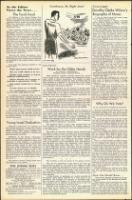

`Gentlemen, My Right Arm!'
As the Editor
Views the News ...
'Prince of Egypt'
Dorothy Clarke Wilson's
Biography of Moses
The Torch Fund
In addition to the Jewish Welfare Fed-
eration, five important Detroit Jewish agen-
cies are included in the Torch Fund of Met-
ropolitan Detroit : Fresh Air Camp, Hebrew
Free Loan Association, Jewish Community
Center, Jewish Social Service Bureau and
North End Clinic.
"I told you that Yahweh had created man,
not the Hebrews, in his likeness."
It is Moses speaking to Miriam, in Dorothy
Clarke Wilson's • "Prince of Egypt," published
this week by the Westminster Press, (Wither-.
spoon Bldg., Philadelphia 7).
The author of "The Herdsman," an outstand-
ing novel that dealt with the Prophet Amos, has
reached new heights with her new novel about
the great Hebrew Lawgiver. She describes Moses
as a human being, involves him in several love
affairs—one with the Princess Nefretiri—and
makes use of the novelist's license to deviate
from some Bibical facts in relating her story.
One Of her deviations is to refer to a feast of
Pesach being observed before the Hebrews' exo-
dus from Egypt.
Her own explanation of her approach to the
subject of Moses is valuable: "I would not pre-
sume even to attempt to do justice to the per-
sonality of' Moses. If I have divested him of
some ancient mustiness and legend and . made
him a bit more real for a generation that has .
barely begun to apply 'his simplest axioms to
their human relationships, I shall have more
than achieved my purpose." Indeed, in this re-
gard she has reached her goal.
Dorothy Clarke Wilson's biography of Moses is
not of the Lawgiver but of the product of Egypt.
It is not like the biographies of Moses by Louis ,
Unteririyer or Edmond Fleg. It is exactly what
the title purports it to be: it deals with
prince of Egypt. It is the story of a boy .who
could have been king, who was offered the
throne of Pharaoh, but tossed it away because.
he was moved by the sufferings of the slaves,
and thought:
• These agencies provide basic needs for
Detroit Jewry. The tradition of Gemilath
Chassodim—extension of loans to needy peo-
ple without interest—is assured through the
Hebrew Free Loan Association. The Center's •
educational and recreational activities are
too well known to call for review. The North
End Clinic provides facilities to protect the
health of many who depend upon the com-
munity for assistance. The Jewish Social
Service Bureau is the chief Jewish relief
agency in Detroit. At Fresh Air Camp, hun-
dreds of boys and girls are afforded an op-
portunity for wholesome summer vacations
under proper supervision.
Through the United Foundation—func-
tioning as the Torch Fund-125 Community
Chest agencies and 14 health service agencies
are financed by the single unified communi-
ty effort.
Last year, the agencies included in the
united fund—
Helped approximately 50,000 families;
Had over 11,000 children in its care;
Handled health problems of between
65,000 and 70,000 Detroiters;
. Offered education and recreation op-
portunities to approximately 170,000;
Made possible 150,000 calls by Visiting
Nurses;
Provided clinical care for 200,000;
Gave hospitalization to over 80,000 at
low fees they could afford to pay.
In - addition to rendering these services,
the United Foundation, formerly known as
the Community Chest, cements friendships
among all faiths. Catholics, Protestants and
Jews are united for community social serv-
ice efforts through this medium. It is per-
haps the best way of joining all elements in
the community for cooperative effort.
The Torch Fund has earned the loyalty
of all Detroiters and it is of the utmost im-
portance that its 1949 campaign should be
a complete success. We urge the community
to respond liberally to this important com-
munity-wide cause.
Young Israel Dedication
Impressive ceremonies are planned for
this Sunday afternoon, to mark the official
opening and dedication of the Young Israel
Youth Center. This modern building will
house an extensive program of recreational
and educational activities.
Residents of the Dexter community,
which the new center will serve, are fortu-
nate in having made available to them, and
primarily to their children, an institution
where they may find recreation, replete with
Jewish content, suited to their own age
levels. For, while Young Israel's program is
designed, for the most part, for those who
adhere to Orthodox Judaism, most of its
activities are open to all. Among those which
are of interest to the community at large is
the Adult Institute of Jewish Studies which
will be opened for the second year on Tues-
day, Nov. 8.
We felicitate Detroit Young Israel upon
this milestone in its career.
THE JEWISH NEWS
Member•. American Association of English-Jewish News-
papers, Michigan Press Association.
Services: Jewish Telegraphic Agency, Seven Arts Feature
Syndicate. King Features, Central Press Association, Paicor
News Agency.
Published every Friday by The Jewish News Publishing
Co. 708 - 10 David Stott Bldg., 'Detroit 26, Mich., WO. 5 - 1155.
Subscription $3 a year; foreign $4.
Entered as second class matter Aug. 6, 1942 at Post Office,
Detroit., • Mich.. under Act of Matx., b 3. 1879.
PHILIP SLOMOV1TZ. Editor
SIDNEY SHMARAK Advertising Manager
RUTH L. CASSEL, City Editor
VOL. XVI—No. 7
Page 4
October Z8, 1949
Sabbath Scriptural Selections
This Sabbath, the sixth day of Heshvan, 5710,
the following Scriptural selections will be read
during morning services:
Pentateuchal portion—Gen. 6:9-11:32.
Prophetical portion—Is. 54:1-55:5.
.
■
■
4400. '11.1.11.041 4 AtarIllt
Guest Editorial
Work for the Older Hands
"How can I lie here—safe—when they're.
down there—lashed and driven—not like cat-
tle—cattle are sacred—ran away and left my
brothers—ran away .. ."
By SAMUEL S. GREENBERG
President, Jewish Vocational Service
With industry's negative attitude toward the worker
over 45 years of age, older workers find themselves increas-
ingly unable to secure employment. The number of quali-
fied workers available exceeds the hires. Providing jobs for
older workers is prominent in the attention of the Jewish
Vocational Service. This is a problem so vital that it must
have immediate community attention.
Then comes the awakening, the return to
Egypt from the desert, the beginning of the con-
stant grind of rousing the masses, of taking
them across the Red Sea, of fleeing from the
tormentors.
"PrinCe of Egypt" is a well written novel. It_
is a tribute to the sense of justice and the pas-.
sion for freedom which motivatad the life of
Moses. It deals with the Lawgiver as a human .
being and justifies the contention of the author
that she found a personality of towering pro-
portions, " a man who recognized the supreme.
value of the individual, who not only conceived
but enforced both a document' of human rights
and an emancipation proclamation over 3,000
years before Jefferson and Lincoln."
The JVS, organized for the purpose of giving expert
job placement, vocational guidance and aptitude testing serv-
ices, specializing in providing the particular needs of Jews
along these lines, is an agency whose work proceeds un-
heralded. From the viewpoint of economic adjustment for
many Jews, its service is significant.
To promote occupational adjustment, JVS is involved
in an effort to improve the economic adjustment of older
Jewish workers, both native as well as emigrees. The older
person unemployed is a non-productive liability of the com-
munity. This liability can be removed and his talents, ex-
perience and maturity should be employed and utilized.
For the welfare of the community and in instances to
relieve the burden which the community bears by assistance
and charity, each employer should report to the agency
every job opening that develops. For the employers, the
agency gives the advantage of carefully interviewing job
seekers and selecting those who fit their requirements. The
agency, supported by the annual Allied Jewish Campaign,
charges no fees to employers or applicants.
The agency's effort to place older workers does not
mean to lessen the job opportunities for younger people. It
is an endeavor of obvious social value and personal security
to the older group.
The stress of war-time demands amply demonstrated
the ability of older workers to handle jobs that had usually
been barred to them or who had previously retired willingly
or otherwise from the labor market. The New York State
Legislative Committee on Problems of the Aging, reported
"that older workers, when compared with their juniors,
were as produCtive, more experienced, more conscientious,
less distracted and absent less frequently"—that "Experi-
ence, Loyalty, Skill—Come with Age." The U. S. Bureau
of Labor Statistics showed "that there was less turnover
in jobs among older persons, and suffered fewer industrial
casualities." Reports showed that "the family responsibilities
of mature persons made for greater stability—age did not
diminish efficiency except in jobs with heavy physical de-
mands—more enlightened employers preferred older work-
ers in jobs calling for experience, judgment, and qualitative
performance."
*
This problem is only one phase of the agency service.
Who are the job-seekers at the agency and what are
the sources_ referral ? The clients are young and old,
skilled and u nskilled, professionals, factory laborers, sales-
men, stock clerks, service wokers, as well as office workers.
The vast majority of job-seekers, come from the gen-
eral community, learning of the agency from persons who
have used its services or heard of it. Some are referred from
other agencies.
A large number of applicants are readily placeable by
the agency, being highly qualified for a wide range of op-
portunities. The refugees, for example, in surprising num-
bers can speak some English and though they have skills,
they usually start in unskilled categories because they are
not immediately convertible to American jobs.
Whatever their background or level of skill, applicants
are referred by the agency only to those opportunities for
which they appear qualified. Employers should be fully
aware of the agency as a source of all types of employees,
and of the advantages of using the agency's careful screen-
ing and evaluation procedures.
Why Do We Vote?
By DR. MAEANNA CHESERTON MANGLE
-
-
As we go to the polls this month, there is no
Presidential contest under way. Much of the
excitement and fanfare of a year ago is missing;
but nevertheless, Americans who cherish democ-
racy will turn out in large numbers on Election
Day.
In casting our votes we do more than essert
the right to select the men who represent us. We
also protect our right to speak without fear; to
print the truth without censorship; to meet with
our neighbors and work together for the com-
mon good. Above all, we insure the right to go
to the house of prayer of our, choice and worship
God as we see fit.
Political freedom and religious freedom go
hand in hand. Religion always is the first casu-
alty in - a tyrant's attack. Religious persecution is
his first weapon. From Nero to Hitler,' every
dictator, bent on usurping the political rights
of the people, trampled their religious freedom
first.
Ours is a nation founded on religious liberty.
We don't often stop to value the rare privileges
of our tradition, until events in other lands
shockingly bring the realization to us. History is
a living thing. Freedoms won must be actively
guarded. Today, more than ever before, eternal
vigilance remains the price of liberty.
Election Day is Freedom Day. Our votes tell
the men and women, whom we elevate to office,
that they are authorized to speak in our name;
but—that we will be watching to see how they
fulfill this duty. If they prove themselves cham-
pions of human rights; if they- advance the wel-
fare of all their constituents, regardless of race,
creed or ancestory; if they rise above party
factionalism and partisan interests—they may
look forward to - long and honorable careers in
public service. Otherwise, their tenure in office
will be short-lived.
Whatever the party we endorse on this Elec-
tion Day, whomever the man we elect, every
vote is a vote for freedom. Let us be SURE to
vote!
Facts You Should Know . . .
.
What do the collection of letters at the hot-
torn of the outside of the Mezuzah parchment
represent?
These forgotten letters sometimes read "Kozo:
Bemoksaz Kozo," which some people are in the
habit of reciting as they leave or enter the
house. They are sometimes explained by the
fact that the letters are those that follow the
letters which would spell. "Jehovah, Elokaynoo,
JehoVah" meaning "God, our God, God," a syin--
bolic way of writing God's name. and -at the same
time indicating that we accept him as (.`our