

Bible and Literature Are UHS Study Basis
By BERNARD ISAACS
The curriculum of the United Hebrew Schools is divided
into three departments : Elementary, secondary or high
school, and the Midrasha (College of Jewish Studies). The
Midrasha curriculum is discussed below. I shall confine my
remarks to the elementary and high school departments.
The elementary school consists of a five-year course of
study and the high school of three years. The 'elementary course
emphasizes the elements of reading, that is, the proper reading of
the prayerbook. Stress is laid not only upon correct reading, but
also on the interpretation and understanding of the prayers.
Study of the Hebrew language not only creates a bond be-
tween the child and his people and serves as a key to their spirit-
ual values, but also connects the child with the state of Israel,
with conversational Hebrew in Israel, and the modern Hebrew
literature.
When the pupil has learned the rudiments of the Hebrew
language, he follows a carefully outlined program of study of
Chumosh and the early prophets.
Jewish history is taught ;in two cycles. In the first, 'the child
becomes acquainted with the
On satisfactory completion of
heroes of our people who occupy
key positions in our history. In this elementary course, • the
the second cycle, history is pupils are admitted to the three
taught in an organized chrono- year high school course. The
logical manner. The schools aim main subjects of the high school
to impart • to the • children a are : Chumosh with Commenta-
knowledge of the past of our tor Rashi; selections of the ma-
people, not only for its cultural jor prophets; the Psalms; He-
and informative Values, but also brew grammar; Hebrew litera-
to aid them in the proper un- ture; Israel; history and Mishna.
derstanding and evaluation of The - high school students, too,
the events of present day Jewish participate in . co-curricular ac-
tivities, but in addition to the
life.
above-mentioned clubs, they are
Customs and Ceremonies
Jewish custom's and cere- also organizedin Hebrew speak-
monies are rich, beautiful and ing groups, where they practice
meaningful. It is therefore very conversational Hebrew.
Conversational Hebrew
important for every child to be
In this connection, I feel it is
fully "acquainted with 'them, with
their origin, an the manner in in place to point out a certain
which- they are observed, par- error in the conception of the
ticularly in connection with the term "conversational Hebrew."
It happens very often that a
holidays and festivals.
each branch of the United patent who is conscious of the
Hebrew Schools, there is one revival of the Hebrew language,
teacher who devotes all his time requests that his child be taught
to the preparation of boys for "conversational Hebrew." When
Bar Mitzvah,. which includes the he is told that we teach Chu-
proper chanting of the Haftorah4 mosh, the prophets, literature,
and everything pertaining to the he feels that this is not exactly
what he is seeking.
Bar Mitzvah ceremony.
The same situation obtains
Co,curriculum activities in-
clude junior •congregation, which when an adult, who wishes to
is conducted each Saturday go to Israel, expresses a desire
morning in ,the auditoriums of to join an adult class for "con-
the several schools by the pupils versational Hebrew." When he
under supervision of instructors. finds out that the course in-
Every Sunday morning the chil- cludes Tanach and Literature,
dren gather in . the assembly he is rather disappointed. That
rooms of the schools, where they reminds me of the little boy who
conduct _morning services. Then wants his supper, but he refuses
they go to their respective eggs, butter, meat, etc.
Even now, with the accelerat-
classes for their lessons. Imme-
diately after the lessons, those ed development of the Hebrew
who are interested ,participate language, the Bible and the He-
in the club program. The clubs brew classics still • constitute
include: Arts and crafts, dra- more than 80 per cent of the
matics, choir, dancing, and cha- vocabulary of the modern He-
zonim.,
brew • language. Without the
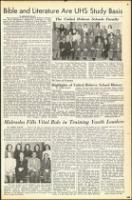
The United Hebrew Schools Faculty
•
■
•
•
•
g
The faculty of the United Hebrew schools:
First row, left to right: Israel Elpern, Joel
Chasdan, Alex Roberg, Michael Michlin,
Bernard Isaacs, Albert Elazar, Morris Lach-
over, Norman Ruttenberg, Morris Nobel, A.
J. Lachover. Middle row, left to right: Sholem
Levitt, Rae Wenner, Clara Kimel, Leah Mich-
lin, Abraham Schacter, Beatrice Kriechman,
Sylvia Albert, Solomon Kasdan, Sarah Selesny,
Philip Caplan. Third row, left to right: Drora
Kleinplatz, Morris Plafkin, Deborah Dworkin,
Yehuda. Goldandky, Ilsa- Roberg, Abraham
Panush, Ray Goodman, Meyer Mathis, Yaffa
Epstein. Members of the staff who do not
appear in the picture: Ruth Chanin, Nettie
Elazar, Max Gordon, Leon Gura, Hadassah Is-
bee, Leah Koven, Blossom Neuschatz, Leah
Pike, Rose Pike, Helen Radin, Irving Schlussel,
Naomi Schlyfestone, Aaron Toback,. Naomi
Tukel, Abe Zentman.
30 Years of Progress
Highlights of United Hebrew School History
By RUBEN ISAACS
April 23, 1919
The Talmud Torah and kinder-
garten which constituted the
first unit of the United Hebrew
SchoolS Of Detroit, was formally
dedicated • April 23, 1919. It was
located at Wilkins and Hasting
study of the above 'mentioned
subjects, one may "pick up" a
few sentences, several phrases,
but this is not the manner in
which one can acquire a lan-
guage.
The Chumosh, the prophets
and • classic Hebrew literature
constitute the backbone of the
studies in the United Hebrew
Schools.
•
• •
Streets, then the most thickly
populated Jewish neighborhood.
Classes began with an enroll-
ment of 675 pupils and a staff
of 10 instructors, headed by Ber-
nard Isaac's.
First officers of the .UHS read
like a roster of leaders of the
Detroit Jewish community. Esser
Rabinowitz was the first presi-
dent, holding that office for 10
years. Other officers were Meyer
B. Cohen, Louis Dann, Louis Dus-
aoff, Max Jacobs, Michael Krell
David Robinson and Isaac Rosen-
thal; with Max Rosinsky as
treasurer and Abraham H. Jaf-
fin, secretary. The board, of edu-
cation included such pioneer
leaders as Rabbi Ezekiel Aishish-
* • •
kin, Abraham ' Farber, Hyman
Goldman, Israel Lieberman, Har-
ry Sosensky and Moses Weis-
wasser.
May 1, 1919
Sabbath morning services in-
augurated for the youth of the
community, a forerunner of such
services now flourishing through-
out the community.
1920
Name "United Hebrew Schools
of Detroit" was formally adopted.
Merger of Wilkins and the Divi-
sion Street Talmud Torahs took
place, with Division School lead-
ers actively participationg in He-
brew Education: William Saul-
son, Jacob Friedberg, Harris
Continued on Page 18
* • S
Midrasha Fills Vital Role in Training Youth Leaders
By ALBERT ELAZAR
A long cherished dream of the
United Hebrew • schools and of
the Jewish Community at large
has been realized with the es-
tablfshment of the Midrasha,
the College of Jewish Studies.
Although the Midrasha • was
established less than a year ago,
It has proven beyond any doubt
that it will play an important
role in the training of teachers
for our schools and leaders and
supervisors for Jewish club work
and also will help improve the
methods and techniques of our
teachers in service. The Mid-
rasha will not only conduct spe-
cial seminars for the teachers
in service and for young men
and women who wish to prepare
for the Jewish profession as a
vocation, but will also provide
varied opportunities for those
who so desire to pursue organ-
ized study in the history, lan-
guage, literature, art and reli-
gion of the -Jewish -people.
The Midrasha is composed of
three departments: The Teach-
ers' Training Department, the
Advanced Studies Department,
and the General Jewish Studies
Department for those who wish
to obtain an understanding and
appreciation of Jewish life.-
EleVen young men and women
enrolled in our Teachers' Train-
ing and Advanced Studies De-
partment, which is open only to
those who graduated from a He-
brew High School of recognized
standing and also 'hold • a cer-
tificate of graduation from a
secular high school. A minimum
of six hours per week of class-
room study and four hours for
preparation are required.
Sixty students enrolled in the
department of General Jewish
Studies.
In conjunction with the
Young Adult Council a. De-
-troit, a special class in Jewish
philosophy was offered.
Although it had not been our
intention to offer courses for
leadership training, the need
was so great that this also was
added to our course of study,
Full-time students at the Midrasha, last year, included
in conjunction with the Zion-
(left to right, seated) LEVI I. GURA, DAVID - RAPPOPORT, ist Youth CommisSion, and in
SHALOM D. LEVIT, YEHUDA GOLANDSKY; (left to right, cooperation with the -Jewish
standing) ANN B. STOLLMEN, EVELYN STOLLMAN, Community Center.
LEAH D. MICHLI'N, RAE G. WENNER, 'SARAH SELESNY.
In addition to formal class
Members of the Midrashi, whose pictures do not appear: Nina study, the Midrasha aimed to
create a Jewish milieu for the
Rose, S. Isaak, Sol Plafkin.
student and also provide an op-
portunity for creative work and
self-expression!. Classes in Jew-
ish art and music were offered
which provided the teacher in
training with techniques f o r
classroom instruction in these
subjects and for the general
student an understanding of
Jewish expression through the
arts. Teachers in service availed
themselves of the opportunity
to acquire the latest techniques
in introducing arts and crafts
and music in their respective
classes.
The students of the Midrasha
also sponsored a Melaveh Malkeh
which helped not only to bring
out the comradery of the student
body but also afforded them an
opportunity to spend an evening
in a cultural .and social atmos-
phere that they themselves
created. When one takes stock
of the past he does so in order to
plan for the future. So it is with
us. The experience of the past
year has served as a blue print
for the future.
The UHS, being the recog-
nized educational arm of the
Jewish community, serves the
entire community. It is in this
spirit that the Midrasha, too,
was established—that it might
serve the Jewish community
in the field of higher educa-
tion. In addition to training
teachers for 'the Hebrew
schools, the Midrasha this
year will include courses for
the training of personnel for
the Yiddish schools. Repre-
sentatives of the Yiddish
schools have been invited to
serve on our board and help
.
formulate and carry out such
plans.
With the introduction of co-
curricular activities into our
school program, such as arts
and crafts, dramatics, music, '
etc., it is imperative that our
teachers should be trained to
conduct and supervise such in-
formal activities. As this type
of training is also required for
club leaderShip and Center work,
vve have invited representatives •
of the Jewish Community Cen-
ter to sit in on the Midrasha •
Board.
In expanding its program, the
Midrasha is also planning to as-
sist various organizations in
their educational program by
providing them with formal
classes for instruction, in plan-
ning seminars and by placing
at their disposal the personnel
and materials of the Midrasha.,
The experience of last year
has given us reason to feel
that the Midrasha has a de-
cided place in the community
and that it can and must
develop into an institution
through which Jewish youth
will not only acquire knowl-
edge but also make a contri-
bution to Jewish learning and
scholarship.
With the destruction of Jewish
life in Europe, we, in America,
must develop our own resources.
Israel . undoubtedly will stimu-
late us culturally but this stim-.
uation will not be effective until
we become More receptive to:
"Torah from Zion."
THE JEWISH NEWS-15
Friday, October 14, 1949
•