

•
As the Editor
Views the News . . .
".-41 11101111111v
Un-American
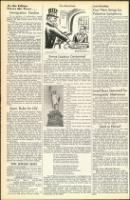
\ In an analysis of immigration trends
among displaced persons, in a report from
Munich, Dr. Max Lerner writes in the New
York Post:
"I want to report a trend which amounts
to a new phase in DP thinking. The great
push to go to Israel is over. Many of those
who had wanted to go have changed their
minds. They have had letters from Israel
saying that life is hard, jobs are not easy to
get, housing conditions bad."
Meanwhile the JTA brought this report
from Haifa:
A total of 1,500 .Jewish immigrants arrived
July '7 aboard the transport Atzmaut.
Last month, 16,373 immigrants entered
Israel as compared with 23,500 in May, 23,275
in April and 30,720 in March. June was the
first month since October that the number of
new immigrants fell below the 20,000 figure.
In discussing this decline, government officials
emphasized that the Israeli Immigration Min-
istry has not issued any orders restricting
immigration.
The average number of immigrants enter-
ing Israel monthly during the second half of
this year will be at least 10,000 less than the
average for the first half; according to official
predictions. The total number of immigrants
who have come since the establishment of the
state is 243,000. Of these, 141,000 arrived dur-
ing the first six months of this year.
In spite of these indications of an im-
pending decline in immigration to Israel,
Premier - David Ben-Gurion asserted last
week that Israel is preparing to welcome
750,000 new settlers in the next four years
and that 500 colonies will be established
for them.
Thus, the Israeli spirit is unbroken, but
the hardships which inevitably arose as a
result of large-scale immigration are fright-
ening away some prospective settlers.
What does this prove ? Only one thing:
that Israel is sound but that Jewish com-
munities have fallen down on the job and
have caused greater crisis for the Jewish
state by failing to provide the large sums
that are needed for the building of the
Jewish state. The United Jewish Appeal is
raising less money this year than in 1948,
but for every dollar subscribed in 1948
Israel needs 10 in 1949. Is it any wonder
that there is unemployment and a shortage
of housing ? Will Jewish communities make
good the deficiencies ? We owe a responsi-
bility to Israel and we must not fail in our
duties.
444.
;417.,o...444
Wer4be
Emma Lazarus Centennial
Today—July 22—marks the one-hundredth anniversary
of the birth of one of the great women in American history
— Emina Lazarus. Her name has become synonymous with
the American quest for freedom. Her sonnet, "The New
Colossus," which is engraved on the Statue of Liberty on
Bedloe Island in New York harbor, has made her famous
throughout the world. Her passionate works in defense of
Jewish rights have earned for her the title "Poet Laureate
for the Jews."
It is possible that no written work, save perhaps the
Bible, has had as many readers as her "New Colossus,"
which is read annually by millions of visitors to The Statue
of Liberty. On the occasion of the 100th anniversary of her
birth, we know of no better tribute than to reprint this
famous poem:
Zaim: 'Ruler for Life'
New York Times correspondent Albion
Ross reports from Beirut, Lebanon : "The
great question in Syria today, it is learned
from Damascus, is the extent to which pro-
posals of the newspapers Al Nasa and Al
Inkilas that Marshal Husni Zaim be made
President for life are officially inspired."
Little, if any, additional comment is nec-
essary on this item. If there were any who
doubted that Arabic countries are ruled by
feudalists, they now have proof of the power
of dictatorship in these lands. When pro-
posals for the creation of "rulers for life"
come from newspapers, proof is all the
stronger that the oppressed masses are be-
ing_ further crushed under the heels of ty-
rants. It is no wonder that Arab "leaders"
are so adamant in their opposition to liber-
tarian Israel.
While Zaim, contrary to the practices of
previous Syrian cabinets, has arranged for
an armistice with Israel, it has been pointed
out that the price for temporary peace with
Israel is being paid by Zaim in order to se-
cure the good will of the United States, and
some foreign observers warn that the con-
ciliatory attitude will last until the new
dictatorship is firmly established. It is clear
that Israel and other liberty-loving people
will have to be on guard for a long time
against the menance of the Zaim regime.
THE JEWISH NEWS
Member: American Association of English-Jewish News-
papers, Michigan Press Association.
Services: Jewish Telegraphic Agency, Seven Arts Feature
Syndicate, King Features, Central Press Association, Palcor
News Agency.
Published every Friday by The Jewish News Publishing
Co.. 2114 Penobscot Bldg., Detroit 26, Mich., WO. 5-1155.
Subscription $3 a year; foreign $4.
Entered as second class matter Aug. 6, 1942 at Post Office,
Detroit, Mich., under Act of March 3, 1879.
PHILIP SLOMOVITZ, Editor
SIDNEY SHMARAK, Advertising Manager
VOL. XV—No. 19
Page 4
July 22, 1949
Ala
Sabbath Scriptural Selections
This Sabbath, the twenty-sixth day of Tam-
muz, 5709, the following Scriptural selections
will be read in our synagogues:
Pentateuchal portion—Nunn. 30:2-36:13.
Prophetical portion—Jer. 2:4-28;8:4.
On Wednesday, Rosh Hodesh Ab, Num. 28:
1-15 will be read during morning services.
Israel Recordings
Four New Songs by
Palestine Symphony
Immigration Decline
•
■
7wwwwwwwilloprigl iiiiMPIWIRIPIIWWW"v
-
Not like the brazen giant of Greek
fame,
With conquering limbs astride from
land to land;
Here at our sea-washed, sunset gates
shall stand
A mighty woman with a torch, whose
flame
the imprisoned lightning, and her
name
Mother of Exiles. From her beacon
hand
Glows world-wide welcome; her mild
eyes command
The air-bridged harbor that twin
cities frame.
"Keep, ancient lands, your storied
pomp!" cries she
With silent lips, "Give me your tired,
your poor,
Your huddled masses yearning to
breathe free,
The wretched refuse of your teeming
shore.
Send these, the homeless, tempest-tost
to- me.
I lift my lamp beside the golden
door!
Emma Lazarus _began to write poetry as a child—
she was only 38 when she died on Nov. 19, 1887—and she
was not too keenly Jewish until the last decade of her life.
The pogroms in Russia, the need for securing succor for her
less fortunate kinsmen, caused her to abandon her concep-
tions of philosophical anarchism and to become a passionate
advocate of Jewish nationalism and of the cause of a re-
deemed Zion. Long before Theodor Herzl she propagated
the Zionist cause. She endorsed the proposals of Lawrence
Oliphant, the famous Christian Zionist, for the redemption
of the Land of Israel.
The noted Jewish Poet Laureate distinguished herself
as a leader in relief movements and as a champion of the
needs of the oppressed. Among her famous poetic appeals
for justice to the Jews is her poem "The Banner of the Jew":
Oh, for Jerusalem's trumpet now,
To blow a blast of shattering power,
To wake the sleepers high and low,
And rouse them to the urgent hour;
No hand for vengeance, but to save,
A million naked swords should wave.
Oh, deem not dead that martial fire,
Say not the mystic flame is spent!
With Moses' law and David's lyre,
Your ancient strength remains unbent.
Let but an Ezra rise anew,
To lift the banner of the Jew!
One of Emma Lazarus' famous essays, "An Epistle to the
Hebrews," pointed out that "antipathy to manual labor is one
of the great social diseases of our age and country", and
resulted in the establishment of the Hebrew Technical In-
stitute in New York for the training of Jewish youth in
productive pursuits.
Emma Lazarus was more than a great poet: she was a
passionate social reformer and a creator of new ideals for
Jewish national rebirth. Her contributions to Israel are
written indelibly in Jewish history. It is proper that Jews
everywhere should pay honor to her memory on the 100th
anniversary of her birth.
The latest Israel Music Foundation Records
produced by Israel Folk Music Orchestra, con-
ducted by Marc Lavry, are:
Hatikvah by Imber, Tel Aviv Opera Choir and
Tel Aviv Workers Chorus, Regina Chomska, so--
prano, playing time: 2:52; Halleluyah, by Han-.
del, Tel Aviv Workers Chorus, Israel Brandman,.
director. sung in Hebrew, playing time: 4:14; No.
107. E. Lucevan le Stelle from "La Tosca" (Puc-
cini), sung in Hebrew, Abraham Vilkorirsky, tenor,:
playing time, 2:30; Vissi d'Arte Vissi d'Amore
from "La Tosca," sung in Hebrew, Yosefa Shock-
en, soprano, playing time: 3:19.
Hatikvah has been the Hebrew anthem for
approximately 60 years. Written as a poem by
Napthali Hertz Imber in 1878, it struck a chord
of hope for those who looked forward to the
establishment of a Jewish State in Palestine.
Set to music by Samuel Cohen several years
later, the song came to be sung by Zionists
throughout the world.
Handel's immortal liturgical work is sung in
Hebrew for the first time in history. The 60-
piece orchestra, under the leadership of Marc
Lavry, gives a stirring and inspiring rendition
of this selection from the great "Messiah" ora-
torio by one of the world's greatest composers.
The son of a cantor and a graduate of con-
servatories in Leipzig and Paris, Mr. Vilkomir-
sky, "La Tosca" soloist, is one of file most
successful tenors in the new state of Israel. He
continued his studies in Palestine with the well-
known opera singer Herman Yadlovker and sub-
sequently served as chief tenor of the Palestine
Broadcasting Station. Although only 26, he is
the leading tenor of the Palestine National
Opera.
Miss Shocken sings a delightful aria from
the opera "La Tosca," in which she has per-
formed many times since 1941 as the prima
donna of the Palestine Opera. A native of Ger-
many, she studied music and dramatic art with
Hermin Bosetti and Lothar Wallenstein. When
Hitler rose -to power il* 1933 she came to Pales-
tine, where she made a highly successful debut
at the opening of the world "Maccabiya" in Tel
Aviv. She then joined the Tel Aviv Opera Com-
pany and has appeared in roles in "Tosca,"
"Cavalleria Rusticana," `Prince Igor," "The Bar-
tered Bride," and others.
Israel Buys Seaweed for
Immigrants Mattresses
Some 400 tons of seaweed have been im-
ported from Algiers to be used in the prodtic-
tion of sorely needed mattresses for immigrantS •
in Israel's transit centers.
This item was included in a broad variety
of transit camp equipment purchased with the •
aid of funds raised in this country to meet im- •
migrants' needs in the jam-packed camps.
Reflecting the astronomical immigration
figures, the purchases also included 12,400 tents,
41,300 wooden beds, 600 tons of iron—for beds
to be manufactured in Israel-105,000 blankets,
92,000 metres of material for mattresses, and
20,000 pillowcases.
Apart from cash and living quarters, Judge,1
Morris Rothenberg, UPA chairman, said, each im.4.
migrant receives for his most immediate needs
$18 worth of equipment, comprising a bed, mat-
tress, blanket and two sheets.
Saint or Horse?
A young man once came to a great rabbi
and asked him to make him a rabbi. .
It was winter time then. The rabbi stood at
the window looking out upon the yard while the
rabbinical candidate was droning into his ears
a glowing account of his piety and learning.
The young man said, "You see, Rabbi, I al-
ways go dressed in spotless white, like the sages .
of old. I never drink any alcoholic beverages;
only water ever passes my lips. Also, I perforrri
austerities. I have sharp-edged nails inside my
shoes to mortify me. Even in the coldest wea-
ther, I lie naked in the snow to torment my
flesh. Also daily, the shammes gives me forty
lashes on my bare back to complete my per-
petual penance."
As the young man spoke, a white horse was
led into the yard and to the water trough. It
drank, and then it rolled in the snow, as horses
sometimes do.
"Just look!" cried the rabbi. "That animal,
too, is dressed in white. It also drinks nothing
but water, has nails in its shoes and rolls naked
in the snow. Also, rest assured, it gets its daily
ration of forty lashes on the rump from its
master. Now I ask you, is it a saint, or is it a
horse?"
yr
Facts You Should Know . .
Where does the river Jordan get its name?
There seem to be two opinions about the
origin of the name "Jordan" and even these two
can be fused into one. It seems to be a point of
universal agreement among scholars that the
name "Jordan" contains the Hebrew root "yorod"
which means "to descend." The fact that the
Jordan is a rapid stream which has a fall of
three thousand feet from its source to its mouth
could very well have been the reason for the name
"Jordan." According to the Talmud, "Jordan" is
made up of two Hebrew words "yorod" and
"Dan." The first means to descend and the sec-
ond is a well-known Biblical city, from where
the Jordan originates. The name would thus
mean "the river which descends from the city of
Dan."