

Purely Commentary
By PHILIP SLOMOVITZ
Penetrating Study of Realities of American-Palestine Relations
Dr. Frank E. Manuel's "The Realities of American-Palestine
HelatiOns: A Penetrating Study Throwing New Light on Recent
U. S. Policies—Based Upon Official Records Hitherto Held Con-
fidential," which Public Affairs Press (2153 Florida Ave., Wash-
ington 8, D. C.) Will publish on July 31, takes its place side by
side with Dr. Chaim Weizmann's "Trial and Error" among the
very great books on the question of Zionism. It is the kind of
history, resulting • from very able research, which can not be
reviewed in one article. Every. chapter of this book calls for
special comment and individual review. That's how good this
book is. Therefore, your Commentator undertakes to write this
introductory article prior to publication date of the book.
The author, a native Bostonian who now resides in Washing-
ton, D. C., made 'use of hitherto restricted official sources of the
State Department and the. National Archives and had access to
first-hand information concerning Zionism in the writing of his
book. Recently named associate professor at Brandeis University,
Worcester, MasS., his earlier activities included lecturing at Har-
vard and an associate professorship at Western Reserve Univer-
sity. His varied career as historian also included work as an Army
military intelligence officer, regional executive of the Federal
Writers' Program and director of the program division of. Rent
Department of OPA. More recently he served as executive secre-
tary of a commission which made a survey of housing and related
problems in Israel.
It is well that these biographical facts should be known, for
an understanding of the background of the man who has been
able to include enough wealth of information in less than 400
pages of text to stagger the reader. He has made history read like
a novel.
Theodor Herzl and Oscar Straus—and the Weizmann View
.
Dr. Manuel enlightens his readers on many aspects of the
Palestinian question as it affected American relations with the
Porte, Jews and Zionism. His factual story of the Consular ac-:
tivities in Jerusalem in the last century read like fables. Many
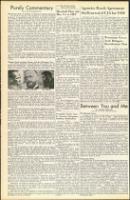
DR. WEIZMANN
OSCAR STRAUS
DR. HERZL
of these details will be reviewed in later issues. At the moment,
this Commentator would like to refer primarily to Prof. Manuel's
account of the activities of the late Oscar Straus and his inter-
view with_ Dr. Theodor Herzl. The reason for the choice of this
incident as the first to be dealt with, as a comment on Dr.
Manuel s book, is the recent criticism that was leveled at Dr.
Weizmann for his treatment of Theodor Herzl in his autobiogra-
phy. Dr, Weizrnann's contention that Herzl was not concerned
with JeWish immigration but that he was a visionary, whose fore-
most aim was to secure the Charter, is fully substantiated in the
Manuel book.
The late Oscar Straus, who was American Minister to Turkey,
is spoken of in most laudatory terms by Dr. Manuel. The Straus-
Herzl meeting is described in a section of his book under the
heading "Herzl and the Minister: An Encounter." His compara-
tive portraits of the two eminent Jewish leaders are drawn as
a result of studies of the diaries of. both men. While Straus took
the position that as an American official accredited to the Sultan
he had no opinion on Herzl's movement, we learn the following
from Dr. Manuel: --
As the conversation with Herzl progressed, Straus was drawn into the
'
cauldron of the Jewish Question and could not refrain from expressing his opin-
ions as a Jew. He considered it unfortunate that so many poor Jews should crowd
into Palestine when there was already dire poverty and no work in the land. 'I
had advised officially against further immigration,' was his frank statement. Far
from disagreeing with Straus, Herz] maintained that he too was exerting himself
to prevent immigration until the rights • of a Chartered Company had been obtained
from the Sultan."
Here we have the crux of the issue that pitted Weizmann
against Herzl in the latter's lifetime and perpetuated animosity
based on principle. While Weizmann's autobiography gives full
credit to the magic of Herzl's name and the genius with which
the founder of the political Zionist movement inspired the Jewish
masses to follow him into his movement, Israel's President's con-
tention is that the only way to build Israel was brick on brick,
through immigration, by creating new settlements and by
strengthening the Yishuv. For Herzl it was only a matter of
securing the Charter. Here is how Dr. Manuel describes the
Herzlian view:
This was the cornerstone of Herzl's political edifice—violent oposition to
any slow, illegal infiltration into the land.
The 'seepage of Jews into Palestine
Herzl's
only led to hostility and ultimately to the enactment of exclusion laws.
State was to emerge full-grown within a few years through a gigantic effort of world
Jewry. In his grand design, the State would arise• powerful from birth and in a
brief period neighboring states would so benefit from its creation that they would
give it their support . . . After 1897 a group of Russian Jews led by Ahad Ha'am
refused to accept the Herzlian thesis that their slow plodding efforts should be
abruptly suspended while their 'diplomatist' roamed the world negotiating with
potentates in secret." .
As an Ahad Ha'amist, Weizmann natural was an anti-Herzlist.
The Herzlian plan was to lend the Turks several million pounds
in exchange for rights for Jews in Palestine. The Jewish leader
counted on the support of rich Jews. Dr. Manuel writes the fol-
lowing interesting description of Herzl's activities:
"Herzl spent the last feverish years of his short life shuttling back and forth
between the Sultan and his entourage 4n Constantinople and Jewish bankers in
western Europe, now exaggerating to the Porte the ready availability of the money;
now assuring the Rpthschilds that the Charter from the Porte was about to be
granted if only the money were forthcoming. The two elements never coalesced.
Abdul Hamid always seemed to increase the tempo of his negotiations with Herzl
when seeking more favorable terms in a French refunding agreement. The perse-
(Wed Jews of eastern Europe hung with bated breath on the consummation of the
negotiations. and made Herzl a demi-God. Such is the course of man that in the
midst of these senseless negotiations in which Herzl was often enough the dupe, he
created an international movement, the embryo of a State."
This is part—only a small part—of a fascinating story in
which great Jewish leaders are the heroes. Herzl was wrong in
some things; he was right in his prediction—which was. belittled
by Straus—that Russia would help Zionism. The Russian Minister
Plehve actually endorsed the Herzlian scheme.,
" Weizmann the practical Zionist was right in asking. fOr the
laying of brick on brick for the Jewish State. But Herzl laid the
foundation for the State in his Vision. And a great American
Jew, Oscar Straus, played a significant role in negotiations with
the Sublime Porte in his day.
. The story as told. in "The 'Realties of American-Palestine Re-
lations" must be read in its entirety for a full understanding of
the great movement which began as a dream and which we are
privileged to see in its Reality,
2—THE JEWISH N EWS
Friday, July 22, 1949
Marshall Plan Aid
May Go to ORT
PARIS, (JTA) — The possi-
bility that . ORT programs con-
ducted In-certain areas may be
financed in part ; through the
Marshall Plan was revealed here
at'-the second postwar congress
of the World ORT Unioh. Dr.
David Ivovitch and Eliahif- Eli-
ashar were among the ORT
leaders who addressed the .par-
ley.
Thee more than 100 delegates
from 23 countries .attending the
parley, were urged to adopt a
five-p oint program providing
for:. 1. Increased fund-raising
in behalf of the ORT; 2. Ex-
panded efforts to secure govern--
mental and intergovernmental
subventions for the organiza-
tion; 3. Efforts which Would
bring about the inclusion of
ORT ,in countries receiving E.C.-
A. aid; 4. Transfer of heirless
property to local ORT branches;
and 5. Creation of a reconstruc-
tion fund.
Mr. Eliashar, a Sephardic
member of - the Knesset, re-
ported to the delegates on the
current situation of Jews in
Arab countries. He emphasized
the danger which would face
these Jews if fighting in the Pa-
lestine area were resumed. Most
Jews, who arrive in Israel 'from
North Africa and Middle East
areas must be given •extensive
training for life in the new
state.
Twenty-seven resolutions were
adopted at the concluding ses-
sion of the Congress. .A new
central committee comprising - 63
members was elected.
The resolutions provide for
intensification of the ORT's ac-
tivities in Israel, the Middle
East and North Africa and also
stipulate certain intra-orga.niza-
tional changes, including trans-
fer of the ORT's accounting 'of-
fices, now situated in New York,
to the world headquarters in
Geneva.
Dr. Aron Syngalowsky,
man of the ORT's executive
committee, emphasized in an .
address that Jews should not
abandon the two trades in which
they have excelled for genera-
tions — tailoring a n d cabinet
making.
Prejudice Factor Seen
In Toronto Synagogue
Building Difficulties
1TORONTO, (JTA) — Opposi-
tion to the building of a second
synagogue the suburban
township of YOrk was "expressed
by the: township's.council. York
township haS only one syna-
gogue for , a Jewish population
of 3,500.
The opposition is based on the
argument that "while the Jew-
ish citizens form foUr per cent
of the township's population,
they hold 20 per cent of the tax-
exempt property for religious
purposes." . -
(The Toronto Globe and Mail,
commenting editorially on this
situation, declared:
("Religion has indeed fallen
to a low estate • when a muni.
cipal council could seriously re-
fuse permission to a congrega-
tion to build a - synagogue be-
cause of the taxes it would lose
on the property . . . it is hard to
believe that racial and religious
prejudice have not had a hand
in the matter somewhere.
("It' is true that there are
already two other synagogues
in the same district and mem-
bers of York Township Council
suggested that another might be
too many. This is unquestion-
ably a point on which no secu-
lar body in this country has a
right to an opinion . . . Not so
long since, the fine flower of
this country's youth went to
war to defend-certain inviolable
freedoms, not least of which was
freedom to worship. It is not
within the right of York Town-
ship Council to limit that free-
dom in any way. .A residential
zoning by-law which prevents
the building of religious edifices
is surely an interference in the
rights of citizens of any faith to
worship how and where' they
would.")
Agencies Reac Agreement
On Renewal of IL JA for 1950
JERUSALEM (JTA) —Dr.
Israel Goldstein, treasurer of the
Jewish Agency, told a press con-
ference here that agreement has
already been reached between
the United Palestine Appeal and
the Joint - Distribution Comthit-
tee in the U.S. for renewal of
the Unithd Jewish Appeal for
1950, although the question of
the percentage distribution of
moneys collected by' the UJA ha _ s
not yet been discussed.
Dr. ,Goldstein predicted that
the 1949 UJA campaign will
raise 20 percent less than was
realized in the previous 'year.
He attributed this primarily to
"the *worsening general eco-
nomic situation in the United
States." The result of file 1949
drive, he said, would have been
poorer were it• not for Henry
Morg•nthau, Jr., general chair
man of the UJA, and a "group
of zealous workers around him."
_Special stimulation was given
to the campaign by President
Chaim Weizmann, Foreign Min-
ister Moshe Sharett, Labor Min-
ister Golda Myerson, and Chief
Rabbi Isaac Herzog during their
visits to the U.S., Dr. Goldstein
reported.
One of . the problems which
the UJA will face next year is
the increasing multiplicity of
fund-raising activities conducted
in the U.S. in the name of vari-
ous projects in Israel; • the Agency
official declared. Within a fort-
night, a conference will be held
in Israel to seek a solution to
this problem, he revealed. Par-
ticipating in the conference will
be representatives of the Israeli
Government, the Jewish Agency
and other interested groups' in
Israel and from abroad, he said.
"American Jews," Dr. Gal&
stein continued, "appreciate the
fact that Israel needs invest-
ment of private capital in addi-
tion to gift dollars. In my judg-
ment, there is a favorable pros-
pect for the- selling of Amidor
debentures in the United States."
He emphasized that American
technical skill and experience in
labor' and managenient are . of
less importance for Israel than.
American capital w h i c h, he
said, is available and should be
eagerly welcome. He stressed
that he is very optimistic about
the economic future of Israel,
if thiS consideration will be
borne in mind by those who
formulate the nation's policy.
Weizmann Favors
Arab Refugees
Resettlement Plan
In an , interview with Gene
Currivan of the New York Times
in Rehoveth, Israel, prior to his
departure for eye treatment in
Switzerland, Dr. Chaim Weiz-
inann, president of the Jewish
state, said-he was• in favor of re-
settlement of Arab refugees un-
der a comprehensive plan of
rehabilitation.
President Weizmann declared
that the Arab state must do
their full share in the job
through an all-around Middle
East development scheme, with
the United Nations, the Arab
states and Israel making their
respective contributions. He said'
Israel has accepted 25,000 Arab
refugees and has made arrange-
ments to reunite Arab families
separated during hostilities. He
praised President Truman Mr
showing "real concern" over
the plight of Jews in the tragic
days of Nazi persecutions.
Declaring that Israel would be
on guard against possible Arab
fifth columnists, he, expressed
regret that the Lausanne con-
ference failed to produce results :
on the Arab refugee question
and abhorred the suggestion2
that Arabs should be compen-1
sated for their aggression with.'
a part of the Negeb.
,
,
Between You a.nd Me
137. BORIS SMOLAR
(Copyright 1949, Jelvish Telegraphic Agency)
The Domestic Scene :
Leaders of the United Jewish APpeal are now searching for
pod candidate to head the UJA in 1950; . Henry Morgenthan,.
Jr., is determined not to take on. the UJA general 'chairmanship
for the Coming, year . . But there' is - optimism that the' right
person to succeed him will be found.
Now that Zionist leaders have announced that the United
Jewish Appeal, may this year raise' 20 per cent less than the total
raised last. year,. it - can be revealed that other Israel agencieS ap
pealing for funds in this country expect to raise $31,000,000 - during
the current. year . . Altogether 67 national • and overseas agen
cies outside the UJA are conducting separate drives to raise abdut
$0 ;000,000 in 1949 as compared with $45,000,000 expended last year
by these agencies. _
Don't look for. Sensations behind Morgenthau's and- Montor's
sudden resignations from Palestine Economic Corporatibn ..
The Corporation is going on with its plans to expand. its activities
and is attracting new capital for investments in Israel. . . The
Israeli presS attaches great importance to a new non-profit mem-
berShip corporation formed in the United States under the name
Of Industrial Inatitute of Israel, Inc ... Its members are said to
be well-known American Jewish industrialists and financiers in-
terested in making investments in Israeli industries • . ;But, little '
is known in thiS country about the existence 'of such an Instittite.
The Council of Jewish Federations and Welfare Funds has been
urged by the executive Committee of its West Central - Region to
explore current campaign plans for investments in Israel . .. The
executive committee, meeting in Chicago, urged the Council to
point up most effective relationship§ between social welfare and
investment needs in Israel.
Community Briefs:
Construction of Jewish community buildings, long delayed be-
cause of the war years, is now the talk of the day in many com-
munities in the U.S. and Canada ... The Jewish Community Coun-
cil in Los Angeles is beginning to explore capital fund needs of
several institutions . . . In Columbus, 0., construction will soon be
started on the $635,000 new Jewish Center . . In Detroit a new
building is now under ,construction ... It will be ready for occu-
pancy at the end of this year and will house the Dexter branch of
the Jewish Community Center and the Jewish War Veterans' Me-
morial Home . . . Cleveland's Mount Sinai Hospital is now con-
structing the second unit in its expansion plan . .. The Federa-
tion of Jewish Charities in Philadelphia completed plans for the
building of a new $1,000,000 home for the aged . . . Toronto's drive
for a new building for the Mount Sinai Hospital hag reached the
$3,000,000 mark and is going higher . . . Houston completed plans
for a Jewish Community Center building . . Youngstown, 0., is
similarly moving ahead with such plans and has already raised
most of the necessary funds . . . Hartford has conducted a drive
for its new Community Center and is proceeding with work on its
Mount Sinai Hospital . . . Montreal is constructing a new YM
and YWHA and is proceeding with its campaign fOr expanding
the building facilities of its Jewish General Hospital .. • Capital
fund campaigns for community center purposes are under way or
planned in Milwaukee, Paterson,.Trenton, Harrisburg, Camden and
Springfield, Mass.
•