

A Passover Treat:
Two Chapters of
Hitler's Rise Perils Jewry;
Palestine Partition Proposed
(Exclusive in Michigan)
Still out as president of the Zionist Organization,
Chaim Weizmann devoted himself to science in Pal-
estine, where he was about to establish his permanent
home. Arabs were restless at the moment, and there
was little peace in sight for Jews, for the persecu-
tions had started in Germany. Dr.Weizmann continues
his story.
By CHAIM WEIZMANN
►
First President of Israel
VII
Scientists and Others
The year 1933, the year of Hitler's advent to
power, marked the beginning . of the last frightful
phase" in the greatest catastrophe that has ever
befallen the Jewish people.
, When I accepted the chairmanship of the
Central Bureau for the Settlement of • German
Jews, I had no particular qualifications for the
work, But the need was so urgent, the human suf-
fering so great, and the men and women who
sought help so pathetic in the misfortune which
had come over them like a tidal wave, that there
could be no question of preparing oneself specifi-
cally for the job. One just did the best he could.
I felt it would be a great access of moral strength
and a valuable source of technical knowledge if we
could offer to the Hebrew University or to the Daniel
Sieff Research Institute, Albert Einstein the physicist,
James Franck of Goettingen; the mathematician Her-
mann Weyl, the physicist Placzek, the chemist Wieg-
ener, to mention but a few names. But somehow I
failed to convince them. Some of them found homes
in England, others in America. That was comprehen-
sible, but there were other places—Turkey, for example
—chosen in preference to Palestine which were utterly
beyond me.
I was in Palestine when the first stream of Ger-
man immigrants came in. Here they were, these .Ger-
man Jews, used to a regular and sheltered life, mostly
in solid business or profession pursuits, altogether un-
familiar with social earthquakes of this kind. They lack-
ed the flexibility and adaptability of Russian and Polish
Jews. Watching these people, one asked oneself: will
they succeed? Will they be able to push new roots into
the hard soil of Palestine? Or will they end their lives
here in a sort of exile, forever bewailing the past and
unable to reconcile themselves to the present?
Remembering that scene, which is ever present in
my mind, I think with pride and deep satisfaction of the
transformation through which the German Jews have
passed in Palestine, and of the distinguished contribution
which they have made to the orderliness and general
quality of our work. They exercised a great educational
influence on the East European Jews, who still form a
majority, and who were inclined to look down upon
the newcomers.
We founded for the Germans special types of subur-
ban settlements, in which the family could devote itself •
to the lighter kind of agricultural work, while the head
of - the family was within easy distance of the city.
Between the garden plot and the job, such as it was,
a livelihood could be eked out, and in time the system
yielded good results.
In 1935 I returned to office as President of the
World Zionist Organization and of the Jewish Agency.
I did it reluctantly, after long and earnest pleading by
my friends. I had got into the stride of my scientific
work again, spending,more and more time in the labora-
tory in the Sieff Institute, among my Palestinian
colleagues. For several months in the latter part of
1934 and the beginning of 1935 my wife and I had lived
in a little rented bungalow in Rehovoth, and we had
begun to plan our home there. It was completed in 1937
and we settled down.
I could not help thinking that very soon after taking
office I would be faced with the same old troubles. I
_would again be made the scapegoat for the• sins of the
British government. Indeed I anticipated .a harder time
than before 1931, for circumstances were becoming more
' and more unfavorable.
.
1 1. 00 PCM' 71 1, ft
lit L100
dig 1
the Ineffable Name, which is never pronounced in vain.
By talking about it too much, by dragging it down to
the level of the banal, yob desecrate that which should
be approached only with reverence."
During the entire period of the- rioting the Jews of
Palestine exhibited moral discipline which won the
admiration and respect of liberal people all over the
world. The consistency with which this policy was
maintained was the more remarkable when we. con-
sider that violence paid political dividends to the Arabs.
The Jews followed their tradition of moral_ discipline,
the Palestine administration followed its tradition of
bracketing Jews and Arabs "impartially" in the "dis-
turbances." It looked very much like incitement of Jews
to terrorism, and the human thing happened when a dis-
sident Jewish minority, the Irgun Zvai Leumi, broke
ranks at last in the summer of 1938; taking its cue
from the Arabs and from the administration. But it
was still a very small minority. The •Yishuv as a whole
then as now, stood firm against terrorism. .
The darkness of those years is relieved by the mem-
ory of a strange and brilliant figure, Orde Wingate, who
has sometimes been called -"the Lawrence of Judea."
He won that title not only for his military exploits as
the leader of the Jewish groupS which were organized
against the Arab terrorist activity, but for his pas-.
sionate sympathy with the highest ideals of Zionism.
The Jews under his command were especially feared
by the Arabs. Wingate used to tell me that when, at
the head of a Jewish squad, he ambushed a group of
raiders, he would hear a shout: "Run!" "These are
not British soldiers! They are Jews!"
I met Wingate and his beautiful young wife, Lorna,
at Government House in Jerusalem. He came often to
my house in Rehovoth, traveling alone in his little car,
armed to the teeth. He had come to his Zionist views not
under any personal influence or propaganda, but by the
effect of Zionist literature on his deep and lifelong study
of the Bible. He preached the doctrine that unless once
forced to it, the Government would never do anything
for us. The Palestine administration, in his opinion, con-
sisted, almost without exception, of enemies of the
Zionist movement.
- In World War II Wingate received an appointment
to India, where he organized his famous Chindits for the
Burma campaign behind the Japanese lines. His achive-
ment in this enterprise has become one of the war's
legends. He was killed in -an airplane accident when
he insisted on flying to an outpost in the jungle against
the advice of the pilot. His death was an irreparable loss
to the British Army, the Jewish cause and to my wife
and -myself personally.
• *
*
*
,
The question of partition of Palestine to provide a
Jewish state when it first was advanced, provoked
one of the most • violent controversies that had ever
divided the Zionist movement. Dr. Weizmann pleaded
for it at the Twentieth Zionist Congress at Basle in
1947. Despite opposition from American Zionists,
orthodox Jewish groups and others, the Congress in-
dicated its readiness to.explre the subject. _
•
VIII
The White Paper
Britain's official offer of a\partition plan for Pal-
estine was contained in a White Paper issued in July,
1947. The offer was accompanied by a series of interim
administrative measures, "while the form of a scheme
of partition is 'being worked out," which struck heavily
at the Jewish National Home. They were the first steps
toward the nullification of the Balfour Declaration;
actually—thullification carne with the White Paper of
1939. It was the classic technique , of the step-by-step
sellout of small nations.
The same may be said of the St. James tripartite
conference—British, Arabs Jews—which the govern-
ment now proceeded to call. The reader must bear
the period in mind. In October, 1938, the Sudetenland
had been-handed over to Hitler as a result of the Mun-
ich Conference; in March, 1939, Hitler annexed the rest
of Czechoslovakia; and Mr. Chamberlain still believed,
or pretended to believe, that by these concessions he
was purchasing "peace in our time." What chance had
the Jewish National Home with such a government,
and what likelihood was there that commissions and
Truman's Ex-Partner in Israel
Riot and Partition
Tha deterioration - of the international situation, the
rise of Hitler Germany, the Ita16-Abyssinian war, the
preliminaries to the civil war in Spain, injected new and
disturbing elements into the Zionist picture. - France's
indeCisivness • toWard Hitler, who was moving toward
the Rhine.; England's indecisiveness toward Mussolini,
- whoa was sending his warships through- the Suez Canal,
tended to give the Arabs the impression that with the
democracies force alone won concessions. In April, 1936,
rioting broke out. in Palestine, and a new and unhappy
chapter opened in Zionist history.
The outbreaks were spo-radic at first. In the general
spirit of the period, the government did not act decis-
- ively. The Arabs gained the impression that they had
in fact chosen the means and the moment well. They
formed the Arab Higher Committee, headed by the
Grand Milli, and called a general strike.
In May, 1936, the British government decided to
appoint a royal commission to "investigate the causes
of unrest and alleged grievances of Arabi or Jews."
- This was the now famous Peel Commission so-called
• from its chairman, Earl Peel, by far the most distingu-
ished and ablest of the investigatory bodies ever sent out
to Palestine. •
The subject of the partition of Palestine was first
broached to me by this . commission at a session which
' was held in camera on Jan. 8, 1937. No colleague was
with me. I was asked how the idea struck . me, and
naturally answered that I could not tell on the spur
of the moment, nor would I give my own impression ex-
cept after consulation with my colleagues.
Actually I felt that it held out great possibilities
and hopes. Something new had • been born into the
Zionist movement, something which could not be per-
mitted to become a matter for crude slogans and angry
controversy. I remember saying not long afterwards
to a colleague, "A Jewish State, the idea of Jewish in-
dependence in Palestine, even if only in part of Palestine
13 such a lofty thing that it ought to be treated - like
-
-
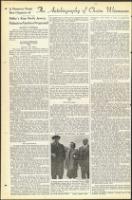
—International Photo
A former business partner of President Truman, EDDIE
JACOBSON is shown with his wife visiting Israel's PRES-
IDENT CHAIM WEIZMANN, in Tel Aviv. Weizmann is
coming to the U. S. within a few weeks to be guest of
honor at an affair held under auspices of New York
Council of the American Committee for Weizmann In-
stitute of Science. -
32—THE JEWISH NEWS
Friday, April 8, 1948
)
',atm.
v
eizrnann
conferences would deflect it from its appeasement
course?
One day, when the conference was fairly advanced,
I received a letter from the Colonial Office, addressed
to me obviously by a clerical error. It was apparently
meant for the members of the Arab delegation. There,
in clear terms, was the outline of what was afterward
to be the White Paper of -1939, submitted for Arab
State of Palestine in five years; a liipited Jewish .im-
migration during these five years -and none thereafter
without Arab consent!
I could scarcely believe my eyes.
I happened to remeinber, when I had finiShed
perusing the extraordinary document, that most of my
Zionist friends were at a party only a few doors from
mine. I went over, and we managed to get Malcolm.
MacDonald to join us. A heated and extremely un-
pleasant discussion ensued. MacDonald was very crest-
fallen and stammered ineffective excuses, that the
document did not represent the final view of - His
Majesty's Government. that it was only a basis for dis-
cussion, that everything could still be changed, that
we should not take it so tragically— the usual twaddle
In spite of the hopelessness of the
I made
arrangements to see Mr. Chamberlain. I pleaded with
him once more to stay his hand. The Prime Minister
of England sat before me like a marble statue. His
expressionless eyes were fixed on - me, but he never
said a word. I got no • response. - He was bent on his
appeasement of the Arabs and nothing could change
his mind. What he gained by it is now a matter of
history.
In the House of Commons Mr. Churchill delivered
against the White Paper one of the greatest speeches'
of his career. The whole debate, indeed went against
the government. The most important figures in the
house attacked the White Paper.
The government answer, delivered by Malcolm
MacDonald, was a clever piece of sophistry which could
carry conviction only to those who were ignorant
of the details of the Problem. It is worth recording
that even in that atmosphere the government victory
was extremely narrow. There were 268 votes in favor,
179 against, with 110 abstaining. As a rule the goy,.
ernment obtained more than 400 votes for its measures.
As I left the House with my friends, I could not help
overhearing the remarks of several members to the
effect that the Jews had been given a very raw deal.
•
The First War Years
The paradox which was revealed with the opening
of the war deepened with the passing of the months.
In the fight against the Nazi monster no one could
have been more fanatically eager to contribute tb the
common cause- than the Jews. At the same time Eng-
land, then the leader of the anti-Nazi 'coalition, was
keeping the gates of Palestine closed against the un-
happy thousands of men, women and children who
were making the last desperate effort to reach the
safety of the National Home. The coffin boats con-
tinued to wander over the Mediterranean, unable to
discharge their human cargoes. The pressure within
Europe intensified. And yet we were determined to
place all our man power, all our facilities in Palestine,
at the disposal of England and her allies. What else
was there for us to do?
In 1940, I visited America, and found it in that
strange prewar mood which it is now so difficult to
recall. Pearl Harbor was still two years off. America
was, so to speak, violently neutral, and making an
extraordinary effort to live in the ordinary way.
I spoke' at Zionist meetingi in NeW York, Baltimore,
Chicago and Cleveland, seeking to call the attention of
my fellow4ews to the doom hanging over European
Jewry. I stressed our positive achievements in Palestine,
and expressed the hope that the end -of the war would ,
bring with it the annulment of the White Paper and
a 'new era of progress.
All in all, this American trip, which lasted three
months was not a satisfactory one. There was, however,
one considerable gain to record. It was during this
visit that I made the -closer acquaintance of two of the
younger New England' Zionists, Dewey Stone and Harry
Levine. Early in 1940 they added, to their general
ZiOnist work, a special and sustained interest in the
Sieff Research Institute at Rehovoth,. Palestine, and
later they were• to take a leading part in the deVelop-
ment of Weizmann' Institute of Science. -
It was genuine relief to get back to the realities
of. England where, if the truth was harsh, it was at
least being faced. The symbol -of England's - awakening
to reality was Chamberlain's retirement and. Churchill's
assumption of office as Prime Minister. The illusions
of "the phony war" were gone, and En-gland knew that,
for a time at least, she would be standing alone.
Our two boys were in active service. Benjy, the older
one, was with his anti-aircraft artillery . group on the
aerodrome in Kent. He had married in -1937,- Maidie
Pomerans, who comes of an excellent family - of RuSsian
Jewish origin living in Leicester,Midlands. ,Benjy and
on, David, a bright
Maidie have one child, our grands
Spark,' almost too intelligent, who .must constantly be
kept back in order that he may not .develop into a so-
called prodigy. He fortunately does as well at games
as in his studies, so there .is every chance that he will
not develop into the. over-grown intellectual type with
which we meet 'so often in modern Jewish society.
Our younger son, Michael, became an officer in
the air force, .arid he* devoted himself to his duties
heart -and soul. He was a phy'sicist by training; deeply
interested in aeronautics and electronics, but in spite
of rep-eated. offers from researchstations of. the Ministry
of Aviation, he insited on active service. (In February,
1942, Michael was lost in action.—Ed.) . _
I was appointed- honorary chemical advisor to
the Ministry of Supply, headed by Mr. Herbert Mor ,.
rison, and was given a little laboratory in London. The
laboratory was conveniently located across Hyde Park, a
few Minutes' walk from the Dorchester Hotel. I found
it a great comfot in this time of personal and general
stress to have a serious occupation _which absorbed a
great deal of energy and attention, and gave one 'the
feeling of making some sort of contribution -to the na.-;,-
tional effort. Among other things we investigated the
fermentation of molasses by mass irinoculation, the fer ;.
meritation of wood and straw hydrolzates, and the prep
aration of methy butinol and its tranformation products;
escially isoprene. This last was of interest in view of
the approaching rubber crisis:
.
-
Next week, Dr. Weizmann will tell how Winston
Churchill and President Roosevelt offered assistance
during World War II to establish the Jewish National
Home in Palestine.
This is a 'serialization of parts of "Trial and Error, - by Chaim
Weizmann, by Harper & Drothers. Copyright. 1949, by the
Weizmann Fpundation.