

Page Six
THE
JEWISH NEWS.
Friday, April 23, 1948 I
•
UJA MEANS 'HAPPY PASSOVER' THROUGHOUT THE WORLD
Refugees from oppression will celebrate The holi day of freedom this year with traditional Passover matzos
and wine at Seddrim sponsored by the .Joint Distributio n Committee in Europe and- on dyprus, by the United
Palestine Appeal in the Holy Land, and by the Unite d Service for New Americans in this country.
Ladino Mu' sic Combines
Judeo-Spanish 'Dialect
With Modern Harmony
Heinrich Heine, Baptized as Young Man,
Wrote Finest Poetry on Jewish Themes
By DR. TRUDE WEISS-ROSMARIN
A century and a half after his birth, Heinrich Heine
Among , the many contradictions of Heine's life his
remains an enigmatic character of clashing contradictions.
remarkable heroism over a decade of harrowing physical
He wrote tender, chaste and lilting love poems — yet he
sufferings is perhaps the most astounding. A sensuous he-
associated with women of the lowest type and married
donist, pampered and afraid of hardship and pain, Heine
Mathilde, who was illiterate, coarse and disdainful of her
rallied from under the cruel blows of a ten-years' painful
husband's
talent.
sickbed and wrote precisely in those years of paralysis,
By ROY BER5tARD _
semi-blindness and complete physical breakdown his best
He loved the German language and the German land-
In 1492, when the Sephardic Jews were expelled scape — yet he spent most of his life in France, aiming
books.
from Spain, they took with them the Judeo-Span-
shafts of satire and cynicism at everything German. He
Although he attempted occasionally to minimize the
ish dialect popularly called Ladino. This language
bore a great devotion and love for the Jews and Jewish
impact of his sickness upon the new outlook of life he
had been developing among the Jews since the
teligious culture — yet he had himself baptized and hurled
acquired in the torturous "mattress crypt," on the whole he
eleventh century, when they first settled in Spain.
not infrequently vicious and vituperative literary brick-
was ready to concede that there are two kinds of religion,
Many of the exiles scattered to the Balkan coun-
bats at the Jews and Jewish tradition.
one
for the healthy and one for the sick. "Yes, I have come
tries and the Near East, where today Ladino has
* * * * *
back to God," he proclairned. Suffering had attuned his.
its own identity and is spoken in Jewish communi-
THANKS TO- THE insight provided by modern psy-
heart to faith and he felt that it was a great blessing to
ties, particularly in Greece, Turkey, Morocco and
chology, we Perceive that so .contradictory and complex
know that "there is someone in heaven to whom I can
Palestine. It .is also spoken in other parts of Europe
a
personality
as
Heine's
is
the
result
of
the
impact
of
early
complain."
and in many parts of Central and South America.
experiences
and
influences.
Heine
was
born
in
1797.
He
In 1942 the colony grew into boyhood in the years when Napoleon was scoring
* • 0 • •
speaking Ladino in
his phenomenal success and -awakening in the hearts of
New York City was the
oppressed, and especially the Jews, hopes for freedom
estimated to be in •
DURING THOSE years of suffering and spiritual re-
birth, Heine lovingly retraced his steps to the Jewish
excess o f 50,000 happiness. There were many Jews in the Rhineland and
Heine's
native
city
of
Dusseldorf
who
believed
that
the
day
interests of his young manhood. As a youth, he had laid
persons.
was near when Jewish distinctiveness and separateness
aside the manuscript of his novel, the "Rabbi of Bacha-
Many old Span- would be `dissolved and resolved in "humanity."
rach." But now, on the threshold of death, the Jewish cre-
ish ballads are still
The fruit of this straining at the leash of Jewish bonds
ative power moved him strongly. He wrote the "Hebrew
preserved among
was
Jewish
self-hatred.
Jewishness
became,
for
the
Melodies," recapturing in "Princess Sabbath" the very es-
the Ladino-speak-
would-be
emancipated
Jews,
a
burden
which,
unable
to
sence
of the Jewish philosophy of life, which he himself yet
ing Jews, although
never followed.
quite a number shed, they decried and defamed.
been adulter-
It was Heinrich Heine's ill fortune that he was the son
• have
The portrait of "Rabbi Yehudah Halevi," likewise part
ated by the inclu- of a woman who suffered of an acute case of Jewish self-
of the "Hebrew Melodies," is among the best of his verse.
sion of foreign hatred. Betty Heine's Jewish sickness of the soul expressed
With remarkable. intuition he gave expression to the undy-
words or by modifi- itself in- rank deprecation of everything Jewish. Scores
ing Jewish hope for national restoration and to the impa-
cations. Ladino has of Heine's statements on Jews and Judaism bespeak an an-
tient ardor for the consummation of the love of the Home-
a wealth of cant- tagonism that clearly exhibits his mother's influence.
land.
Some have opined that his "Rabbi Yehudah Halevi"
ares (canticles of
Heine grew into manhood without a definite focus and is a wishful self-portrait. They suggest that Heine, a God-
Songs of Solomon)
firm conviction. After Napoleon's defeat, the dream of Jew-
kissed poet like Rabbi Yehudah Halevi, ached under the
and coplas (short ish emancipation evaporated in the harsh climate of the
abnormality of his Jewish ambivalence and so created, out
rhymes), which are- Reaction. Heine was a Jew, hated and discriminated against
of the longing for wholeness, the ripe, mellow and harmo-
sung or read dur- as all Jews, and unequipped and unprepared to face this
nious portrait of Rabbi Yehudah Halevi.
ing Jewish holidays, destiny with dignity — or, at least, with equanimity. After
especially Purim.
a short and unsuccessful attempt in business, he studied
Heine's prediction came true. When he died, in 1856,
Ladino music law — but the University of Goettingen did not give de-
Kaddish was said for him.. Having never formally re-
consists almost en- grees to Jews and so he had himself baptized.
nounced
his adopted faith, he was buried as 'he had lived,
ROSENBLATT tirely of folk songs,
* * S * *
among non- Jews. But sufferings purify — Heine had not
with a small number of prayers. The songs
merely suffered beyond normal human endurance but had
HE DID NOT BELIEVE it possible for a Jew to em-
range in mood from happy, jubilant songs of the
also repented- and made amends through his "Hebrew Mel-
brace Christianity out of conviction. Despite his youthful
field to sombre, soul-moving chants and laments.
rebellion against God, he pointed to Judaism as the most ' odies" and his many tributes to positive Jewish values.
In this respect they resemble folk songs of other
reasonable religion.
(Copyright Seven Arts Feature Syndicate)
lands, but with an inimitable flavor of their own
which suggests the semi-Oriental Moorish influ-
ence on Spain. Today it is sung only in Egypt,
but Henry RoSenblatt, son of the late cantor- Josef
Rosenblatt, intends to introduce it to the American
•
Alberto Hemsi, the leading exponent of Ladino
music today, has compiled some thirty-fiye Ladino
songs through his own , extensive research in Spain, -
Salonika, Turkey and Rhodes. Hemsi, born in
Rhodes and now living in Egypt, toured the primi-
tive countrysides and jotted down the living music
which had never before been preserved in writ-
ten form.
Ladino is- written in Hebrew characters, and a
distinct pronunciation and flavor of the old tongue
is preserved in the folk songs and imparts an
authenticity to the music which adds to its charac-
ter.
Rosenblatt became interested in Ladino 14 years
ago: A graduate of the Juilliard Graduate School,
he feels that Ladino deserves a hearing because it
is musically worthwhile as an indication of one of
the Jewish contributions to music.
Rosenblatt considers Ladino the most exciting
music in his repertoire because, although the music
is old in years, it is so intellectually and artisti-
cally constructed that - it sounds up-to-date to mod-
'em ears. This is not surprising, since the scales and
modes are built up into harmonies as modern as
we have today. Added to the musical structure are
beautiful melodic lines, and the total effect har-
monizes into a satisfying whole.
The past 15 years have seen a musical revival
of all • types of Jewish music centered primarily
in Palestine. Today the chairman of the Palestinian
Composers' League is in the United States for the
purpose of exchanging American and Palestinian
music. Although the present political situation
leaves little time and thought for cultural ideas, it
is to be fervently hoped that one day soon there
will be peace in the Holy Land, so that Palestinian
Jews can once more enjoy their rich and extensive
musical heritage.
The vevial of Ladino music is, an. important
manifestation of, the Jewish, renascense and will
assume even greater- significance when audiences
can listen to it and thus become aware of its beauty
and value as music of a long-neglected, almost for-
gotten, segment of JewiSh culture.
(Copyright, 1948. Jewish Telegraphic Agency, Inc.)
Interfaith Cooperation Extends to Cultural,
-Social Level at Hunter College Roosevelt House
By CLARA S. CROWN
In an era when the "Gentlemen's Agreements" in social by prominent American artists, including James N. Rosen..
discriminations against minority groups are being brought
berg.
to public attention, it is' heartening to learn that in one of
Dr. George N. Shuster, president of the college, charac-
America's leading women's colleges the ladies are learning terized, the House as being "dedicated to the task of giving
to live together and like it-
young people a feeling that they are truly at home in Amer-
Five successful years of day-to-day activities at Roose-
ica. No one hides or veils his religious or social allegiance
velt House have made it a unique symbol of ,interfaith
as he enters, but all — of whatever creed or race — meet
amity. This proving ground for sisterhood among the stu- _ in these beautiful rooms as friends and neighbors."
at
New
York's
Hunter
College,
the
Sara
Delano'
dents
(Copyright, 1948, Jewish Telegraphic Agency, Inc.)
Roosevelt Memorial House, and its furnishing represents
more than 1,000 gifts by men and women of the Jewish,
Protestant and Catholic faiths.
The five-story limestone house was at one time the
residence of the Roosevelt family. Into a town house of a
type popular in past generations, moved dozens of women's
clubs, In their vanguard were the three major religious
clubs of the school — Hillel; the College Protestant Asso-
ciation and the Catholic Newman Society.
In warmly appointed meeting rooms and studies each
of the three groups has set up headquarters for educational
and social programs among its members and for their
friends of other faiths and races. All groups participate in
Christmas parties and the festivities and dinner tables at
the Purim Feast and Passover Seder include women of all
faiths and colors.
At Hillel headquarters, rooms which were Franklin D.
Roosevelt's bedroom and study, discussion groups and
classes lit Jewish history, religion and literature are offeied,
forums and Zionist -groups meet and neighborhood groups
interested in Jewish activities use the meeting room. In
the cultural field, classes in Yiddish, Hebrew, drama, dance
and music are offered. Similar programs are arranged by
the other two groups. Social events are planned and largely
administered by a "house council" consisting of student
representatives of the religious clubs and all the other
college groups using the House.
Among the most impressive rooms in the House are
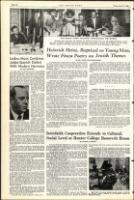
RAY LEV, American Jewish concert pianist, performs
the two libraries — one secular and the other religious. for Hunter College students at an interfaith concert at
Scattered throughout the House are a number of paintings Roosevelt House.
.
'