

Page Four
THE JEWISH NEWS
As the Editor
Views the News ...
U. S. as
Officer, Do Your Duty
Sam..ity of Marriage
The statement published last week in be-
half of the Detroit Rabbinate on the question
of the sanctity of the marriage institution
should be given serious and careful consid-
eration by all Detroit Jews.
Our Rabbis ask for very little. They point
out that marriage is essentially a religious
ceremony and should be performed by au-
thorized Rabbis who are recognized in the
community through their association with
recognized synagogues.
Any deviation from such recognition would
threaten to undermine religious authority in
our community and all of us should be on
guard against abuses. In other communities
there have been - instances of "reverends" as-.
suming to perform marriages and to act as
"Rabbis." An increase in civil marriage is
aggravating the problem. By adhering to the
request made by the Detroit Rabbinate, we
can avoid similth- abuses of the basic prin-
ciples inherent in Jewish traditions.
Let us all give heed to the Rabbis' warning
and to their serious admonitions.
THE JEWISH NEWS
Member Jewish fele,graphic Agency, independent Jewish
Press Service, Seven Arts Feature Syndicate. Religious
News Service, Palcor Agency, King Features, Central
Press Association.
Member American Association of English-Jewish News-
papers and Michigan Press Association.
Published 'every Friday by The Jewish News Publish-
ing Co., 2114 Penobscot Bldg., Detroit 26, Mich., WO. 5-1155.
Subscription. $3 a year; foreign, $4. Club subscription
every fourth Friday of the month. to all subscribers to
Allied Jewish Campaign of Jewish Welfare Federation of
Deiroit. M.) cents pet year.
Entered as second-class matter Aug. 6, 1942. at Post Of-
fice. Detroit. Mich.. under Act of March 3, 1879.
BOARD OF DIRECTORS.
Maurice Aronssoh
Slomovitz
Fred M. Butzel Isidore Sobeloff
Judge Theodore Levin Abraham Srere
Maurice H. Schwartz Henry Wineman,
IN MY FATHER'S PASTURES: By Soma Morgen-
stern. Translated from the German manuscript by Ludwig
Lewisohn. Philadelphia: The Jewish Publication Society
of
America.
•
ritLIMPAp.4. AVINtv
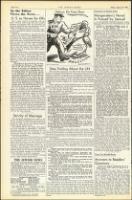
Stop Fooling About the UN
-
The powerful appeal by the New York Herald Tribune
in favor of giving Jewish Palestine "access to arms" and W. K.
Kelsey's excellent summation of the problem affecting the
implementation of the UN decision on Palestine—both quoted
elsewhere in this issue; and the Christian Science Monitor
editorial under the heading "UN—Let's Stop Fooling" emerge
as the most humane appeals for justice sounded in recent
weeks.
"How weak .can the United Nations get?" is the question
posed by the Monitor whose editorial declares with regard
to the threats of the Arab League:
"So the United Nations has come to this—it can be
flouted and defied by anybody!"
The Monitor's editorial proceeds to make the following
important recommendations:
We believe the time has come for the people of America
and Britain to insist that their Governments show more interest
in giving UN at least the power to fulfill its obligations in Pales-
tine. If it is really impossible to form a genuine international
police force, they should at least act under Articles 106 or 51.
Both duty and opportunity commend such action, for at
least three reasons:
1. The imperative need for order. Disorder hardens hates,
invites Communism, grows into war. Britain and America have
both intervened in Palestine, both have an obligation to main-
tain order — the first requirement for the -building of freedom
and justice. UN affords an instrument for policing controlled
not by any power's imperial purposes but the moral aspirations
of humanity.
2. The Importunity to develop UN. It can best grow and
gain strength—and the allegiance of the world's people—by
performing necessary tasks. Debating and passing resolutions
may be requisite steps, but become stultifying gestures unless
carried out. It is time to quit pretending.
3. Exploring a final avenue of co-operation with Russia.
The Soviet voted for partition of Palestine. There are special
to co-operate. If
reasons why. in that area it might be
it. won't the case will be that much clearer. e• But America and
Britain must first prove they want UN success.
Let's quit fooling.
There is nothing partisan about these statements. They
are serious admonitions to heads of the world powers that
unless the UN decision is accepted with dignity and sincerity
the entire UN structure may collapse and peace will be post-
poned in the Middle East—and therefore in the entire world—
for generations.
The Christian Science Monitor's powerful editorial as-
sumes greater significance by virtue of an interesting expose
of the arms situation cabled from Jerusalem by the Monitor's
correspondent, Francis Ofner, and "appearing in the same issue
as the quoted editorial. The Monitor's correspondent points
out that—
Weapons purchased by the . Jews, are only partly of Amer-
ican origin, while Arab arms are chiefly British, German and
Russian made.
Russian arms are almost exclusively "balalayka" sub-
machine guns lehich have been smuggled into Mid-eastern coun-
tries since 1944 from northern Iran.
German war equipment is more widely distributed among
the Arabs in the Holy Land.
The Arabs of Bethlehem are reported in possession of nine
German light tanks of the Tiger Mark 3 type.
Near , the village of Bir Abu Kefa around Gaza there is a
secret Arab airfield.
A considerable quantity of American tommy guns have
found their way to armed Arabs in Palestine. These weapons
once were part of American aid. to the British, which the latter
passed to the Arab governments in the Mideast.
The Jews are obliged to pay black market prices for
equipment ... The price which Arabs are paying for one round
of .303 rifle ammunition is 18 Palestine mils (between seven
and eight American cents). But the Jews are paying up to 70
mils (28 cents).
The only weaporfs which Jews do not purchase for exorbi-
tant prices are those which are being manufactured in secret
Haganah factories in Palestine.
These facts reveal the seriousness of the existing situa-
tion. While Jews are deprived of the right td self-defense,
the Mufti-inspired Arabs are receiving arms from many quar-
PHILIP sLomoviTz. Editor
ters and appear to have the blessings of the British govern-
VOL. XII—No. 20
JANUARY 30, 1148
ment in their destructive activities. Meanwhile our own State
Department hasn't "quit fooling" about the UN. The time
Sabbath Scriptural Selections
This Sabbath, the twentieth day of Shevat, 5708, las come for real action—and. the sooner we force a sincere
the following Scriptural selections will be read in approach the better for the prestige of the United States and
- our synagogues:
the United Nations and the security of the Jews in Eretz
Pentateuchal portion—Ex. 18:1-20:26.
Prophetical portion—Is. 6:1-7:6;9:5,6.
Monument to Eastern Jewry
Morgenstern s Novel
Is Praised by Samuel
Haven. for DPs
After many months of agitation and ap-
peals, there is some hope that the present
seassion of Congress may act favorably on
pending legislation for the admission of dis-
placed persons to the United States.
The N. Y. Herald Tribune last week echo-
ed the sentiments of liberal Americans when
it declared:
"There is everything to be said for per-
mitting a fair share of the dislaced persons
to come to our shores. The United States re-
sponsibility for leadership toward a just and
permanent peace requires that we offer a sol-
ution of the war's gravest human problem.
Resettlement is now the only acceptable
solution for the hard core of refugees remain-
ing in the DP camps. This country must
open its doors if it hopes that other nations
will open theirs ..
An important role in Congressional action
is being played by Michigan's Senator Homer
Ferguson, co-author with nine other U. S.
Senators of a bill in the Senate for the ad-
mission of DPs. We are encouraged by the
following statement made to us by Senator
Ferguson:
"We expect to have the bill on the Sen-
ate Calendar by February 1: The legisla-
tion is on the list for action in this
session. I am going to undertake to have
it receive priority for consideration by
the Senate when the Committee reports
it out February 1. The reason for its
not having been on the list of legislative
proposals approved for action by the
Policy Committee was that there did not
seem to be any use of putting it on the
list until we could get it out of the Com-
mittee. Now that we know it will be re-
ported out by the first of February, it is
on the list for action in this session."
On the strength of this assurance, the
efforts of all liberal forces should be exerted
to make it known to our representatives in
Congress how important action on the DP
problem is at this time. While our major
responsibilities lie on the Palestinian front,
since the bulk of survivors from Nazism will
have to go to Palestine, the lives of tens of
thousands of DPs - depend upon an open door
policy in other lands, and the United States
must—as the Herald Tribune has pointed out
—take the lead in welcoming refugees as
an encouragement for similar action by other
lands. It- is sincerely to be hoped that action
will not be long delayed.
Friday, January 30, 1948
Israel
A review by MAURICE SAMUEL, author of
"Harvest In The Desert", "The World of
Shalom Aleichem," etc.
What a rare and wonderful experience it is to
pick up a new book, to glance through the first
paragraph, and to be pulled up by the feeling:
"Good heavens! This is a writer!" Then to settle
down comfortably, willingly and gratefully to
the slow perusal, ungrudging of the hours, un-
haunted by the thought: "I might be doing some-
thing better with my time."
This, quite simply, is what I want to say
first about Soma Morgenstern's "In My Fath-
er's -Pastures." It is not something put to-
gether for the market by someone who "had
an idea" and is able to string sentences togeth-
er. It is literature. It is a clear vision of life
mirrored in a record; the product of a mind
which brooded for many years in careful and
loving scrutiny over an entire world, anti
then proceeded to set down, with grace and
clarity, with tenderness and insight and
humor, all that it had perceived and all that
had moved it.
I would have read and re-read this book with
deep joy even if its particular theme had not
been so precious to me; and I 'would have felt
as keenly the protest of its pure craftsirianship if
it had not been applied to a Jewish subject. For
it is, among other things mentioned below, an im-
plied protest. Every honest man is a reproach to
rogues and mountebanks and charlatans; and the
Jewish theme, now being to the fore, has at-
tracted its quota of these—the "easy popularity"
boys and girls, the "clean-up-while-the-going's-
good" word peddlers, the , shrewd speculators in
drooling goodwill movements. Against - these shod-
dy offerings, which confirm the corruption of pub-
lic - taste by exercising it daily, "In My Father's
Pastures" stands like a prophetic rebuke.
The narrative of this book moves with skilfull
counterpoise on two levels, the personal and the
panoramic. On both there is—despite the tragic
close—enchantment. The personal story deals - with
the 19-year-old Alfred Mohilever, who has been
brought up unjewishly in Vienna, and who is
adopted by his uncle, Wolf Mohilever, of Galicia,
a landowner and an orthodox Jew. Alfred in
turn as eagerly adopts and learns the religion of
his uncle and of his:‘.‘:orfathers.
The milieu is not the city, and not even the
urbanized village life of the Jew. It is the
country- itself. A group of Jews on the land,
in the midst of a gentile landscape: orthodox
Jews, with a Jewish and rural tradition; Jews
as familiar with cattle and crops, ploughshares
and scythes, as they are with chumosh and Ra-
shi, Tzadikkim and Sabbath candles— these
are the protagonists. What is immensely at-
tractive about it all is that they are drawn as
persons, not as types. The writer does not
strike an attitude and invite one in the read-
er. He narrates and describes: meticulously,
intimately, slyly,-affectionately, making a con-
tinuous drama of the revelation of character
and personality, so that each individual be-
comes an unforgettable event. Some of them,
like the boy, Alfred, - the red-headed pious
old maid, Pessa, and -the 77-year-old bailiff,
Y ankel Uhristiampoter, become obsessively
interesting.
I am afraid to say of this book, and of its pre-
decessor, "The Son of the Lost Son," that they are
the begining of a monument of that perished.
Jewry—afraid only because the reader might
gather that I am speaking of some vast and for-
bidding classic which one tries to read only in a
passing fit t'shuvah. These are books which in the
reading are a continuous delight, and in the re-
membering a permanent treasure. "In My Fath-
er's Pastures" has the immense advantage of
having been translated by Ludwig Lewisohn;
but in both books there are memorable passages
which I have read out over and over again to
friends: Judah Mohilever davvening, the mourn-
ing ceremony at the Agudat Israel convention, the
concert in Vienna, in the first book; in the second,
the Sabbath service in Judah Mohilever's home
chapel, the harvest day among the peasants, the
kitchen scene between red-headed Pessa and the
maid, Malanka, the wooing of the shickse, Donja,
by Alfred (right in the midst of his redemption,
too). I think these will in time to come take their
place in every anthology of Jewish writing.
If the third and fourth volumes of the series
maintain the standard set in the first two, the
monument will have been completed.
Facts You Should Know
Answers to Readers'
Questions ...
Is there any place in Jewish Law that it is
written that a child cannot be named for a
living person?
In "Sefer Chasidim" the author, "Judah the
Pious", definitely prohibits naming .children
after living persons. For a time it was customary
to name Jewish children after living persons—
usually grand-parents. It was later discouraged
for a number of reasons: Some writers feel
that it was prohibited because of the spread of
such a custom among foreign nations. Others
feel that it was preferable to name the child
after deceased persons in order to protect and
promote geneologies; that it was a means of
promoting the feeling of immortality implying
that the dead can thrive through the liVing.
Many claim that doing so avoids some confusion
involved in having two relatives bearing the
same names. Jews today are very strict about
this custom. On the other hand there are definite
sects among Jews which still name children
only. after living relatives. Many Sephardic, .corn- ,
munities do so.