

- THE JEWISH- NEWS
Page Thirteen
TM' INVESTS IN TOMORROW
filth . . . Recreation . . . Foster Homes
Jewish Education:
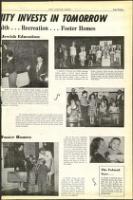
In addition to Hebrew and Yiddish language
studies, pupils in Detroit Jewish educatioi
agencies learn early the beautiful traditions be-
hind the Jewish holidays. Here a group of
boys and girls attending kindergarten at The
Sholem Aleichem School declaim the Hanukah
story. Other community-supported schools which,
like Sholem Aleichem, are devoted principally to
Yiddish culture, are the Farband Folk School,
Workmen's Circle Schools and the United Jewish
High School.
Under the guiding eye of teacher Joseph Haggai, an eager
student writes in Hebrew, during a class session at the United Hebrew
Schools. Jewish education was one of the first children's services to
come under community auspices, with the UHS a member agency of
the Jewish Welfare Federation for 20 years. The Federation's Educa-
tional Planning Commission brings together in cooperation represent-
fives of the Hebrew schools, the Yiddish schools, Sunday Schools, and
he Jewish Community Center—all devoted to educating Detroit
children for Jewish living.
That children should learn to give to community causes and to
support community projects is another principle taught in local Jewish
schools. This Keren Ami collection (right) at the United Hebrew
Schools will be allocated to social service causes. Other education'
agencies maintain similar funds, with the children active in such causes
as the ,SOS (Supplies for Overseas Survivors) and the anngal Allied
Jewish Campaign.
Foster Homes:
. One of the most compelling
community needs is for adequate
foster homes for boys and girls
from 10 days to 20 years of age.
The Children's Department= of the
Jewish Social Service Bureau wants
to find • warm-hearted foster
mothers, like the one at right, who
can provide the security of a good
home for a child. Funds from the
Bureau will cover the child's ex-
penses.
Anyone interested in
opening her home to a child is
invited to call "Foster Homes," at
TR. 2 -4080.
The Talmud
Says .
A familiar friend, the social
worker from the Children's . De-
partment of the Jewish Social
Service Bureau, delivers a brother
and sister to the friendly hands of
their new foster mother. The
worker will continue to work with
the foster mother in meeting any
problems that may come up . in
the care of the ai ildren.
A mother is likened unto a
mountain spring that nour-
ishes the tree at the 'root,
but one who mothers an-
other's child is likened unto
a water that rises into a
cloud and goes a long dis-
tance to nourish a lone tree
in the desert.