

our
THE JEWISH NEWS
As the Editor
Views the News - - -
A Good Buy
By DAVID MORANTZ
Wanted: Volunteers
the Talmud and folklore of the Jewish people dating back
as for as 3,000 years).
PEARLS OF WISDOM
"Be not one who gives alms with one hand,"
says the Talmud, "and steals with the other."
- "He who gives alms to the poor with an un-
friendly mien and downcast face, even if he give
a thousand pieces of gold, has no merit owing
to his manner of giving, but one should give joy-
fully with a cheerful mien."
"If a poor man ask your help and you have
nothing to give him then appease him with cheer-
ing words."
"He who urges others to give charity and
causes them to practice it, earns a greater reward
than he who gives."
"One's own maintenance takes precedence be-
fore that of any one else. One is, therefore, not
obliged to give alms before he can maintain him-
self.
Children's Corner
Dear Boys and Girls:
The Holy Days are over, but the period of
Jewish fall festivals will not conclude until after
Simhat Torah.
This Saturday and Sunday we will observe as
the first days of Sukkot, the Feast of Tabernacles.
The following week-end we will observe Fri-
day as Hoshanah Rabbah, Saturday as Shemini
Atzeret and Sunday, Sept. 30, as the joyous
festival of Simhat Torah.
As you all know, it is traditional for us to
build Booths or Sukkoth during this festival as
a reminder that our forefathers lived in tabern-
acles when they left Egypt to settle in Palestine.
I wish all of you a very pleasant holiday.
* UNCLE DANIEL.
Bigotry in Central Europe
THE JEWISH . NEWS
Member of Jewish Telegraphic Agency , Independent
Jewish Press Service, Seven Arts Fe ature
Syndicate,
Religious News Service, Palcor News Agency. Wide World
Photo Service, Acme Newsphoto Service, King Features
Syndicate. Central Press Service,
Member
Association of English-Jewish News-
papers
and American
Michigan
ig
Press Asso ciation
Publish ed every Friday by
The Jewish News Publish-
ing Co.. 2114 Penobscot Bldg., Detroit 26, Mich. Telephone
RAndolph 7956 Subscription rate. $3 a year; foreign
$4 a year. Club subscription of one Issue a month,
published every fourth Friday ir the mnth. to all
subscribers to Allied Jewish Campaign of o the Jewish
Welfare Federation of Detroit, at 40 cents a club sub-
scription per year.
Entered as second-class matter August 6, 1942. at the
Post Office at Detroit, Michigan, under the Act of
March 3. 1879.
Er
BOARD OF DI RECTOFtS
MAURICE ARONSSON
PHILIP SLOMOVITZ
FRED M. BUTZEL
ISIDORE SOBELOFF
THEODORE LEVIN
ABRAHAM SRERE
MAURICE H. SCHWARTZ HENRY WINEMAN
rum". SLOMOVITZ, Editor
A. R. BRASCH, Advertising Counsel
VOL. 8—No. 1
SEPTEMBER 21, 1945
The Week's Scriptural Selections
On Saturday, the first day of Sukkoth, the fol-
lowing selections will be read:
Pentateuchal portion s—Lev. 22:26-23:44;
Num. 15:12-16.
Prophetical portion—Zech. 14.
On Sunday, the second day of Sukkoth, the
following selections will be read:
Pentateuchal portion s—Lev. 22:26-23:44;
Num. 29:12-16.
Prophetical portion—I Kings 8:2-21.
Talmudic Tales
(Based upon the ancient legends and philosophy found In.
Within two weeks, general solicitations
will begin for the annual War Chest cam-
paign.
Actually, however, the task of securing
the large sum that is needed to guarantee
the continuation of overseas relief activities
and the support of major national and local
welfare, educational and recreational pro-
jects requires immediate effort on the part
of all of us.
Men, women and children of all faiths
cry to us for help. Our concern over the
tragedy of Irsael makes the task of the War
Chest, which includes the 55 causes of the
Allied Jewish Campaign of the Jewish Wel-
fare Federation, the major responsibility of
the Jewish community.
The immediate need is for workers. Of-
fer your services NOW. Call Miss Esther
R. Prussian, director of the Detroit Service
Group, CO. 1600, and render whatever ser-
vice you can—as a solicitor, as a volunteer
clerical workers, or in whatever capacity you
can serve the cause.
Bigotry has not ended anywhere, and
one of the tragedies of the post-war experi-
ences is that anti-Semitism is rife in Europe.
Correspondents for leading American
newspapers agree that the situation is a very
sad one.
John MacCormac, in a cable to the New
York Times from Bratislava, states: "The de-
feat of Nazism has not ended anti-Semitism
in Central Europe. Too many fellow-travel-
ers of one kind of fascism or another benefit-
ted from the dispossession of Jews from
positions and properties to welcome the re-
turn of the survivors now."
Mr. MacCormac, in a lengthy description
of the tragedies suffered by. Jews in the era
of peace, refers to charges made by Jews
that they "were not allowed to share in the
distribution from the United Nations Relief
and Rehabilitation Administration in some
rural parts of Slovakia, and even in Bratis-
lava were rudely jostled when they tried to
stand •in line for their allocation."
* * *
Another eminent correspondent, Joseph
G. Harrison, in a cable to the Christian
Science Monitor, also from Bratislava, de-
clares that "for the Jews of Slovakia, the
persecution which started with Hitler is still
going on." He charges: "Perhaps the most
cruel treatment occurs when Jews appear
in •relief lines. Despite 'the strictest rules
that United Nations Relief and Rehabilita-
tion Administration aid must be handed out
impartially and on a basis of need, in many
areas of rural Slovakia Jews are met with
laughter when they ask for UNRRA food,
notwithstanding the fact that they are in-
variably the members of a community most
in need."
A major responsibility devolves upon
this country to press the issue and to de-
mand that there should be an end to anti-
Semitism, especially where government of-
ficials and relief workers are responsible
for prejudice.
And it is the duty of Jewish leaders to
mobilize all availale strength to secure action
against the continuation: and spread of the
Nazi ideas which Europe has inherited from
Adolf Hitler and his gangsters.
Friday, September 21, 1945
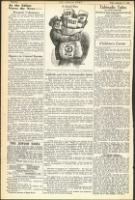
Drawn ror National War Fund—Web. Brown, Akron (0.) Beacon-Journal
Sukkoth and Our Indomitable Spirit
THE SUKKAH AS A SYMBOL
The Sukkah recalls the pioneering days of
the Jewish people. They were periods of hard-
ship but evidently of high worth and importance,
for again and again the prophets remind the
people of those great days. In America, similar-
ly, the frontier days are idealized. We speak
with admiration of that era of heroism. We de-
scribe the life of the frontiersmen as one of
freedom and self-reliance, simple and honest.
The Sukkah reminds us of the ideals of the
pioneers and calls us to follow in their paths of
honesty, love of freedom, self-reliance, and
democracy.
The Sukkah is also a reminder of the tents
and shacks in which the Halutzim first live when
they establish a new colony in Palestine, as well
as of the harvest booths used by modern Jewish
farmers in Eretz Israel. These pioneers, too, are
idealists from whom we have much to learn.
Great teachers have pointed: to the Sukkah
for lessons of conduct. Maimonides said it
teaches us that in days of prosperity we should-
remember periods of evil and, of poverty, so that
we may remain humble and sincere at all times.
The frail roof, the Talmud declares. should
prevent us from putting our trust in the power .
of man.
Benjamin Disraeli's description of the indomitable Jew-
ish spirit remains the classic definition of all times.
"The vineyards of Israel," we quote Disraeli, "have
ceased to exist, but the eternal law enjoins the children of
Israel still to celebrate the vintage. A race that persists in
celebraing their vintage, although they have no fruits to
gather, will regain their vineyards. What sublime inexor-
ability in the law! But what indomitable spirit in the
people!"
It is a good piece to recite on Sukkoth, in an age when
only a few of our people have survived to celebrate the
vintage and to be satisfied to live humbly—even in a Suk-
kah—yet to be deprived of the frail security even of the
Sukkah.
Think of it: in the hour of liberation, Jews are being
massacred in Poland; those who had returned to their
former homes in Poland are fleeing back to their former
"shelters"—the concentration camps of Germany.
*
*
THE MEANING OF SUKKOTH
Yes, the Sukkah is a symbol—of homelessness and in-.
The ancient Feast of Sukkoth, meaning "Booths,"
security; but because it remains a tradition in Jewish life, celebrated for eight days beginning at sun-down,
it is also proof of the inexorable and indomitable powers of Friday, Sept. 21, and for nine days in Orthodox
was originally a harvest festival and
a people physically weak and on the face of things defense- synagogues,
a period of thanksgiving. Reminiscent of the-
less.
days when Israelites, and other oriental peoples,
The spirit of Israel is the people's strength. It has pull- because of the short harvest season, when fruits -
ed us through many crises and will pull us through the and crops had to be gathered speedily, dwelt in
booths in the field, it is also a time to recall the
present tragic condition. History will undoubtedly continue fact
that the children of Israel dwelt in booths
to append the complimentary descriptive word "sublime" in the wilderness when they journeyed out of
when speaking of such a spirit.
Egypt. Their wandering in the wilderness was
These sentiments, satisfying as they are to the spirit followed by entrance into the Promised Land—
an augury of the Promised Land we hope the
of our people, are not without their challenging elements. nations
of the world will now enter if we in-
They must not lull Jews into a sense of false satisfaction and augurate a real era of peace.
security or into a feeling of smugness.
Many congregations erect booths in a suitable
Let us return to a consideration of the horrible medieval place in the synagogue and decorate them with
fruit and other products of the fall harvest, and
position to which liberated Poland has reverted as soon as many
families and synagogues still erect booths
a handful of Jews began to return to their former homes in for the -entire Sukkoth period. The Book of Ec-
that land whose martyrdom under Nazism is being disgraced clesiastes is expressive of the character of the
festival. "All may be vanity to some people,"
by massacres.
says Ecclesiastes, "but to revere God- and keep
*
*
his commandments" is the primary duty of the
A little more than a year ago, there was already an in- Jew.
dication of impending trouble. What was purported to be
It is interesting to realize that the Pilgrim
the text of a confidential memorandum, submitted by the fathers patterned the Thanksgiving Day which
we
celebrate, after this Old Testament harvest
Polish underground to its government in exile, stated, with festival
of thanksgiving. The symbolic fruits of
an implication of strong endorsement of its views, that this beautiful feast are the citron,
the willow,
Polish Jews were not entirely exterminated by the Nazis the myrtle and the palm. With these beautiful
and that the non-Jewish Poles would "consider the mass works of creation we celebrate God's wisdoni
thank Him for His kindness 'and His mercy
Deimmigration of the Jews not as a return to their previous and
will endure forever.
position but as an invasion against which it would defend
MY EARLIEST SUKKAH
itself even in a physical manner." -
By DR. ISRAEL ABRAHAMS
My Earliest Sukkah was .my. mother's. In
One's hair stands on edge upon examining the develop-
ments affecting the surviving Jews in Europe, upon reading those days—how many years ago I do not care
to count—my summer holiday lasted exactly nine
such a statement.
days a year. We needed no train to take us to
Yet, we dare not succumb to despair. And we must not the country destination—we just stepped into
become overconfident, or haughty, and we can not be in- our little city garden. In brief, our one and only
annual outing was spent in our Sukkah and we
different.
young • boys and girls enjoyed our change of
*
*
*
far more than I have relished longer and
We must re-examine our "inexorability". We dare not scene
more distant excursions in recent years. It has
be smug, and we MUST be courageous in this hour of need. been said that the pleasures we make for our-
An entire remnant of our people must be saved, and it is selves are fuller and fairer than the pleasures
are given to us.
our responsibility to rise sublimely to the challenge of the which
Perhaps
this is why we loved our Sukkah,
day.
for we made it. ourselves. We did not- employ a
Our opportunity to show our strength, as symbolized professional carpenter to put in a single nail. or
in the Sukkah, will come during the War Chest drive, and plane a single beam. We bought rough logs
and boards at the city timber yard, which was
continually thereafter whenever the demand is made upon never
after the fire of a quarter of a
us to be fair with ourselves in providing the means with century rebuilt
ago. We- planed the logs and grazed our
which those who can be rescued shall be rescued.
fingers, but -the pain did not count. Though all
these preparatory stages occurred a fortnight be-
We must be above petty consideration.
the actual building operations never
We must not be deaf to or stone-hearted in dealing with forehand,
began until the night when the great Fast was
the cries for help that come to us from the unfortunate over. Old traditions clung to us, and somehow
segments of oppressed Israel.
we knew that it was a special merit to close the
These are the challenges of the Sukkah and Sukkoth— Day of Atonement, hammer in hand, putting m
the first nail of the _ - Sukkah, passing _ as the
and we must not be found wanting.
Psalmist has it "from . strength to strength."