

Friday, September 7, 1945
THE JEWISH NEWS
Page Eighty-Eight
''160:4Me"
,
\
.
4. -t. •
.:-. 1:;,,
t
''''%-s
ree
or What?
Victory Has Come—But It Is Not the End;
Survivors "Free Only to Die" Unless We
Provide Material Help . . . Community
Needs Stressed By Federation Director
BY ISIDORE SOBELOFF
Isidore
Sobeloff
(Executive
Director,
Jewish
Welfare
Federation)
- AT HOME
- ABROAD
F
OR THE FIRST TIME in years,
the tortured of Europe now dare to
cry out in their ' suffering. A full
eighth of a century has gone by since
that spring over 12 years ago when
Hitler swept to power "for a thousand
years". For those who died in the .
slaughters that followed — and even
for many of those who lived—it has
. been a thousand years. Each day,
each hour that held out no hope of
escape was, indeed, a thousand years
to those who lived in that strange
world, half-living and hall-dead.
And now, victory has come. And
yet victory itself is not the end. Vic-
tory, at best, is the hope that they
may begin again to live. The silent
tears of tragedy still flow. Fortunate-
ly, they flow with hope, but they
still flow.
Limited by War Barriers
Now, after all these years, we can
hear their cries. We can reach them,
we can help them—those who before
military victory did not know wheth-
er their voices would ever be heard
.again by the outside world. Until
now it was we .who needed courage
to carry on against the day when we
could re-establish contact with those
who required our help.
It was tantalizingly disheartening
to feel that with all our freedom and
all our wealth we were limited by
barriers of war and hate from corn-
ing to their rescue. Now we who
were free to offer sympathy, are really
free to breathe life and hope into
their twisted bodies and to make
them, too, walk again as free men.
Until and unless we shower our
'resources on • them, they who have
gone through the wilderness—and
worse—of hunger and concentration
camp—are free for what?
As they approach the promised land
of peace and a measure of equality,
they will be denied the sight of that
promised land, until and unless we
come to their rescue. Without • our
help, they are free only to die and
the day of liberation will be' a taunt
and a mockery to there.
Must Help Thoasands
Where before we helped hundreds
who managed to escape, we must now
help thousands. Where before we
stood by helplessly beyond the bor-
ders of Nazi territory and waited for
a handful to come to us, now we can
go to them and give them material
help, limited now not by our enemy's
power, but only by the extent of our
own generosity.
This, at last, is the year of libera-
tion. Military victory does not as=
sure life—it assures only the oppor-
tunity to live, and that opportunity,
in so far as our European brethren
are concerned, is in our hands. Giv-
ing this year must be lavish and un-
restrained. To us has been given the
privilege of determining "who shall
live and who shall die; who shall not
live and who shall not die".
-
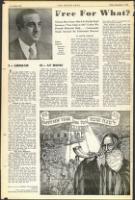
Drawn for the JEWISH TELEGRAPHIC
AGENCY
from a theme suggested by the
RATIONAL JEWISH WELFARE BOARD
While this certainly is no time to
relax our efforts in behalf of the Jews
abroad, -the task of ministering to
their needs by maintaining life in
Europe and strengthening the collec-
tive life in Palestine can be perform- ,
ed most effectively—especially now—*
if the will to help flows out of a con-
genial and • wholesome community in-
terest among us here in Detroit.
Continued adequate support over-
seas depends on an informed and
smoothly-functioning community here
at home. Concentration on special
war-time needs has created in too
many instances a mistaken belief that
the domestic economy and the domes-
tic social structure can take care of
themselves.
The sudden change-over to peace-
time economy brings with it mount-
ing unemployment, with consequent
changed living standards, increased
dislocations in family life, the need
for re-adjustment of the returning
veterans, and a host of economic and
social problems that already are re-
flected in indigence, • delinquency,
crime, illegitimacy and other, abnor-
mal patterns of living and conduct in
our general community. When these
tensions attending the conversion from
war-time economy are likely to be
greatest, there may be a tendency to
get back to "normal" • by pretending
that the end of the fighting automa-
tically takes care of the home front.
Replenish Material Losses
There may he a tendency to forget
that, by and large, social services
have marked time during the war
years and that tires and new homes
and paved streets have not been the
only victims of an economy that was
geared for military victory. There
is general recognition that the home
front must replenish the material
losses that cities have suffered.
There is need for new construction
and expanded public works and for
the resumption of peace-time devel-
opment of public resources . and ser-
vices, along with the parallel re-birth
of industrial activity. But there, is
a pressing need also for the resump-
tion and widening of our social ser-
vices.
4o less than our. brethren abroad,
we are the survivors of a war that
endangered the future of decent so-
ciety: And now, we are free to help
our neighbors, here and elsewhere
and to help durselves establish a so-
cial structure that will provide a max-
imum opportunity for all individuals
to live in security and -health.
Toward General. Welfare
A comprehensive program for all
the people is dependent on the will
and skill of each segment of the pop-
ulation and the contribution that we
are prepared. to make within our-
own ranks will be a contribution to-
ward the general welfare.
- Most dramatic of the tasks that
we have set for ourselves is our de-
cision to enter the Detroit scene with
the establishment of a voluntary . hospi-
tal under Jewish auspices. Voluntary
hospitals have become indispensalke
to the country's extensive program -of
medical service. ,
It is our wish to give Detroit a
good hospital and we are drawing on
the knowledge and experience of
those who possess these qualities.
Soon we shall -have our own hospital
and thereby contribute toward the
community's entire • need of more
general beds. To insure the new
hospital's scientific program and high
standards _ of service, there must fol-
low the establishment of sizable en-
dowment and research funds.
With continued community interest
and support, we shall have not mere-
ly a physical facility, but also an ex-
pression of our culture, philanthropy
and humanitarianism.
The Needs of Tomorrow
Similarly, in every other major field
of communal endeavor, we must turn
now to the needs of tomorrovv—for
many of the needs of tomorrow, are
also the needs of today. The com-
munity of the future involves social
planning, both by governmental and
voluntary effort. Of these, voluntary
effort is not the lealt. Formal edu-
cation, recreational and cultural
needs, the indigent aged, the chronic
sick, the convalescent, the 'dependent
and neglected child, the maladjusted
individual—and above all, the normal
individual who requires work and
play and inner strength and satisfac-
tion—all of these are illustrative of
the people and the, nature of the
problems that require our common
attention and united assistance.
To meet these needs, there will'
be required neighborhood buildings,
finances and workers with sympathy
and skill. In the days ahead all of
us Will be asked to address ourselves
to these problems. All this is a priv-
ilege of freedom. It • is a divine priv-
ilege. May we be worthy of exercis-
ing that privilege.