

Page Twenty-Eight
THE JEWISH ,NEWS
Friday. September 7, 1946
Facts You Should
Know About
Rosh Hashanah
By CARL ALPERT
Dear Boys and Girls:
A Happy New Year to all of you!
Let us hope that the New Year 5706 will usher in the era of unending peace
for the entire world and of happiness fo r everyone.
Rosh Hashanah, as you surely know, means "the beginning of the year."
The day ushers in the solemn Ten Days of Repentance which are followed by Yom
Kippur, the Day of Atonement.
we do
Unlike the celebration of the civil New Year which occurs on Jan.
not go into hilarity on Rosh Hashanah. On the contrary, this doy is solemnly ob-
served in prayer and meditation.
The traditional greeting on this day is; "May. you be inscribed in the Book
of Life for a Good Year."
The blowing of the Shofar is a distinguishing feature of Rosh Hashanah ser-
vices. The Shofar is not blown on the Sabbath and since the two days of Rosh
Hashanah this year occur on Saturday and Sunday, the Shofar will be blown only
on Sunday.
•
As Rosh Hashanah reading, I have gathered some interesting material which
will enlighten you_ on the customs and observances of Rosh Hashanah.
Le-Shanah Tovah Tikosevu!
UNCLE DANIEL..
*
THE MEANING OF THE SHOFAR
•
with God is to remove the causes that
have estranged us from Him. If we
, By MOSES MAIMONIDES
would have Him mercifully and forgiv-
(Great Jewish Philosopher of the 12th Century)
ingly mindful of us, we must be mind-
The Scriptural injunction of the Sho-
ful of our responsibilities to Him and
far for the New Year's Day has a pro-
found . meaning. It says: Awake, ye
to our higher nature. So that the Day
sleepers, and ponder your deeds; remem-
of Memorial is a day for 'human as well
ber your Creator, and • go back to Him
as Divine memories. It should bring us
in penitence. Be not of those that miss
face to face with ourselves; it should
realities • in their hunt after shadows, and
help us to under-
stand our true
moral position; it
should set us asking
"What am I doing
with my life?" It
should spur us to
the task of self-
recollection, s e 1 f-
scrutiny.
New Year's Day
is a solemn occa-
sion, though not a
mournful one. Un-
like the ordinary
New Moon it is not
marked by a re:
cital of the joyous
Hallel; but, on the
other hand, the
prayers with which
we mark its advent
have little in them
that is sad, a day
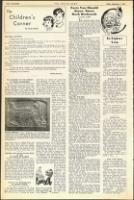
Shofar Blower: Rosh Hashanah, the traditional yom of chastened mem-
ories, a day for re-
t'ruah—Day of the Blowing of the Shofar, finds its spirit de-
flecting upon our
picted in the study of the patriarch with the ram's horn. It is a
frailty o f frame
reproduction of a bronze placque by Boris Schatz, Jewish artist,
and is from the collection of the Union of American Hebrew
and 'character—
Congregations.
'that is the aspect
in which the Pray-
er-Book presents it to us. But beneath
waste their years in seeking after vain
things which cannot profit or deliver. this' sombre sense of weakness, both
Look • well to , your souls and consider physical and -moral, there lies in the
your acts; forsake each of you his 'evil worshipper's heart the serene' certitude
of. God's justice and mercy. If we pass
ways and thoughts, and return to God,
away, He will redeem us; if we have
so that He may have mercy upon you.
• * -*
sinned, He will help us resolve to sin
no more. We are not morbidly to fix
WRITTEN AND SEALED IN THE BOOK our thoughts upon ourselves alone; we
OF LIFE
are bidden to turn them also to God.
By ISRAEL BAAL-SHEM
Our littleness, but His greatness too, is
(Founder of Hassidism: Written in 1700)
to be the theme of our meditations. And
so among the most impressive, as well as
"To be inscribed in the Book of Life."
the most ancient passages of the New
This must , be understood in a spiritual
Yaer liturgy are those which celebrate
_sense. When a man clings to the love of
God, and, putting his trust in His infinite
the Divine ma-
mercy, takes upon himself the yoke of
jesty, which tell
the Kingdom of Heaven—he therewith
of the kingdom
inscribes himself in the Book of Life.
of Heaven to be
Whereas the man, a slave to his passions,
established o n
who so loses his belief in the all-embrac-
earth i n t h e
ing love of God that he fails to repent
Messianic time,
and return to his Father in heaven, this
of God, the Om-
despairing of the love of God is equiva-
niscient Searcher
lent to his being inscribed--God forbid—
of hearts, of the
in the Book of Death.
great Sovereign
* * *
who has reveal-
ed His will to
THE DAY OF REMEMBRANCE
mankind. Sub-
By MORRIS JOSEPH
lime conceptions
(In "Judaism as Creed and Life")
all of them, and
An impressive significance has clung
To assure a lasting they clothe both
to the New Year Festival for centuries
peace — continue to
the Liturgy and
past. The Day Gf Memorial reminds us save paper—and nsayk-
the Day with
that the one way of making our peace
er be wasteful!
grandeur.
THE JEWISH NEW YEAR,
always of peculiar interest to non-Jews be-
cause it seems to come in the middle of the
year, does not occur on the first days 'of
the first month even on the Hebrew calen-
dar, surprising though this may sound. In all
Biblical references to this day, which is re-
ferred to as the "Day of the Blowing of the
Horn," it is placed on the first day of the
seventh month, Tishri, and it is on this day
that we observe Rosh Hashanah.
Ancient Israel Had
No New Year's Day
In ancient Israel there was no New Year's
Day, strange as that may seem.
Yet the first of Tishri did have . signifi-
cance, first because of the Biblical com-
mand to "blow the horn" on this day, and
because of the mystical significance of the
number 7. Sabbath was the seventh day;
Shevuoth occurred seven weeks after Pass-
over; every seventh year was a Sabbatical
year; seven Sabbatical years were followed
by the year of Jubilee; the first day of the
seventh month, therefore, was likewise
given a prominent place in the calendar.
From the very beginning of the reckon-
ing of a Hebrew calendar Nisan has always
been ,recognized as the - first month. Even
today in Talmud Torahs throughout the
land youngsters are taught the names of
the Hebrew months beginning with Nisan,
the first month. It is believed that this day
was given the original New. Year's signifi-
cance, with observance later transferred to
coincide with the day known for the blow-
ing of the trumpets.
Two Schols of Thought
On Calendar's Beginning
Legend has it that that the creation of
the world fixed the date in the calendar.
There were two schools of thought on this
matter, one group maintaining that the
world was created in the spring, when all
things were to be found in germ ands bud.
The other group insisted that the world
was created in the autumn when all vege-
tation was full grown and ripe. This latter
point of view, crediting God with produc-
ing all things in their completion, was ac-
cepted, and Tishri was proclaimed the first
month, instead of Nisan, in the spring.
Some say that Tishri began to be ine-
porta.nt in Solomon's day because it was at
that time that the Temple was dedicated,
thus marking the beginning of a new era
in.Judaism.
Four New Year Days
Called for in Talmud
The Talmud calls for observance of four
distinct New Year days, each with a sig-
nificance of its own. The first Mishna of the
Tractate Rosh•Hashonah tells us :
"There are four- New Year days. The
first of Nisan is the New Year's Day re-:
specting the numbering of the years of a
Jewish monarch's reign and respecting the
order of the festivals; the first of Elul is
New Year's Day for the tithing of cattle;
the first of Tishri is New Year's Day of the
civil year, and also of the regna4,, years of
foreign rulers, of the Sabbatical Year, the
Year of -Jubilee, the planting of trees and
the tithing of vegetables; the first of
Shevat, according to the School of Sham-
mai is New Year's Day in regard to the
tithing of fruit, but according to the School
of Hillel, the fifteenth of Shevat."
day,
It should be observed that the
now known as the New Year of the trees,
is observed on the fifteenth day _ , Chamisho
Osor B'Shevat.
The apparent doubt regarding the begin-
ning of the New Year is not peculiar with
the Jews. The. early Romans marked. New
Year's Day on December 21 until the
Julian calendar changed it to January I.
The ancient Egyptians and Phoenicians
began their year on what is today the
equivalent of September 21. The Chinese
New Year today begins in late January or
February, In Persia March 21 opens another
year.
Few peoples, however, have imparted to
the New Year the significance that it has
derived from Hebrew observance. The Ro-
mans marked the day with such riotous
celebration and pagan debauchery that the
early Christian church forbade its members
to have anything to do with the day. The
exchange of gifts on the day was made a
source of great profit to the Emperor.
A Period to Cast Away
Sins, Ask Forgiveness
To the religious Jew Rosh Hashanah is
the day on which •God 'assigns to each
mortal the destiny that is to be in keeping
with his merits. On this day entry is made
in the divine ledger, though confirmation
of the decision is not reached until Yom
Kippur. On the intervening 10 days man
may still repent of his sins and obtain 'for-
giveness, thus altering the fate that has
been entered for him.
The notion of casting away of sins has
given rise to one -of the most picturesque
rituals connected with any Jewish holy
day, the ceremony of Tashlikh. Taking its
origin in the words of the prophet, Micah,
"They will cast all their sins into the
depths of the sea," Tashlikh, which means
literally, "Thou wilt ,cast" is still observed
by orthodox -Jews.
Most significant of the Rosh Hashanah
ritual is the blowing of the Shofar. As has
already -been pointed 'out, the day finds its
origin in the Biblical command to "Blow
the horn." As a result a complex Talmudic
law has grown 'up about Shofar, inter-
spersed with interesting legends.
In Lighter
Vein
Supererogation
During the High Holy Day ser-
vices in a Brownsville Synagogue
a bearded young man chanted
the introductory prayers. When
the services were- over an elder-
ly gentleman walked up to
the young fellow and congrat-
ulated him. "May I. ask how
much you are being paid for
your services?"
"Nothing at all," replied the
young man. "This represents my
contribution to the congrega-
tion."
The other thought a moment
and said: "That's very nice of
you. If one is unable and is yet
a willing contributor his con-
duct is certainly praiseworthy."
*
* *
Konried of the Met
Jewish changes of names, us-
ually to meet the needs of the
particular country in which they
lived, were the subject of stories
long before Harry Hershfield
tried his hand at them. Many
years a g o the Metropolitan
Opera Company had a director
named Heinrich Kotried.
An applicant appeared before
him and announced that his
name was "Rosen." -
"And where did you leave the
`Feld?' " Konried demanded.
"In the same place you picked
up Your `Ried,' " the singer re-
plied.
The story has historical value,
too, for it indicates that some
thirty years ago a Jew in Amer-
ica who called himself "Rosen"
instead. of "Rosenfeld" was sus-
pected of trying to'evade his ori-
gins.
* * *
Baptized Jew
Jews who want to escape be-
ing Jews are not new. Books
could be compiled of the stories
in amused tolerance, told by
Jews in various European coun-
tries who saw their fellow Jews
trying to better their own - or
their children's fate by taking to
Christianity.
One day- a Protestant came to
a Catholic priest and said that
he wanted to enter the Roman
Catholic Church. The priest
looked through the candidate's
papers and noticed that the. man
had originally been a Jew and
only a week before had been ac-
cepted into the Protestant faith.
"But why didn't you get bap-
tized immediately as a Catholic?
You don't seem to know exactly
what you want," the priest said.
The Protestant replied:
"I did that so that later I
wouldn't have to say I was for-
merly a Jew."
* * *
.
Relief From gelling
While many Germans still are
reported to be living under the
delusion of Hitlerism, most of
them must be relieved that they
no longer need to "heil" the Nazi
leaders.
Describing how awkward it
must have been to use the tele-
phone in Germany and to rem-
ember to "heil," an exchange
reported the following conversa-
tion before Hitler's fall:
"Heil Hitler! I want Stench-
undburger ern, drei-ein
Hitler—No fraulein Heil Hitler!
—I do not want Burgenstencher
dreiein drei-ein—I want Heil
Hitler—Burgen-heiler ein d -, 41kler
. .. no I don't—I want Heil-drei
eintenchenund . . . I mean .. .
Heil Hitler . . . Geilunburger-
aw heck-heim—never mind . . .
I a postcard send will!"