

Page Six
THE JEWISH NEWS
;Ways %Ai 2Z 196
What Shall e Do
With Gran ma?
Aged parents should live where they are
the happiest. Surprisingly enough, this
isn't always the hOrne of their children.
By MYRON A. KEYS
Chairman, Old Age Bureau and
President, Jewish Home for Aged.
W
HAT are we going to do about
Ma?" The question dropped re-
luctantly from Abe Levinson's lips as he sat with
his wife in their living room. You could tell he
wasn't anxious to discuss the subject but was
forced to do so by his emotions. Bessie Levinson
shrugged her shoulders. Then, suddenly, she end-
ed all pretense of indifference and the words
came pouring out:
"Abe, I can't stand it any 'more. It's not that I
don't love your mother. But she just doesn't
seem to be happy here. We're both busy and
can't give her the attention she needs. She feels
that we're ungrateful children, that' we care noth-
ing about her now that she's old, because we
don't spend all our time with her.
"She's old-fashioned and objects • to the way
the children act and speak. I tell you, Abe, some-
thing will have to be done about it or our home
will be broken up. She has caused arguments
between us that should never have come up. I
don't blame her, really. She's just old, but that
doesn't help us. We're the ones that suffer for her
old age."
Perhaps you know a family like the Levinsons.
You can find them in every neighborhood of
Detroit. They are all faced with the dreaded prob-
lem of what to do with an aged parent. What
would you do if_you were in their shoes?
When the problem of caring and providing a
home for an aged parent first arises, most child-
EDITOR'S NOTE: Detroit has an estimated
Jewish population of nearly 4,500 in the age
group of 60 or over. In common with the entire
American population, we are witnessing a steady
growth in the proportion of Jewish aged, trace-
able to a declining birth rate and to increased
length of life. Although the Federal Social Se-
curity program has made important strides in
meeting the problem of financial dependency in
old age, problems of providing elderly people
with adequate medical care, a satisfying Jewish
environment, and help toward the normal per-
sonal and social relationships they need, are
placing a heavy responsibility upon Jewish
Welfare Federation agencies.
es-
age, especially among Jewis
people. In addition, publi
opinion, is strong and fe
individuals care to run th
risk of being called heartle
and ungrateful because the
do not take their parents in
to their homes. In man
cases, the aged parents als
feel that their childre
should provide a home fo
them, that they should no
have to spend their last . fe
years "with strangers."
The par ents, therefore,
move into the homes of their
children and an adjustment
period begins. In most cases,
the old folks are exception-
ally thoughtful and fit into
the family life with very
little effort. Their adjust-
ment to family relationship
is complete and they become
"pals" of their children and
grandchildren. In such cir-
cumstances, their presence is
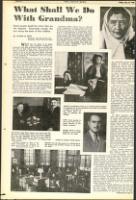
ABOVE: Grandfather carries on an ancient Jewish tradition
considered an asset rather
by remaining one of the guardians of our faith as he devotes
than a burden. They are con-
a portion of his time at
tributing to the general hap-
the Jewish Home for
piness of everyone and all is
Aged to studying the
well.
Talmud. -
In other instances, -how-
ever, the adjustment cannot
be made even partially and
LEFT: Card playing is
a tragic situation develops.
Children who may have dif-
one of the many recrea-
ferent standards, ideals, and
tional interests of the
beliefs than their parents,
Home's residents.
and who lived apart from
their parents for many years,
suddenly
find old feuds and
RIGHT: Myron A. Heys,
conflicts have been reawak-
President of the Jewish
ren throw open their homes and insist that Ma
ened. The parents may have
Home for the Aged.
and Pa live with them. There are several reasons
become even more old-fash-
for this, the strongest being that the children
ioned than before. They may
have enough affection for their parents not to
insist t h a t their children
want to see them "homeless" or "living with
spend every possible mo-
—Photos by Isadore Arnold Berger
other people."
ment with them to the exclu-
sion of friends and relatives,
Another reason is that it has
BELOW: The old folks pause for a photograph in
or be hurt because they are
been traditional for children to
the spacious and beautiful Lounge of the Home
left out of something even
take care of parents in their old
for Aged.
(Continued in last Column)
though it is personal.
T h e y, become dictatorial
and there is continual con-
flict because Ma or Pa
or d e r s everybody around,
tells a daughter how to raise her children, how to
cook, and how to clean her home, and offers the
family advice on various other matters, like
spending money, conduct, and attitudes. In some
cases, a parent may side with one member of the
family against another in an argument, complete-
ly disrupting the harmony of the home.
The most important difficulty arises if the old
folks are ill. Many aged people have something
wrong with them, and often are unable to do
much for themselves. They must be given con-
stant care and not all families are able to devote
the necessary time. In addition, there is the ex-
pense involved. Sometimes, the father is barely
able to support his family. The cost of another
mouth to feed, an additional room for the parent,
and doctor and medicine bills, may stretch the
family budget too far.
The situation, though difficult, is one that can
be solved if it is approached boldly by both the
old and young. The grandparent wants to end
his years happily, but he also wants his children
and grandchildren to lead happy lives as well.
(Continued on Page-7).