

Page Ten
Friday, December 1, 1944
THE JEWISH NEWS
Profile of a Fellow Named Joe
By RUSSELL McLAUCHLIN
T SAYS IN THE ENCYCLOPEDIA
that a concertmaster is "responsible for precise
attack, steady tempo and uniform bowing by
the violins." In no work of musical reference
which I have been able to consult does it define
a concertmaster as "a fellow named Joe." And
that, as most Detroiters will agree, is a serious
omission by the books of musical reference.
For a fellow named Joe is, nowadays, our
perfect definition for the word "concertmaster."
The concertmaster of the Detroit Symphony
Orchestra is such a fellow. His full and formal
entitlement is Josef Gingold. He is a good-
looking young chap, who passed his thirty-fifth
birthday last October. Karl Krueger engaged
him last summer. He had been second concert-
master of the NBC Symphony since that or-
chestra's inception, sitting side-by-side with
the famous Mischa Mischakoff. He came to
town in tha early autumn and, being such a
friendly sort, he almost immediately grew ac-
quainted with a great many Detroiters. I
wouldn't know about the rest of them, but in
the course of a single evening, he became per-
manently "Joe" to me.
Drama and Music Critic
of The Detroit News
He was six years old when the Germans of
the. Kaiser's army occupied his home city. He
had been playing the violin for three years. One
day, this little boy came upon some German
soldiers, one of whom was tuning a violin. He
spoke to them in Yiddish — which is quite in-
telligible to a German-speaker — and told them
he was a violinist. They handed him the fiddle
and he played for them. They offered him
money. But he told them that his family had
not eaten for days. And, that evening, four
sacks of food arrived for the Gingold family
and thereafter, all through that desperately'
troubled time, there was no starvation for the
Gingolds; all because little Joe had played a
violin.
The Gingold Career
I have been writing pieces about music in
Detroit for 25 years. I hate to think what the
early ones were like, but they've been going on
for a quarter-century, whatever their • quality.
And it would bother me to remember, in all
that time, another musician who has come to
town and so soon grown into the musical life
of the city as conspicuously and into the bosoms
of his colleagues, as affectionately.
All this being so happily the case, it might
be useful to explore the Gingold career and
search for meanings in the man's vital statistics.
Here, then, is a brief biography of our new
concertmaster:
He was born, in 1909, in Brest-Litovsk; the
town where the dreadful treaty was signed, at
Germany's pistol-point, just after the Russian
Revolution. Brest-Litovsk has come back into -
the news, fairly recently; and it's another story,
this time. Anyhow, that's where Joe Gingold
was born.
,
A Bouquet. for Krueger
It would have been so easy for him to have
replied with a lot of fine-sounding ' nonsense.
"A.-great musician, an extraordinary character,
a lofty scholar" — anything of that kind might
have come from a new concertmaster, in his
first conversation with a music critic. And it
would have been just exactly what lots of
Americans — even concertmasters and music
critics — call malarkey.
A Musician's Modesty
"This Joe Gingold," said one wise, old head
in the first fiddle section, "is the best man I
ever played behind. And, on top of all that, he's
such a heck of a nice guy. I complimented him
on a solo, the other day, after rehearsal. Do
you know what he said? He said, 'Nuts, I'm an
orchestra-player.' But I went on. And, all of a
sudden, he looked me in the eye and he said,
`It's pretty silly for any of us to get the 'big-
head, while Heifetz is alive.' You gotta like a
chap like that."
The first time I met Joe Gingold, we talked
of a thousand subjects and finally, in a gingerly
manner, I led the conversation around to Karl
Krueger. After all, the lad had been playing
under Toscanini for years. I knew this, and he
knew that I knew it. It was a mean trick, no
doubt.But I put him on the spot. I a Detroit
music critic, whom he'd just met and who was
years his elder, was asking hiin what he
thought of his new boss. It was a tough ques-
tion, as I perfectly well knew; a' test-question,
if you like.
Joe Gingold gave a broad grin. "Well„" he
said, "we've had two rehearsals. And do you
know what I think? I think he's my man!"
And, in a few weeks' time, we w e r e all
powerfully aware that this modest, genial
young musician was extraordinarily adept at
the promotion of precise attack, steady tempo
and uniform bowing by the violins. In a word,
we knew that we had an authentic treasure in
our new concertmaster. Karl Krueger had hint-
ed at something of the kind, of course. It was
fine to see it demonstrated.
But the opinions of conductors and of music-
critics — if it isn't blasphemy to say so — are
sometimes of lesser significance than those of
fellow-musicians; of the hard-working, dis-
illusioned, mellowed fiddlers whom nobody can
fool. How did they feel about the man who had
overnight become responsible for their uniform
bowing? It was easy to discover. The violinists
of the Detroit Symphony were eager to be in-
terviewed.
know that, one night every week, Gingold en-
tertains the younger violinists of the orchestra
in his home and, in the midst of good fellow-
ship, most carefully searches and analyzes the
current music for their benefit, gives a legion
of valuable pointers and, very often, specifical-
ly shows them how. No aspiring young fiddler
could possibly purchase such a benefit as that.
Our concertmaster feels that such a thing is
clearly within the scope of his duty — as it
certainly is his pleasure.
But, instead of that, he replied, with com-
plete honesty, and sincerity and conviction,
"He's my man!"
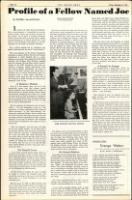
—Photo by Herman Krieger, Jewish News Staff Photographer
JOSEF GINGOLD AND SON, GEORGE
The family came to the United States in 1919.
Joe grew up in an East Side school and became
concertmaster of the school orchestra. When he
was 16 years old, following long study with
Vladimir Grafman, a wealthy New York real
estate man made possible two years of Eu-
ropean study, under 'Eugen Ysaye, the famous
old Belgian Nestor of the violin. That New
Yorker's name was Joseph Milner; another Joe
whom we'd do well to remember.
His Eminent Relatives
Especially on his mother's side, there is much
notable quality in his family line. Her maternal
grandfather was a lecturer on the Bible and he
gained great fame and the title of "Schneider-
sher Maggid." An uncle was editdr of the War-
saw "Hajnt" and composed the popular song
called "Die Grine Kuzine." Another uncle is
one of the editors of the New York Freiheit. He
has a cousin who is a music critic in Palestine;
but having a Music critic in the fami I y is,
naturally, something about which the clan does
not boast.
Our Joe is married and has a son named
George who, although only five years old, is
already showing promise as a pianist.
It was rather broadly hinted, early in this
writing, that Joe Gingold is popular with his
fellow musicians in the orchestra ,:This; is not
entirely due to a modest manner and a sense of
humor. It has a firmer basis than that. Did you
I hope I have given a faint hint or two of why
we are getting superlative music, this season.
When I reflect, as I must, on the state of things
two years ago, when the orchestra was hanging
for dear life to its weekly broadcast and had no
other organizafional existence at all; when I
reflect on this and contrast it with the splendid
promising present, then I must feel that it was
one of Detroit's greatest days when Karl Krue-
ger first shook hands with Henry Reichhold.
And I assure you that I know what I'm talking
about when I say that, of all the notable fruits
of that historigthancl-shake, there is none more
packed -with high potential for all of us who
cherish music, than. the presence in this town
of the fellow named Joe.
HANUKAH POEM
Strange Waters
"I have dig,g,ed end drunk strange waters"—II Kings 19:24.
By DR. NOAH E. ARONSTAM
I have digged and drunk strange waters,
I have drained the dregs of life;
have spilled my blood for ages
And have dreamt for end of strife.
And the end of ceaseless torments,
That assailed my day and night
Like the spectral shadows trembling
With the sunmaths in their flight
I have digged. and drunk strange waters,
I have fought the Syrian host;
I have judged my cause as hopeless,
And thought myself as lost.
I have summoned to my rescue
All the pledge of sacred trust,
And I fight today as ever
In the light that win I must!
I have digged and drunk strange waters,
But no longer shall. I grope!
For there becons in the distance
The promised land of hope!