

August
THE JEWi11 NEWS
Page Siz'
LEONARD BERNSTEIN
Leonard Bernstein, the composer who created a sensation
during the past season as assistant conductor of the New
York Philharmonic, has been engaged as guest conductOr
for the Detroit Symphony Orchestra' broadcasts on Sept.
24, Oct. 1 and 8. These weekly radio programs are spon-
sored by SAMS, Incorporated, and are broadcast over
Station WWJ. During the summer months, Mr. Bernstein
appears in the Hollywood Bowl, Hollywood, Calif., and at
Ravinia Park, outside Chicago.—The Editor.
able to strike a
death blow at
Fascism," he
said. He was dis-
tressed when
both the Navy
and the Army
rejected him be-
cause of an asth-
matic condition.
—World Wide Photo
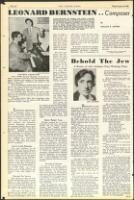
YOUTHFUL CONDUCTORS
NEW YORK—Leonard Bernstein, 25-year-old as-
sistant conductor of the New York Philharmonic Sym-
phony Orchestra and composer of the sensational new
ballet, "Fancy Free," conducted and played at the
Lewisohn Stadium.
When Mr.-Bernstein stepped down from the podium
to play the "Ravel Concerto for Piano and Orchestra,"
he was replaced by an even more youthful conductor,
20-year-old Lukas Foss, composer.
Mr. Bernstein won the New York music critics
award for his symphony "Jeremiah" in 1943 and Mr.
Foss won the award the same year for his shorter work,
"The Prairie."
This photo shows Lukas Foss conducting while
Leonard Bernstein is at the piano in Mr. Bernstein's
apartment during a rehearsal.
EONARD BERNSTEIN,
dark handsome young man,
barely past his 25th birthday, was
given an opportunity which is the
dream of veteran conductors the
world over. On notice so short
that rehearsal was impossible,
Leonard Bernstein, substituting
for seasoned Maestro Bruno Walt-
er, conducted the New York Phil-
harmonic Symphony Orchestra
through a difficult performance.
vs. The audience in Carnegie Hall
contained some of America's se-
verest music critics. The program
was broadcast on a nation-wide
radio hookup and short-waved
overseas. The result was acclaim
for Mr. Bernstein.
Had A Jewish Education
This new luminary in the
musical field was born in Sharon,
Mass. His parents, emigrants from
Czarist Russia, sent their son to a
Hebrew school, and he was reared
in the traditions of his forebears.
He is a graduate of Harvard Uni-
versity. At a recent interview, a
reporter from the Yiddish press
offered to send him a translation
of the story as it would appear in
the Yiddish daily. In "mama
loshen" the young maestro de-
clined saying, "I don't need trans-
lations, I can read Yiddish my-
self.•
Rejected for Service
The result is a man of well-
rounded personality who lives and
thinks as any intelligent young
American might, and who also ac-
cepts as his on the problems of
his people, the terrible plight of
the Jews in the hands of Fascism.
"How can I be blind to the
problems of my people?" he stat-
tkl to reporters at an interview.
"I'd give everything I have to be
His first sym-
phony, just com-
pleted and soon
to have its debut,
is " Jeremiah , '
based on the bib-
lical story of the
Prophet. In its
third movennt
is a vocal solo
sung in Hebrew.
NIr.Bernstein
plans some day
to compose and
direct a serious
Jewish opera.
While attending
Harvard, Leo n-
o r (1 Bernstein
took an active in-
terest in social
problems. He
continues to pur-
sue these inter-
ests today. His
reading is not
confined to mu-
sical scores, but
his tastes extend
to modern novels and philosophy.
His bookshelf in his Carnegie Hall
bachelor studio contains some pro-
found works, but Mr. Bernstein is
not above relaxing with a blood
and thunder comic book. His
tastes in music take the same wide
range.
Enjoys 'Boogie' Tunes
Perhaps unusual for a serious
musician he not only enjoys but
admits that he enjoys modern
"swing" and "boogie woogie"
tunes. When not working he is al-
ways ready for a good time. It may
be a "conga" line in a Latin night
club or a football game where he'll
yell his head off for. Harvard.
The person Leonard Bernstein
admires most is Sergei Koussevit-
zky, the Director of the Boston
Symphony Orchestra. Koussevit-
zky recognized the young man's
talent, his excellent ear, his mem-
ory of difficult scores and his un-
derstanding of the various styles
in which the classical masters
composed. Koussevitzky admitted
Leonard Bernstein to his special
class in conducting and orchestra-
tion, a class composed of a few
young musicians who showed great
promise.
Directed at Festival
As part of his training under
Koussevitzky, he was allowed to
direct concerts at the Berkshire
Music Festival. At these music
Pests, reminiscent of the Salzburg
festivals in pre-Nazi Austria, Bern-
stein gained his first experience as
a conductor of symphonic works.
Later, in the summer of 1943, he
was appointed one.. of Koussevit-
zky's assistants.
After he graduated from Har-
vard Mr. Bernstein took the advice
of Edward Burlingham Hill and
Heinrich Gebhardt, who suggested
that he make conducting his ca-
reer rather than the concert piano.
He feels he owes a great deal of
his success to his parents. He re-
calls with a smile the days when
his mother stood over him and
forced him to practice his music
when he would have preferred a
baseball game with his neighbor-
hood "pals."
At present, besides his assistant
directorship of the New York Phil-
hai-monic Symphony Orchestra,
Bernstein has a' commission to
25, 1944
Composer
By
WILLIAM B. SAPHIRE
write a ballet for one of the lead-
ing ballet companies. Already two
of his compositions, a sonata for
the clarinet and a cycle of five
humorous songs, have been per-
formed. He is under contract with
Warner Brothers for all his future
compositions, many of which will
be used in forthcoming motion
pictures.
(Copyright. 1944 by Independent
Jewish Press Service)
Behold The Jew
A Review of Ada Jackson's Prize Winning Poem
and hard upon his heaving flanks
the Huntsman, thirsty as a stoat ..
Wherefore of all earth's harried hosts
I beg God hardest for .the Jews.
*
ADA JACKSON
S
PREADERS of hate
have resorted to all sorts of tricks to
accomplish their purpose. They have
written their • words of venom in prose
and in poetry. They have used the
press and the radio, the public plat-
form and the rumor.
To reply to those who defame the
good names of individuals and groups,
the same media have been used.
Seldom, however, has the entire anti-
Semitic argument been answered in a
single poem.
Ada Jackson has finally accom-
plished this task, and her poem "Be-
hold the Jew," may well be said to
be the strongest argument that has
ever been advanced against bigotry.
Mrs. Jackson is a prize-winner.
In 1933; in England, she received the
National Poetry Prize. In 1943, also
in England, her "Behold the Jew" was
chosen for the Greenwood Prize.
The entire book containing this
poem. has only 24 pages. But every
word on every page is a gem, and
every one of the eight sections is an
epic answer to bigotry.
Mrs. Jackson has done such a
magnificent job and her poem is so
great a contribution to the cause of
justice and decency that she deserves
the Nobel Prize for her efforts. And
the Macmillan Co. has earned highest
commendations for publishing it.
* * *
The poet's. genius is reflected in
•
two elements: in deeply moving verse
and in a brilliant compilation of argu-
ment against anti-Semitism. Ada
Jackson emerges in "Behold the Jew"
as a one-person civic-protective agency
able to teach national groups how to
manage the fight against the ant i-
Semites, and how to put them to
shame.
She opens with a prayer for the
Jews:
Jew, I say—and in my heart
it rhymes with all the hunted things
that cower in brakes or die in reeds
of shattered beasts and broken wings,
so that upon the selfsame breath
I pray for Jews and driven birds
and badgers baited to their deaths."
In the spirit of Lord Byron, Mrs,
Jackson reminds her readers that "the
fox has yet his lair, the bird her nest;"
only among them all the Jew
must run and run without surcease
by day and night the long year thro',
the baying ever in his ears,
the dogs forever at his throat,
*
*
What can this brilliant author do
to alleViate Jewish sufferings? She
avows that
If I speak not—
if I forbear—I am as one
turned murdefer. It is as tho'
my own hands bore the knife, the
gun.
If she had gold, land, strength of
arm, "I would make battle for your
cause," she declares, addressing the
Jews. Not having these things, she
offers her one available talent:
One talent, yea. I have my words.
I give them to you, full and free;
will cry your name out without fear—
this will I do; this shall it be.
* * *
Ada Jackson's "Behold :the Jew"
contains an account of great Jews who
have made undying contributions to
mankind. But the glory she finds in
Israel is best described by the char-
acters who played a part in her own
life—the tailor Isaacs, the Yedvabniks,
Anna Marks.
It is a glorious account leading
up to a demand that all good people
should rise up against hatred. It is an
eloquent plea which finds its climax
in the concluding stanza:
There was a day
when warriors paled
and armies shook,
and a young lad
stooped down and took
five little pebbles
from the brook-
* * *
Every. charge against the Jew is
disposed of in simple and brief refu-
tations. There._ is nothing more elo-
quent than this Christian's call to
genuine brotherhood.
"Behold the Jew" is a very great
poem.
Will it be read by the people who
need its message?
Here is a job for someone to see
that this great work—which can be
read in 30 minutes—is read, that its
message is heard not by a handful
but by millions.
* * *
In his review of this poem in The
New Palestine, Dr. Ludwig Lewisohn
criticizes the book and states that "the
existence of a great and history-laden
people is not to be jukified and NEED
not be justified by its by-product con-
tributions to other cultures." He
states that he shudders to say that
"Mrs. Jackson's approaches and argu-
ments are merely the common or gar-
den variety of the philo-Semitic, which
is anti-Semitic turned inside out."
This criticism, in the view of this
reviewer, is applicable only insofar as
general criticism of the approach to
the anti-Semitic issue is concerned.
But since this has been the approach
of Jews as well as non-Jews, a great
poem like Mrs. Jackson's should not
be made to suffer for it.
Had Mrs. Jackson listed the great
Jewish achievements in Palestine in
her epic poem, Dr. Lewisohn's criti-
cism would have been removed. Give
Mrs. Jackson the chance to know this
angle thoroughly, and we are conf i-
dent that her next work—we sincerely
hope there will be a next—will be
complete and thoroughgoing.
,.--P. SO