

•Paige Sixteen
T'HE JEWISH NEWS
Mitoses, Strike
That Rock Again
A True Passover Story by DAVID SCHWARTZ
(Copyright, 1944, Jewish Telegraphic Agency, Inc.)
P
RIVATES MOSHE YAARI and Richard
Saunders were very unlike as far as superficial
appearances are concerned. Moshe was a Jewish
soldier from Palestine and Richard Saunders was
an Australian. Moshe was a brunet and Richard
was a blond. Moshe had 2,000 years of Jewish life
with all of its suffering bottled up - in him and
Richard had that background of freedom from op-
pression, which the non-Jew enjoys but only the
Jew can fully appreciate.
Yet despite all these differences, there was
much in common between Moshe and Richard—
beside the fact that they were both members -of
the same company of engineers in the British
forces in the Western Desert • under the command
of Brigadier Frederick Kisch. Richard, for one
thing, had a peculiar interest in things Jewish. He
was a rare mixture of the realist and mysticand
the Jew appealed to the mystic side of him.
On furlough some months back, Moshe and
Richard had gone together to Palestine and Rich-
ard had stayed at the home of Moshe. He felt that
this acquaintance with Palestine had made him a
great authority on Jewish affairs—he was alm.cAt
an amateur Jew himself. He had seen the Wailing
Wall and Tel Aviv—and above all he had met
Rivkeh, Moshe's sister, in Tel Aviv.
When Richard and Moshe talked together, yoU
wouldn't exactly suspect that they were friends,
for Richard had a light, almost sarcastic way of
talking to Moshe. But the sarcasm was a cover.
Richard was just afraid of allowing himself to
get sentimental.
It was the day before Pass-
over that Richard entered his
tent where he and Moshe -
camped, and found the latter
opening a box.
"Look what Rivkeh sent,'
said Moshe, "Matzohs, and she
writes, that you must eat them
with me. She said that now that
you are in the desert fighting
for freedom, as e did our ancestors
fleeing from Egyptian slavery,
you are a Jew too in the funda-
mental sense of the word and
must observe Passover also."
Wants Something Else
"Good old Rivkeh," said
Richard. "Thanks for the Mat-
zohs, but I wish it was some-
thing elSe, eh what, Moshe?"
Moshe paused and said noth-
ing. He knew, of course, what
was on Richard's mind. There
was only one thing on every-
one's mind in the desert.
"You know, Moshe," said
Richard, "what I dreamt last
night?" "You don't have to tell
me," said Moshe. "Everybody
in this company had the same
dream. They dreamt they walk-
ed along and lo and behold a
fairy stepped out and beckoned
them and pointed to a great
fountain of water and then you
opened your mouth and drank
and drank and said you would
spend the rest of your life drink-
ing water."
"Right," said Richard." That's
exactly the dream I had. You
know, if you will permit me to
change the subject back to your
Passover—you Jews are a disap-
pointment to me."
"How is that?" said Moshe.
It's Very Simple
"It's very simple,". said Rich-
ard. "Way back there in olden
times, you Jews would not go
along wishing for water. If you
came to a situation like this, you
would get water. Why in the old
Biblical days, you even parted
the waters of the Red Sea in
order that the Jews might cross.
Where is your magic power to-
day? Di the old days, Moses
A
when he needed water, struck a rock and there
gushed forth a strewn of water.
`Strike That Rock Again'
"Moshe," wound up Richard, "strike that rock
again."
Moshe listened—but said nothing. The desert
sun was beating down furiously. Ah, if only there
were a Moses, he thought, that could strike a rock
again—and bring forth a stream of sweet cooling
water. Seeking to forget the situation, Moshe
turned to rereading Rivkeh's letter. "You know,
Rivkeh is working in a factory now. She says she
is helping make pipes."
"They had better be making more guns," said
Richard. "You know what they are saying Moshe.
They are saying that without water, we will not
be able to go on—that the British forces are
doomed. Rommel will push on—in a few weeks he
will be in Palestine. The -whole Near East is -
dooined—the whole cause of the Allies—but the
vengeance that the Nazis will let loose on Pales-
tine will make everything they have done. in the
past look tame."
Yes, Moshe knew that Richard had not exag-
gerated the picture. If Rommel pushed on, Pales-
tine and the entire Near East was lost—and once
the Near East was conquered, a junction could be
formed with the Japanese and India could be con-
quered. The whole war might be lost—for the
want of water.
FrIcIaY, April 7- , 1944
Moshe thought about all these things—but like
the other soldiers—always their thoughts came
back to their own parched spirits—Oh, for a drink
of water!
As Richard and Moshe lined up for evening
call, they found only about half the members of
the company present. The rest were either lying
on their cots, parched for want of a drink or wer
in the field hospital.
Moshe took out- his gun: "If this were not a
fight for freedom, we could solve this problem,"
he said. "This gun could go off. A shot in the leg -
and we'd be in the hospital. They still have a little
water there."
.
.
Richard and Moshe turned in. The lights went
out and restlessly, they sought sleep.
It was still dark, when they heard .4 noise out-
side of their tent. How could this be? It was still
too early for reveille. Could the enemy be attack-
ing? No—it couldn't be that. It was simply a sound
of quiet talking they heard. They arose and poked
their heads outside. Everyone seemed to be stand-
ing in front of their tent, saying only one thing.
Water.
They Have Found Water
They went to the next tent. "What is it?" they
asked. •
The men simply said: "Water."
"Water, water—what about water?"
The men scarcely could speak. - "Water—water
they have found water."
"Found water. Gfeat Heavens. Where have
they found Water?"
MoShe looked on thoughtfully. He understood.
Now he understood the letter of Rivkeh. Under-
stood about that pipe factory in which she was
working. Moses had struck that rock again.
The Jewish brigadier, General Kisch, had con-
ceived the idea of piping water through a hundred
miles of desert. Thanks to this, the British were
able to forge ahead—and the whole Near East and
the Allied cause was saved.
•
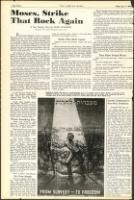
EDITOR'S NOTE: The above is a fictionalization of a true incident told by Peter Rainier in his new book
"Pipeline to Peace." It was the Jewish Brigadier Kisch, who later fell in battle, who conceived the idea of
bringing water to the desert soldiers, which at a critical time saved the whole Allied cause.
Jewish Community's
Post-War Problems
(Continued from Page 14)
We rightly assume that our
social problems require our spe-
cial efforts. It. is also wise to
recognize that our special Jew-
ish problems will not be solved
independently of other prob-
lems to which they are related.
This important lesson should
have been taught us by the
World War. If anti-Semitism
had been the only serious prob-
lem created by Nazi aggression
it would have been easier to
solve since it would have been
the irrational element in an
otherwise normal situation. On
the contrary, it was the total
situation created by the, Nazis
that was abnormal.
While the organization of ac-
tivities dealing with anti-Semi-
tism locally and nationally is go-
ing to call forth vigorous efforts
during a period of social flux, it
is important to recognize that
the special functions assumed by
national and local agencies in
this field are properly only a
part of a much larger program
of Jewish action.
Still Unanswered Questions
Many of the basic world ques-
tions are still unanswered. The
forms of national organization
for small nations in Europe,
their economic and political re-
lationships with the Great Pow-
ers, the way in which minority
ethnic and religious groups will
be adjusted in the societies of
the future, the extent to which
economic problems are going to
be determined in the post-war
settlement, all of these are basic
questions for the statesmen and
for all of us.
The characteristics of the post-
war world in Europe; -in the
Orient, hi the Near East, in the
United States, and elsewhere
will shape the future environ-
ment here and abroad. It is ex-
tremely doubtful whether Jew-
ish ideological viewpoints as
such are going to have an ap-
preciable effect on the decisions
which are going to be made on
these major issues.