

Pge Ten
THE- JEWISH NEWS
New Women
Take A NOW
residents
By RUTH KARPF
National Director of
Bnai Brith Publicity k
Passover, the Jewish Festival of Freedom commem-
orating the deliverance of Israel from Egyptian bond-
age, which this year begins on April 8 (first seder is
on April 7) is observed by Orthodox Jews for eight
days, but according to the Bible the holiday lasts only
a week. In Palestine Passover is observed for seven
days.
*
*
*
Archaeologists have established that the date of
the exodus of the Jews from Egyptian slavery was1
1447 B: C.., and that the Pharaoh of the Passover story-.
was Thotrnes III.
4
*
rX
*
country, this year was election year and two
new presidents have taken a bow.
Mrs. Epstein explains that her Zionist
career dates back practically to the embryo
stage. Her parents were Zionists and Mrs.
Epstein herself began taking an active part
as soon as she got out of college — New
York's Hunter.
In that record of two decades of service
is- included a six-year period as national
secretary, two years as president, a number
of years as vice-president and other respon-
sible positions. Mrs. Epstein includes the
direction of the f u n d raising campaign
which resulted in the erection, in 1939, of
the Rothschild Hadassah University Hospital
and Medical School in Jerusalem. Of the
many contributions Palestine has made to the
Allied war effort in all fields, this Hadassah
project is one of the most vital.
Next in interest is her work with youth. For
two years before her election to her present post,
she represented Hadassah as a vice-president on
the American Zionist Youth Commission. She
is a mother of two children.
Mrs. Epstein won her spurs heading the
Hadassah delegation to both Zurich and Geneva
World Zionist Congresses in 1937 and 1939.
*
*
*
A newcomer to the post of president—although
she has served six years as first vice-president
and the same number of years as second vice-
president of the National Council of Jewish
Women is Mrs. Joseph M. Welt of Detroit, who
will head the Council for the triennial period of
1943-46.
Mrs. Welt takes t h e responsibility *women
bear at this time very seriously indeed. "Never
since women-have received the right to vote have
they been faced with more serious responsibili-
ties than confront them at the present time," she
feels.
"With 10,000,000 American men in the fighting
forces it is up to the women to provide them
with a better peace time world to which to re-
turn. Today it is every woman's duty to make
an intelligent study of legislation and of candi-
dates in this election year and help to place in
public office the kind of men and women who
will qualify as leaders • in solving some of the
major problems which will result from this war.
To make more women conscious of this respon-
sibility is one of the Council's main tasks,". Mrs.
Welt explains.
Despite the long and extensive list of social
and civic activities to which she devotes, and
has devoted time and interest both in the past,
in the present "and in the future" as she points
out with a smile, and despite, or perhaps because
of, her vital interest in the affairs of the world
and people, she is basically a mother and a wife,
proud of her pretty little granddaughter a n d
deeply concerned with her whole family and
their - problems. She has simply translated her in-
telligent, unsentimental but affectionate concern
with them into her social and public work.
Thus, while she is, of coftrse, interested in
every phase of Council work (she summarized
the organization's goals in a letter written to
members a few days after she was elected as:
"first, to do our utmost to aid the war effort;
second, to guard our social gains and maintain
established programs which are important for
long range planning; and third, to be prepared
to do our share in meeting the problems of re-
habilitation after peace.") It is the direct' human
problem which touch her most directly.
"Council's work with the foreign born—mak-
ing individuals that have lost security and the
ground under their feet into happy and useful
citizens, this seems to me one of the most wonder-
ful tasks a woman could be entrusted with," Mrs.
Welt said. "In our work with immigrants we
have been concerned with many unattached
women and children, but our real objective is
the preservation of the family unit." It is for
this reason, Mrs. Welt explains, that Council has
compiled a master file which will be used after
Passover
Particles
By BERNARD POSTAL
F OR TWO of the most
important Jewish women's organizations in this
One of them is Mrs. Moses P. Epstein, na-
tional president of Hadassah, who is really giving
a repeat performance of her leadership of the
Women's Zionist Organization of America. Mrs.
Epstein held that post once before, from 1937 to
1939. The other is Mrs. Joseph M. Welt of Detroit,
president of the National Council of Jewish
Women.
Friday, XpriT 7, 7344N,
.
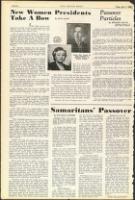
Below,
Mrs. Moses
P. Epstein,
President of
Hadassah.
Although in this country we use square, rectangul ;
lar or round matzoth impartially, depending on which
company's products we buy, the custom until the age!
of--machinery was that matzoth should be round.
*
*
The original reason for perforating matzoth was tat
prevent the dough from rising.
*
*
*
The earliest kriown edition- of the Haggadah extant
is dated 1505 A.D., and was printed at Fano, Italy.
*
*
*
Handel, Schubert, Rubinstein and Mendelssohn are
among the famous composers inspired by the story c
the exodus of the Jews from Egypt to create musical
masterpieces.
*
*
*
The word seder literally means "order of service.'
*
*
*
In the Spitalfields section of London's East End,
was once the custom for Jewish householders to pre,
sent matzoth to their non-Jewish neighbors on Pass.-
over and to receive in return plum puddings on
Christmas.
*
*
*
The pasty charosses, which is included in the Pass-.
over menu as a reminder of the mortar used by the
Israelites for making bricks in Egypt, once had a more
practical meaning. Taking the injunction to eat bitter
herbs at the seder table literally, many Jews' would
seriously burn their tongues on the sharp condiments.
To allay the burn a preparation of apple, nuts, wine
and cinnamon—our own charosses—was suggested.
*
*
*
"Chad Gadya," which is the closing hymn of the
Haggadah, is written in the style of the popular nursery
rhyme, "This is the house that Jack built," and is de-
signed to retain the interest of children in the Pass-
over service. Musicologists claim that the melody for
"Chad Gadya" was borrowed from a French folk tune.
*
*
*
The first Passover service to be broadcast by tele-
vision came from New York City in 1940.
-
Above, Mrs. Joseph M.
Welt, President of
National Council of
Jewish Women.
the war
an en-
deavor to unite fami-
lies that have b e en
separated in the havoc
the Nazis w r ought
throughout Europe.
Mrs. Welt is all energy and her gray eyes all
determination as she sums up why she is happy
to be able to- shoulder the responsibilities that
come with being preident of a national women's
organization of Council's size and activities:
"We must remember that our boys who come
back will have changed to the extent that they
will never again recognize such a thing as dis-
tance between countries, or isolation from, other
peoples of the universe. We must keep alive their
faith in us and the belief that this time the fight
for freedom and dec'ency has not been. useless."
(Copyright, 1944 ; Jewish Telegraphic Agency, Inc.)
Samaritans' Passover
By WILLIAM B. SAPHIRE
EDITOR'S NOTE: The most an-
cient Passover rites are still practiced
in our times by the Samaritans. re-
siding in Nablus, Palestine. Inde-
pendent Jewish Press Service writer.
Willian B. Saphire, tells you of this
strange sect.
At twilight this Passover eve,
on the slopes of Mount Gerizim
in the heart of 'Palestine, a small
group of people in the tradi-
tional garb of their biblical an-
cestors will congregate around a
sacrificial altar to witness the
slaughter of the Paschal Lamb.
For more than 2,000 years these
people have been coming to an-
cient Gerizim to open their Pass-
over observances with the origi-
nal sacrificial ceremony of the
Old Testament.
They are t h.e Samaritans,
claimed by some to be the rem-
nants of part of the ten Lost
Tribes of Israel. They are the
only Jewish group today w h o
observe the sacrificial custom.
The history of the Samaritans
is bound up with the mystery of
the dispersion of the Kingdom
of Israel. Nearly 2,500 years ago
the Ten Tribes of Israel were
conquered and scattered by the
King of Assyria, who then
brought a tribe known as the
Cutheans to replace the Israel-
ites and settled them in Samaria,
the f o r in e r capital of Israel.
Whether the Cutheans really
numbered members of the tribes
of Ephraim, Levi, and Mannas-
seh among them, as some claim,
no one can say with certainty.
After settling in Samaria, they
became known as Samaritans;
and made the Law of Moses
their religion.
Chosen Sanctuary
The people of Benjamin and
Judah, returned from "the wil-
lows of Babylon," looked upon
the Samaritans as an idolatrous
clan who would corrupt Juda-
ism. To the Jews, Jerusalem was
the Holy City; to the Samari-
tans, Mt. Gerizim, overlooking
the ancient city of Shechem, was
the chosen sanctuary of God.
The Judeans were not alto-
gether wrong in accusing t h e
Samaritans of idolatry. Their
early religion was a strange
blend of Mosaic law and pagan-
ism. Dark terrors and supersti-
tions of their tribal days still
haunted them. When they first
settled in the land of Israel, the
Samaritans suffered plagues and
other hardships. They attributed
these to the wrath of the un-
hospitable God of Israel. To at-
tain the goodwill of the Hebrew
God, they imported Levites to
train them in the ways of their
predecessors. But these were not
true Levites, being themselves of
mixed blood and their concep-
tions of Judaism were distorted
by pagan fantasies.
A Samaritan Council
During the construction of the
Second Temple in Jerusalem, re-
lations between the Judeans and
Samaritans were especially tense.
The Samaritans used every
means to sabotage the building
of the Temple. In small bands,
they fell upon supply • trains
bringing timber from Lebanon.
They succeeded in delaying for
15 years the construction of the
Temple.
Nonetheless, there was a grow-
ing resemblance between the re-
ligious institutions, of Samaria
and Judea. The resemblance in-
creased with the erection of a
Temple on Mt. Gerizim. Though
Samaritans and Judeans• often
fought among thernelves, they
joined forces against the common
enemy when Vespasian and the
Roman legions invaded Pales-
tine. At the time of the Diaspora,
the Samaritans were absorbed iby
the Roman political state.
Remained on the Soil
. While the majority of Jewry
suffered and enjoyed the alter-
nate oppression and prosperity
of exile, the Samaritans remain-
ed on the ancient soil. From their
fastnesses in the rocly hills of
central Palestine, they watched
the great Roman Empire- crumble
with slow corruption and_*eari-
ness. While Arabs, and later the
Turks, swept over the Near East,
the tiny Samaritan community
lived in peaceful obscurity. Its
numbers dwindled with each
generation. -
Today the surviving Samari-
tans still cling to their traditions.
They speak Hebrew, Arabic and
the ancient Aramaic. Their city
is still Nablus (Shechem). They
graze their sheep and goat herds
even as they did in biblical days,
while along the nearby highway
between Jerusalem and Galilee,
speed the modern buses of their
Hebrew brethren.
The little Samaritan commu-
nity now numbers no more than
258 persons. Yaacov ben Uzzi
Hacohen, a leader of the- com-
munity, has appealed to the Jew-
ish leadership -in Jerusalem to
save them from destruction.
This year, too, the Samaritans
Will assemble on Mt. Gerizim
and offer the Paschal Lamb on
the ancestral altar, even as the
ancient Hebrews had done cen-
turies - ago. Their hearts will be
laden with grief over their own
diminishing number and over the
tragedy that has befallen their
brethren, the Jews of Europe.
Their sons and daughters often
follow their fancy and marry
some of the young Jews who
flock here from all corners of
the world. And the parents look
on and nod their heads wist-
fully as they see the gap be-
tween them and the Jews being
bridged. .
(Copyright, 1944, by Independent
Jewish Press Service, Inc.)
—