

Page- Eight
THE JEWISH NE'W . S
Fr-Ocfoliet 1,. 1941
Dr. Max Nordau
The Moulder of a People's Ideals
A Review of a Splendid Biography by the
Widow and Daughter of the Great Philosopher
and Zionist Leader.
AX NORDA1.1 was the
man chosen by Theodor Herzl to deliv-
er the keynote addresses at World
Zionist Congresses, beginning with the
First Congress in Basle, Switzerland.
There was good reason for this choice.
Dr. Nordau was a great philosopher
and was a brilliant interpreter of the
ideal of freedom, especially as it ap-
plied to the needs of the Jewish peo-
ple.
Dr. Herzl was the brilliant states-
man who impressed heads of govern-
ments with his impassioned pleas in
behalf of his suffering people—and
even more so with his striking per-
sonality. But Nordau could do more
than that: he was the one man who
could sway the Jewish people and who
was able with his oratory and logic
to become the chief factor in laying
the foundation for the Jewish national
movement as it is represented by Zion-
ism.
For Zionist Cause
Dr. Nordau was outstanding in many
fields. He was an able journalist, a
good physician, an art critic, linguist
and sociologist, a playright of merit.
But all these qualities were incidental
to his passionate love of freedom
which led him ,to leadership in the
movement for the acquisition of liber-
ty for Jews: the Zionist cause.
It requires real art to be able ade-
quately to describe the genius of this
man, and properly to evaluate the.
heights to which he rose in champion-
ing Israel's cause. His widow, Anna
Nordau, and his daughter, Maxa Nor-
dau, the distinguished painter, suc-
ceeded in accomplishing this task.
As joint authors of the biography of
their husband and father, they have
given this generation a magnificent
pen portrait of one of the greatest
men of this century.
This biography ought to serve as re-
quired reading for all students of mod-
em history. In reviewing the life of
Nordau, the authors naturally cover
the important phases of European his-
tory as they affected their hero and
as they influenced the course of his
future career.
Bitter Experience
Had it not been for the turn of
events in Europe, the corruption, the
bigotry, the failure of emancipation,
Nordau, like Herzl, might never have
interested himself in Jewish nation-
alism. But bitter experience dictated
the course of action both leaders had
taken in choosing their major careers
as champions of their people's rights.
By
PHILIP SLOMO,VITZ
tions, the fact that he was the first
"columnist" in the modern sense of
the word, makes his life's story read
like a novel. But his Zionist activities
did dominate his career, and it is as a
Zionist Bible that this biography must
be considered.
In listing Nordau's qualities, there
is one term that must not be omitted.
It is that of Prophet. He was a modern
prophet in every sense of the word.
His warnings to German Jewry, nearly
50 years ago, read today like the ad-
monitions of the sages of old. He
pleaded the cause of Zionism with a
devotion and conviction which often
devastated the arguments of his op-
ponents. Hurling back the arguments
of the anti-Zionists, in an address in
1898, he declared: "In our camp is
Israel, in the other dead limbs."
"Herzl, unwilling to rise
to his own defense, asked
Nordau to reply. The con-
troversy raged with flam-
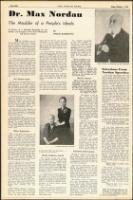
Max Nordau—A Painting by His Daughter
ing. bitterness. To Nordau
these 'dreamers of the
ghetto' seemed to conceive the
Jewish people as a gigantic head
without a body, a monstrous im-
age. He wrote an article which
He had sad experiences in Berlin,
burned its way through the en-
where Jews met him with cold hos-
"I must utter the painful word. The
tire Jewish Press.
tility. At this meeting, on Jan. 23, 1899,
nations which emancipated the Jews
before an audience of 4,500, he de-
have mistaken their own feelings. In
Herzl's Answer
clared:
order to produce its full effect, eman-
"Herzl, having read the article,
cipation should first have been corn-
"A day will come on which Zionism
wrote him: 'I've now read your
pleted in sentiment before it was de-
will be as needed by you, you. proud
annihilation of Achad Ha'am. It's
clared by the law. But this was not
Germans, as by those wretched Ostju-
remarkable enough that we are
the case . . . The emancipation of the
den, whom you fear and hate! A day
already forced to fight such bat-
Jews was not the consequence of the
will come on which you too will beg
tles. The only explanation is this:
conviction that grave injury had been
our help and be suppliants for asylum
we are already in the midst of
done to a race, that it had been mis-
the Jewish State, though
treated most terribly, and that it was
few suspect it as Yet.' "
time to atone for the injustice of a
thousand years; it was solely the re
The history of the en-
sult of the geometrical mode of
tire Zionist movement
thought
of French rationalism of the
passes in review in the
18th century . . The men of 1792
Nordau biography. Those
emancipated us only for the sake of
who are puzzled by the
principle.
events of 1920 and 1921,
"To Jewish distress no one can re-
the years which were
main indifferent, neither Christian
marked. by the rift in the
nor Jew. It is a great sin to let a race
Zionist movement, with
to whom even their worst enemies do
the late Justice Louis D.
not deny ability, degenerate in intel-
Brandeis as a chief factor
lectual and physical distress. It is a
in the controversy, should
sin against them and against the work
study the Nordau biogra-
of civilization, in the interest of which
phy. This great leader was
Jews have not been useless co-work-
then in London. He made
ers.
certain proposals which
were ignored.
"The Jewish distress cries for help.
To find that help will be the great
Perhaps it is out of def-
work of this (Zionist) Congress."
erence to some of. Nor-
—Address at First World Zionist Con-
gress, in Basle, Switzerland; in 1897.
dau's best friends, like
*
*
*
Dr. Chaim Weizmann,
that the biography does
"It was once humorously asked
not make much of the re-
what would haVe become of Liszt and
jection of the Nordau
Paganini if they, with their specific
program. From the biog-
genius, had come into the world be-
raphers we gather that
fore the invention of the piano and
Weizmann and Nordau
the violin. Herzl supplies the answer
were great friends.
to this question. He was actually a
Liszt or Paganini born before the in-
Weizmann was among
vention of the instrument by which
those who urged Nordau
alone his genius could be revealed.
to make a trip to the
Herzl was born a statesman of the
United States in the in-
first water, without a state, without
terests of Zionism. But a
an organized people, without a single
severe illness which re-
Anna and Maxa Nordau
one of those assets with which one
sulted in his death on
can engage in practical politics . . . .
Jan. 21, 1923, prevented it.
"Our people has had a Herzl, but
in that land which you now scorn! .
Herzl never had a people. That does
Crowded
Achievements
I warn you of the future.!"
not depreciate him, but casts a slur
upon us . . . Herzl was a model and an
He was 74 when he died. But into •
educator. He straightened the back of
Berlin Audience Jeered
his lifetime, which was marked by
a .broken people. He gave them hope,
many controversies, and by exile to
The audience jeered. The authors
he showed them means. The seed will
Spain from France during World War
of the Nordau biography state that
sprout, and his people will garner the
1, were crowded achievements and ac-
"the German Jews . . . wanted to get
harvest.
complishments that seem to total up
rid of that threatening voice." Even.
into many generations.
—Memorial address in tribute to Dr.
Theodor Herzl at Seventh World
Herzl suppressed that passage from
Zionist in 1904.
This reviewer warns his readers to
the report of Nordau's address pub-
*
*
*
accept his recommendation of the
lished in the Zionist organ, Die Welt.
"The
Zionist
organization
is the
Nordau biography as a very humble
But the admonition stuck. Those who
framework of the redeemed Jewish
and limited description of this fine
recalled it later recognized prophecy
people of the future . . . The Jewish
book. It must be read to be appre-
in Nordau's words.
people will live. Zionism is the ex-
ciated, and no Jew who seeks infor-
pression of this determination to live
A conscientious reviewer must ad-
mation and desires to know well the
. . . Our Zionist consciousness, our
mit a sense of guilt in his inability to
story of mankind and his people can
undismayed Zionist activity, denote
do justice to a review of this great
afford to pass up this book.
that the Jewish people remains true
biographical sketch. If it even remotely
to itself and its two thousand year old
Max Nordau, author of "Degenera-
suggests commentary on European his-
ideals. Such faith overcomes every
tory, it is actually an effective inter-
tion" and "Conventional Lies," and
obstacle!"
of at least 25 more books, including
pretation of Jewish history during
—Address at Tenth Zionist Congress
essays,
short
stories,
dramas,
travel
in Basle in 1913.
Nordau's lifetime.
descriptions, philosophic discussions,
has received merely a hurried intro-
Those who seek full explanation of
duction in this review. To be fully
(Note: The Nordau biography was pub-
the many complicated elements of the
lished by the Nordau Committee, 386
appreciated, every Jew, certainly
Affaire Dreyfus must read Nordau's
Fourth Ave., New York City. The book
every Zionist, should possess and read
is available at a reduced price to mem-
speeches to acquire understanding of
bers of Zionist organizations. Informa-
Anna and Maxa Nordau's "Max Nor-
tion will be offered gladly at. the of-
this famous case.
dau: A Biography."
fice of The Jewish News),
—
There is a vast difference between
the Jewish upbringing of Herzl and
that of Nordau. The former was more
thoroughly assimilated and his Jew-
ish background was limited. But Nor-
dau had a fine Jewish training. The
son of Rabbi Gabriel Suedfeld of
Budapest, he had learned the Torah
and the language of the Torah.
At the age of 16 he gave Hebrew
lessons to children of a family at an
estate at Rakosz - Keresztur, near Pest,
and he often had to recite passages
from the Torah and put on Tephilin
with his pupils daily. The peasants
even called him "Cantor." But soon
thereafter, when he settled in Paris,
he was, like • Herzl, estranged from
Jewry. Subsequent events caused him
to find his way back to his. people.
Of interest is the fact that Nor-
dau was named Simon Maximilian
and that his family gave him the pet
name Simi. His Jewish names were
Simcha Meir, meaning "joy" and
"light."
Even without reference to Zionism,
Nordau's checkered career causes his
biography to be a most fascinating
story. His controversies with other
Writers, his first literary contribu-
For complete knowledge
of the basic elements of
Zionism as contrasted with
territorialism and with the
cultural aspects of Achad
Ha'Amism, it is necessary to
get the viewpoint of Max
Nordau. When Achad Ha'Am
launched his attack on pc.-
` litical Zionism, Nordau re-
plied. His biographers ex-
plain:
Selections From
INTordan. Speeches