

THE JEWISH NEWS
Page Eight
N% EVERY BOND YOU BUY BRINGS VICTORY CLOSEfr
nu,.
Friday, September 3, 1943
Back the Attack with War Bonds
This Advertisement Sponsored By
WILLIAM HORDES
Insurance
605 FOX BUILDING
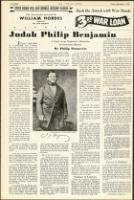
Judah Philip Benjamin
J
UDAH P. BENJAMIN
U. S. SENATOR from Louisiana,
1853-1861, who held the posts of At-
torney General, Secretary of War and
Secretary of State of the Confederacy,
and who was one of the guiding spirits
of the rebellious Confederate States,
has been compared with Benjamin
Disraeli by biographers who have re-
ferred to these two illustrious men as
the outstanding Jewish statesmen in
world history.
Biographers also have
grouped Benjamin with
Louis Dembitz Brandeis, in
referring to America's out-
standing Jewish personali-
ties.
A Study of an Important Character
In American History
B y Philip Sloniovi 4z
Disraeli. The parallel is rather remote.
True, they were both born Jews; both
had intermarried; both rose to great
political heights.
But Benjamin Disraeli, in .spite
of his conversion, had to his
credit such great -nooks as "David Al-
roy," "Tancred" and "Coningsby",
In one of the hundreds of notes
appearing at the end of the volume,
the author gives as authorities for
these statements: "Herbert T. Ezekiel
and Gaston Lichtenstein, 'The Jews of
Richmond,' and conversation with the
authors. They wrote that it was a
Richmond Jew, Ellis Bot-
tingheimer, who remember-
ed seeing Benjamin being
`called up' at the syna-
gogue."
2—The strongest claim
to Jewishness made for Ben-
jamin is contained in the
following statement in
Meade's biography (page
50): "Like so many of Jew-
ish blood today, Benjamin
tended to become cosmopoli-
tan. But although he grad-
ually separated himself
from Jewish affairs, he nev-
er renounced his ancestral
faith."
Robert Douthat Meade,
who has been professor of
history at the University of
Illinois, Vanderbilt Univer-
sity and the University of
North Carolina, makes an
excellent case for the former
claim in his interesting bio-
graphy, "Judah P. Benja-
min: Confederate States-
man," which was published
by Oxford Press. But Jewish
historians will seriously dif-
fer with him.
But—read the explana-
tory note on this statement:
Mr. Meade's historical- re-
cord woven around the life .
of Benjamin reconstructs
one of the most interesting
periods in American history.
He acquired his background
on the subject from three
experts on Southern history
—William E. Dodd, Dumas
Malone and Avery Craven.
But he did not limit him-
self to these. He went to
Jewish sources, interviewed
descendants of the Benjamin
family, and his study is one
of the most all-embracing
ever undertaken on the sub-
ject.
"Mrs. Myrover . . . quoted
her mother-in-law as say-
ing that Benjamin inquired
complainingly of his own
mother why she named him
Judah.
The result is therefore an excellent
contribution to American literature,
and an able analysis of the life and
character of the brilliant Confederate
leader.
At the outset, the author of the Ben-
jamin biography makes much of the
fact that the Confederate statesman was,
like Ibn Ezra, Baruch Spinoia and Dis-
raeli, of Spanish Jewish stock. "The
aristocrats of Jewry" he calls them.
-
The elder Benjamin was an affil-
iated Jew. In Charleston, the family
worshipped in Beth Elohim Synagogue.
But Philip Benjamin, the father of
Judah, rebelled against orthodoxy and
joined in forming the Reformed So-
ciety which lasted but a few years and
was dissolved in 1833. It is believed to
have been the first Reform Jewish
movement in this country, antedating
the Reform movement started by Dr.
Isaac M. Wise.
It is evident that the Jewish influ-
ences on the life of Judah P. Benjamin
were weak and that his loyalties to
Jewry were limited, and on this score
this reviewer differs with Mr. Meade
in his comparisons of Benjamin with
"William Cabell Bruce
(letter to author, 8 Apr.
1931) gave the following
story which was repeated to
him by John K. Cowen, for
many years General Counsel
—(Photograph by U. S. Army Signal Corps)
for the Baltimore and Ohio
Railroad: 'On one occasion,
Benjamin, when in Balti-
more, went before a Justice
of the Peace to make affi-
davit to a paper. A blank
had been left in the certificate of affi-
each representing a great tribute to the
davit for the insertion of the name of
spirit of the people Israel.' The only
the affiant, and, when Benjamin hand-
parallel to this in the life of Judah P.
ed the paper to the Justice, he asked
Benjamin is to be found in two refer-
him to fill in the blank.
ences to his Jewishness in Prof. Meade's
" Instead of inserting the name Ju-
biography.
dah, the Justice inadvertently inserted
Here is the first instance:
the name Judas; whereupon, Benjamin
reclaimed possession of the paper and
1—"With the future so critical for
dashed it down with great force on the
(Jefferson) Davis and his chief minis-
desk of the Justice, exclaiming, as he
ters, did Benjamin turn more to relig-
did so: 'My God, man, is not Judah
ion? Did he now find in Judaism the
Jew enough?' "
faith that sustained so many of his
forefathers in their hours of trial? The
This appears to your reviewer il-
undeniable fact is that he was seldom
lustration enough of an attitude that
among the crowds who flocked to 'the
seemed to mark the character of a man
churches during the war. A Richmond
who was a great lawyer, a brilliant
Jew remembered his being 'called up'
statesman, one of our country's out-
to the reading of the law at Beth Ahaba
standing orators of all time.
synagogue, but he never attended there
more than a few times. Yet Benjamin
Evidence to Contrary
did not foreswear Judaism and he 're-
There are numerous references to
mained always a firm believer in im-
Jews in this fascinating biography,
mortality and in personal divinity.' It
which, was written with painstaking
appears to have been a genuine, if not
devotion by Prof. Meade. It is evident
too active faith.-
throughout the book that the author is
"Incidentally, he was friendly but
anxious to indicate that anti-Jewish
not partial to the Jewish soldiers; of
prejudices were non-existent. But there
whom more than 10,000 served the
is occasional evidence to the contrary.
Confederacy, some with conspicuous
For instance, while he was Secretary of
bravery." (Page 285).
War of the Confederacy (page 280):
"Many of the suspicions against him
arose from the fact that he was in a
public position that made him suscepti-
ble to criticism, and from his manner
of living. Thus to attempt to bring the
cask of sherry into lean, suffering
Richmond of 1864 was to invite suspi-
cion of corruption even more than
gambling.
"There was an exaggerated story in
the army about 'that damned Jew,' liv-
ing on 'fine wines, fruits—the fat of
the land,' and keeping open house in
Richmond. But doubtless Benjamin felt
that he was making tremendous sacri-
fices for the Confederacy and fully
earned his little pleasures. At times he
seemed so indifferent to criticism that
some of his associates may have been
inclined to suspect the worst."
In reality, he was not indifferent to
attack, and was hurt by some references
to him, including the charges of thiev-
ery while a student at Yale.
Jewish Senators
There is another interesting refer-
ence in this biography to Benjamin's
Jewishness. Mr. Meade states:
"There appears to have been little
or no opposition to him because of his
Jewish blood ... The Wilmington Jour-
nal had quoted an article from the
Mercury written before his appoint-
ment, praising the Jews as 'amongst
the most faithful and patriotic of the
people of South Carolina.' It adds: In
the Senate of the United States they
furnished two Senators, and both of
these Senators were from the South,
and both of them have been foremost
in vindicating the rights, interests and
liberties of the South. Mr. Benjamin
and Mr. Yulee are worthy to sit in any
assembly of statesmen in the world.'
This story will be incomplete
without recapitulation of the story
of Senator Yulee who shared Ben-'
jamin's sentiments on the questien of
the South's secession from the Union.
Yulee was the first Jewish Congress-
man, servino. in the House of Rep-
resentatives b before being elected to
the Senate.
Florida seceded from the Union,
Jan. 10, 1861, and the formal an-
nouncement was made 11 days later
in the Senate by Yulee. After Lee's
surrender, Yulee was named a mem-
ber of the committee from Florida
to go to Washington and confer
with Lincoln concerning Florida's
return to the Union.
He was arrested on his way to
Washington, and was the last of the
Confederate leaders to be released,
in 1870, through the efforts of the
former Confederate General John-
son, whose plea was made to Presi-
dent Grant.
Success in England
In this connection, it will be of in-
terest to take a census of the Jews who
served in the United States Senate, and
the States they came from. Towards the
end of Meade's biography (page 372),
in the chapter which describes Benja-
min's great success as a lawyer in Eng-
land, after his flight from this country
upon the defeat of the Confederacy, we
are told:
,
"The last American known to have
called upon him was a Cincinnati Jew,
Gustavus Wald. Arriving with a letter
of introduction from Senator Jonas of
Louisiana, he was cordially received by
Benjamin. He took Wald to hear him
argue a case before the Privy Council,
(Continued on Page 9)