

Page Six
-
Friday,
9 June I., 1 43.
THE • JEWISH NEWS
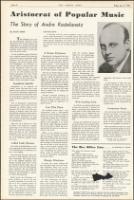
Aristocrat of Popular. Music
The Story of Andre Kostelanetz
By DAVID EWEN
T
HE UNIQUE place that
the Russian-Jewish musician Andre
Kostelanetz fills in radio recently was
emphasized by a national poll among
radio editors. Kostelanetz was the only
musician voted a place in both pop-
ular and serious music.
In the symphonic group, Kostelan-
etz's orchestra earned third place di-
rectly below that of Toscanini's NBC
Orchestra and the New York Phil-
harmonic, and several degrees above
the Philadelphia and Cleveland or-
chestras. What is amazing about this
is that Kostelanetz never has con-
ducted a major symphony orchestra
over the air. His orchestra—on the
Sunday afternoon Coca Cola "Pause
that Refreshes" program—has con-
cerned itself for the most part with
lighter classics and popular songs.
Symphonic Quality
Kostelanetz is an aristocrat of
"sweet" music. His music has a sym-
phonic quality when he is performing
a current hit. Kostelanetz exploits lus-
cious orchestrations. He presents them
in performances requiring almost as
much fastidious preparation as a sym-
phony.
Part of Kostelanetz' phenomenal,
and sustained, success comes from his
insistence on taking popular music
seriously. He is one of the few per-
formers of popular music who have
had lifelong training in serious music.
Unlike serious musicians who turn to
more popular expressions, he does
not look upon his work with snobbery
or condescension.
When he was in Warsaw, in 1922,
he heard a jazz record in a phono-
graph shop. It was his first acquaint-
ance with American popular music.
Then and there, he says, something
happened to him. It was a case of love
at first hearing, He has remained in
love with American popular music
ever since.
Called Little Dictator
He works as painstakingly as if he
were preparing an opera performance
at St. Petersburg or a symphony con-
cert in Los Angeles.
The musicians who play under him
call him a little dictator. He drives
them relentlessly. His temper flares
up at the slightest defection. But,
though working under him is hard,
the musicians would rather play for
him than for most any other popular
music conductor. For one thing he
knows what he wants, and he has the
technique and knowledge to achieve
it without blind groping.
Radio knows the Kostelanetz 45-
piece orchestra as one of the best
sounding ensembles of its kind over
the air. It has a luscious texture of
tone, and a beautiful blending of
choirs. That tone is a Kostelanetz
trademark, and identifies his perform-
ances as unmistakably as the sound of
the old Philadelphia orchestra used
to betray the hand of Stokowski.
EDITORS NOTE:
A musician who has given symphonic stature to the popular
classic, Andre Kostelanetz is a favorite - among radio editors because
of what he has done for the democratization of American music. The
noted musical biographer and editor, David Ewen, here sketches
the background and the achievements of the Russian-Jewish artist who
has gone far since he was assistant conductor at the St. Petersburg
Opera.
A Serious Performer
Kostelanetz's background had pre-
, pared him for his career. It is much
to his credit that he still considers
himself a serious performer with an
artistic purpose — even though
- the
bulk of his repertoire today consists
of Kern, Gershwin, Berlin and the
hits of other popular composers.
The son of wealthy Russian-Jewish
parents, he was early trained in mu-
sic. As a child he showed so little
aptitude for the piano, and such a
dislike for practicing, that his par-
ents reconciled themselves to the fact
that their son was not musical. When
Andre was six and convalescing from
an attack of scarlet fever his nurse
used to soothe him by singing the
songs of Schubert.
Schubert awakened something in
him, and from that time on he re-
quired no urging to follow music. At
the age of eight he appeared at a
public concert.
Can Pilot Plane
He combined music study at the
Conservatory with a well-rounded
education at the University. Today he
betrays the fruits of his schooling in
a searching intellect that is almost as
much at ease in science, literature,
politics and languages as in music.
He speaks eight languages fluently.
He can even pilot a plane. He is un-
questionably the best air-traveled mu-
sician in the world.
When, at the outbreak of revolu-
tion in 1917, his parents decided to
flee from Russia, Andre was left be-
hind with the hope that his presence
might help salvage something from
the wreckage of confiscated millions.
He was not able to save anything ex-
cept a sound musical training, with
which he continued at the Conserva-
tory. Completing his studies he was
given a post as assistant conductor
at the St. Petersburg (subsequently
Leningrad) Opera.
Hungry
Musicians
In those days, music making did
not take place under the most favor-
able conditions. There was no coal
with which to heat the opera house,
and Kostelanetz had to rehearse wear-
ing his overcoat, hat and gloves. The
men, playing and singing under him,
often were hungry as well as 'cold.
In 1922, Kostelanetz left Russia;
then, after a short visit to Poland,
came to the United States. He filled
various jobs, doing everything music-
ally that could earn him a few needed
dollars. He did an orchestration for a
popular song written by a young com-
poser who later became Kostelanetz's
press agent. He did some conducting
with the Andreas Dippel
Opera Co. and coached sing-
ers from the Metropolitan
and Chicago Operas.
In 1928, he became a citi-
zen of the United States; and
he made his debut over the
radio. He had interested him-
self in radio since 1924. His
debut took place with the
Atlantic Broadcasting Co.,
predecessor of the Columbia
network. Kostelanetz has remained
exclusively with Columbia since.
In 1931, he directed his first com-
mercial. Since then he has earned top
ranking for his radio work. Twice—
in 1936 and again in 1937—he won
the Radio Guide medal of merit for
providing his listeners with "so much
enjoyment" while refusing to "cheap-
en or compromise the quality" of his
programs.
Won
Leading Lady
In 1938, he was called to Hollywood
to direct the music for "I Dream Too
Much," starring Lily Pons. Because his
radio work in New York made even
a temporary stay in Hollywood im-
possible, Kostelanetz made weekend
flights to Hollywood to complete his
film.
During that Hollywood period he
not only stormed and conquered Hol-
lywood, he also won for himself the
leading lady. In the summer of 1938,
Kostelanetz was married to Lily Pons.
They have become the most famous
husband-and-wife act in serious music.
Concerts in which Kostelanetz di-
rects the orchestra and Pons appears
as soloist earns for the pair $5,000 an
appearance and attracts record audi-
ences.
In the summer of 1939, they per-
formed in five large cities to an ag-
gregate attendance of 385,000. At
Grant Park, in Chicago, they set what
must surely remain the all-high at-
tendance for a concert-250,000.
Kostelanetz has been an uninter-
rupted feature over the radio for al-
most 15 years. At one time he experi-
mented with musical masterpieces in
"capsule form."
Compresses Music
He took works like Tschaikovsky's
"Romeo and Juliet" and compressed
the principal melodic material into
about three minutes of playing time.
This innovation brought him the
wrath of many musicians, and Kos-
telanetz was compelled to abandon it.
More successful has been his recent
attempt to spread the gospel of Ameri-
can democracy through music by com-
missioning composers to write new
musical works inspired by, and de-
scribing, great Americans.
(Copyright 1943 by Independent
Jewiah Press Service, Inc.)
The Box Office Line
• • •
By EMANUEL G. FRANK
That night Fritz Kreisler would
appear
And I was all aflame to hear
The sobbing music swell and flow
As that great master drew his bow
Across his 'violin.
And as I waited in the line,
Three places just ahead of Mine
There stood a figure worn and gray,
The relic of a better day,
Impatient to get in.
The ticket window—and his turn,
The blood within him seemed to burn
As, handing in his dollar ten,
He said—repeating it again-
"Pleese gif to me one seat."
A voice behind the window said
"All gone." The -old man drooped
his head.
We have some tickets left at two,
But that's the best that I can do."
He staggered to the street.
The iiite moved slowly—I could see
His wistful; strange anxiety,
And, as the file would pa rch
stand,
I saw him clutch within his
A dollar and a dime.
His eager eyes, like some glaa,ouy's,
Revealed the night would yield him
joys
That gnawing hunger could not dim,
For such this spending meant to him,
And how he watched the time! - - .
The light within his eyes was dead
AS if ,11 ;i' fondest hope had fled,
And
despairing and forlorn,
'jure bent and worn
shoulders
bowed.
_
en mindless of the joustling throng
He shuffled drearily along,
And where the street lamps merged
their light
Into the darkness of the night,
Was lost amid the crowd.
EDITOR'S NOTE: This poem is reprinted with the author's permission from
his book "Lesser Clay and Other Poems." Mr. Frank, prominent Detroit ad-
vertising executive, has won national recognition for his poems.
.