

Page Six
THE JEWISH NEWS
.
Friday, May 2 t 1943
From City Pavements
to Farmer's Plows
The Story of The Michigan Experiments and Other Jewish Agricultural Projecis
By Dr. LEO M. FRANKLIN, Rabbi Emeritus Temple Beth El
EDITOR'S NOTE: Dr. Leo M. Franklin's article throws light on an interesting
chapter of Jewish history in Michigan. This article is based on the facts contained
in Dr. Gabriel Davidson's "Our Jewish Farmers: The Story of the Jewish Agri-
cultural - Society" (L. B. Fischer Publishing Corp., 381 Fourth Ave., New York),
as well as upon his personal knowledge of the history of the Palestine Colony
at Bad Axe and the encouragement given the Jewish farmers in Michigan by
the late Martin Butzel and Emanuel Wodic.
0
easier for the elder generation in
the country, the Jew sought the
city for the sake of his children.
Then, too, religious considerations
may not be forgotten as an im-
portant factor in turning the Jew
toward urban life. Generally
speaking, it would be impossible
for the Jew living on the farm to
gather a "minyan" of his co-relig-
ionists for the conduct of religious
services, besides which the impos-
sibility of securing ritually • pre-
pared food was an almost insur-
mountable objection to his living
in the country.
NE WHO IS A MERE
statistician could never have writ-.
ten the book "Our Jewish Farmers
and the Story of the Jewish Agri-
cultural Society" which Gabriel
Davidson has recently published.
What at the hands of most writers
would have been a dry - as - dust
chronological record becomes in
the present volume a stirringly
human document. While the major
portion of the book has to do with
Group Settlement
Group settlement therefore be-
came an indispensable condition of
settling Jews on farms and it was
this work that was the primary
purpose of the Jewish Agricultural
Society whose story
is one of romantic
interest not to say
of tremendous im-
portance in the his-
tory of the Ameri-
can Jew.
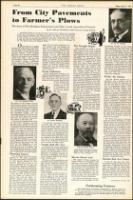
The Late Emanuel Wodic
the history of the Jewish Agricul-
tural Society during the two-score
years of its existence, it becomes in
fact the story of a people's struggle
for emancipation from spiritual
and economic bondage. It tells of
the dauntless courage and the
sustaining idealism of a group seek-
ing to lift itself above the sordid-
ness and the spiritual depression
into which it had been cast.
It cannot be forgotten that while,
as the • author indicates, natively
the *Jew was a. people of the soil,
he had not been permitted, because
of political and economic discrimi-
nation, to own or cultivate the
land in most parts of the world for
2,000 years. The man of the soil
had.',-been... forcibly converted into
the Urban- dweller. The Jewish far-
mer had become an anomaly. He
was definitely unfitted, it was gen-
erally . :,believed-and that belief
still PO.vails—for. work with his
hands - or for artisanship in any
form. He was looked upon as a
parasite and not a producer. He
was recognized as the petty trader
and money lender, and the peddler
upon a menial or an exalted plane.
_
Deterring Factors
It is, of course, true that in pro-
. portiOn to the total population
there are, even today, comparative-
ly few Jewish farmers in this
country. That this is due to no
lack of aptitude on his part for
agricultural pursuits is sufficient-
ly proved by what he has done in
Palestine where he has converted
an arid and apparently unfertile
soil into a richly productive land.
Why the Jew in this country
has not taken up farming on a
larger scale may be easily ex-
plained. Among other things to
be considered is the fact that the
Jew has always had an avid ambi-
tion that his children might begin
life more advantageously than had
been the privilege of their parents.
Now the country could not offer
the same educational advantages
as the city and therefore, though
life might have been happier and
.
Dr. Leo M. Franklin
The. Struggle Begins
The attempt to wrest a liveli-
hood from the soil in this unprom-
ising region is the more interest-
ing because not one of the dozen or
more families who were parties to
the experiment had any previous
knowledge of agriculture. They
were all peddlers and none of them
had been in America for more
than four years. Their peregrina-
tions in pursuit of a livelihood had
brought them into contact with
farmers and roused in the mind of
one Hyman Lewenberg the idea
that farming might offer to the
Jew a better chance of earning a
living than peddling. This idea took
tangible form when Lewenberg
purchased 10 adjoining parcels of
land in behalf of himself and eleven
other Jewish peddlers in July 1891.
The price paid was $11 an acre for
60-acre parcels and $12 for smaller
holdings. Of this amount a total of
less than $200 constituted the down
payment. It was probably the full
amount that these 12 families
had in their possession.
From the very first, the struggle
was a hard one because these peo-
ple had neither the experience nor
the capital to carry the experiment
to a successful issue. It looked as
though the whole ef-
fort put forth by these
brave men and their
families would prove
to be futile and fruit-
less.
Dr. Gabriel Davidson
It would be a mistake, however,
to think that the work of this
great organization began and end-.
ed with this achievement. The truth
is that together with the Baron de
- Hirsch Fund it gave the inspira-
tion and laid the foundations for
many of the most significant for-
ward strides that have been taken
by experts in the field of agricul-
ture and by the Agricultural Bu-
reau of our National. Government
in the course of recent years.
.
Temple Beth El's Part
It is, however, not my purpose in
this article to deal with this phase
of Mr. Davidson's book. What I
desire is to call attention to an ex-
periment of primary interest to
the Jews of Michigan and one in
which Temple Beth El of Detroit
took a leading part.
The story of this experiment was
recorded in the annals of the Amer-
ican Jewish Historial Society in
1925 and the account given by Mr.
Davidson in a supplement to his
main treatise is essentially a re-
print of the records of the His-
torical Society.
.1,The incident carries us back to
the year 1891 and to a rather un-
inviting region in the thumb dis-
trict of Michigan in the vicinity
of the town of Bad Axe. The re-
gion had been denuded by great
forest fires and would scarcely
have been chosen by experienced
and well-to-do farmers as a place
of settlement. None-the-less it was
in this uninviting area that one of
the very first experiments in the
creation of a Jewish agricultural
settlement was undertaken.
The Late Martin Butzel
(The father of Leo M. and Emma
Butzel. He was the brother of the late
Magnus Butzel, the father of State
Supreme Court Justice Henry M.
Butzel and Fred M. Butzei.) .
Martin Butzet Aids
The plight of these people, by
happy chance, was brought to the
attention of the late Martin But-
zel, who at the time, was president
of the Temple Beth El Hebrew Re-
lief Society, an organization fos-
tered by Temple- Beth El and re-
motely the forerunner of the
United Jewish Charities of Detroit,
which in turn was succeeded by
the Jewish Welfare Federation.
Mr. Butzel immediately became
interested in the sad plight of the
pioneering farmers of the Pales-
tine Colony, as they had chosen to
call themselves. Not only did he
secure a considerable amount of
money from the Relief Organiza-
tion of which he was the head, and
from the members of Temple Beth
El, but he also interested the
Baron de Hirsch Fund which had
come into existence about a year
previously, to the extent that this
organization contributed the sum
of $3,000 to meet the most pressing
needs of the colonists. Of this fund,
Mr. Butzel was appointed trustee
and he administered it with wis-
dom and with his characteristic
meticulous integrity.
Wodic, the Advisor
But Mr. Butzel himself was a
merchant, not a farmer, and he
therefore turned for assistance to
the one Jew who, in this vicinity,
was an experienced farmer. This
man was Emanuel Wodic (mis-
spelled in the book, Woodic). Mr.
Wodic was a rare personality.
Bearing a striking resemblance to
Abraham Lincoln, he possessed the
same sturdiness of character, the
same unflinching courage, the
same devotion to duty that charac-
terized America's statesman. He
was crude in exterior but he had a
heart of gold. His devotion to Ju-
daism was equalled only by his
loyalty to the land of his adoption.
It reveals something of this man's
devotion to country and to faith
that in his last will and testament
he asked that his prayer book and
the flag of his country should be
placed in his coffin.
Mr. Wodic had come to America
from his native Bohemia in 1854.
His first job was on a farm in Long
Island where he received $6.00 a
month for his work. Later he be-
came a sailor on a wrecking vessel
in Delaware Bay. In 1856 he en-
listed as a private in the United
States Army and served throdg,h-
out the duration of the Civil War.
During his service he was wound-
ed on a number of occasions but
would not permit his physical suf-
ferings to be used as an excuse for
his retirement from the army. At
the close of the Civil War, he was
honorably discharged and moved
to Michigan where he bought and
worked a 40-acre farm in Macomb
county. There he became known
as one of the most successful agri-
culturalists in that area. In 1922,
he gave up farming and came to
Detroit to make his home.
Headed Bad Axe Colony
It was to this man that Mar-
tin Butzel turned to take over the
supervision of the Bad Axe Colony.
This was in 1892 at which time
Some 16 families had joined the
Bad Axe Colony. The livestock of
the entire group was seven horses
and two cows, and not one of the
farmers had been able to clear
more than one or two acres of his
land.
(Continued on Page 20)
Forthcoming Features
The Jewish News has made arrangements to publish articles by
the best known figures in the literary world during the coming weeks.
To keep fully abreast of the news and to have the most authorita-
tive opinions on issues facing the Jewish people, be sure to read The
Jewish News regularly.