

Page Six
THE JEWISH NEWS
Fr lay, Fe6ruary
194I
Experiences in Soviet Russia
How A Jewish Telegraphic Agency Reporter Proved
To Kremlin Officials That His Stories Were Correct
By BORIS SMOLAR
Editor, Jewish Telegraphic Agency
MOTORCYCLIST appeared at
my home at the Krasnaya
Vorota (Red Gates) in Mos-
cow one morning with a
summons for me to im-
mediately accompany him
to the Kremlin. As I tossed about in
the side-car of his motorcycle which
raced over the rude cobblestone
streets of Moscow, I speculated as to
why I had been so suddenly summoned
to the inner sanctum.
The reason was explained to me
soon after my arrival. I was shown
into a room where a Soviet official
was waiting for me. He was wearing
the usual Russian blouse of linen, and
shiny boots, and he introduced himself
as one of the secretaries of the Soy-
narkom, the Soviet Cabinet.
Clarify Certain Matters
"I sent for you because I want to
clarify certain matters," he began in
Russian, offering me a seat and a
cigarette. His manner was friendly.
"You see," he continued, "we have
been reading your cables and articles,
and while on the whole we consider
yOu an objective reporter—no better
or. worse than the other bourgeois
correspondents — we are puzzled by
what you write in your articles con-
cerning the mistreatment of Jews in
our country.
"You know very well that we have
liberated the Jews. We have given
them freedom which they did not
enjoy under the Czar. We have helped
them to settle on land in the Crimea
and in the Ukraine. Anti-Semitism is
considered a crime in our country and
we make no distinction between Jew
and non-Jew.
EDITOR'S NOTE: Mr. Smolar's article is an authoritative account of a significant
personal experience. Having toured every important world center during his
service with the Jewish Telegraphic Agency, Mr. Smolar's experiences in Russia
make him an outstanding authority on conditions under the Soviets.
Next week's issue of The Jewish News will carry important
feature articles in addition to another list of names of Detroit Jews
who are serving in the armed forces of the United States•
particularly interested in Jewish life
in the USSR. It was to these dispatches
that the Soviet official referred.
- Impressed by Story
The picture which I painted for this
official in "giving my side of the
story" seemed to make a deep im-
pression upon him, especially the
details which I related to him con-
cerning the persecution of former
Jewish small traders by local Jewish
Commissars in small towns of the
Ukraine. The Jewish Commisars took
special pride in torturing the declassed
Jewish population.
"But it can hardly be true," com-
mented the official when I had finished
nay story. "Situations such as you de-
scribe could hardly be tolerated in the
Soviet Union. They are diametrically
opposed to our basic policy of abolish-
ing anti-Jewish discriminations. Either
you are mistaken, or some of our of-
ficials whose business it is to report on
the Jews as a national minority are
not keeping us properly informed."
"Your assumption that the officials
are not reporting the complete picture
is possibly quite correct," I replied.
"Someone Will Pay"
Watching Closely
"From your articles, however, which
we have been watching very closely,
a picture emerges which represents
us as treating the Jews worse than
any anti-Semitic country. We are con-
vinced that the information you are
forwarding is very much prejudiced.
There must be some basis, however,
for your writing in this way. We
like to hear your explanation."
My story was simple. Though the
Soviet law drew no distinction be-
tween Jew and non-Jew, the Jewish
section of the Communist party was
trying to be holier than the holy.
There was hardly any imaginable per-
secution which the Jewish Communists
had not imposed upon the Jews who
clung to their faith.
Religious Jews as well as those
who engaged in small trading under
the Czarist regime were considered
parasites and deprived of the right to
receive bread cards, to be members of
cooperatives and labor unions and to
earn their livelihood as laborers, or to
be offered any kind of employment.
Suffered Starvation
They :suffered actual starvation,
social persecution and even their chil-
dren, considered outcasts, shared their
sad lot.
Day after day reports used to. reach .
Moscow from the provincial cities,
telling about Jewish suicides. Young
boys and girls of the category barred
from schools because of the so-called
sins of their parents, were committing
suicide en masse in protest against the
.unjustified discriminations.
This unbearable situation, affecting
hundreds of thousands of the Jewish
population in the Soviet Union, was
scarcely touched upon in the Soviet
press. As a foreign correspondent, I
found it my duty to report the situa- •
tion in my cables and articles to the
Jewish Telegraphic Agency, which was
"In that case, someone will have to
pay and pay heavily," the official
remarked.
For a while, silence reigned in the
room. He seemed to be lost in thought.
Finally, he rose from his chair and
faced me with a look of determination.
"I am going to find out the truth,"
he said. "What you have told me
throws light on conditions which we
cannot tolerate. If you are right, some-
body is wrong. That's what I am
going to investigate.
Government, decided to restore cer-
tain civil rights to declassed Jews.
They will receive the right to enter
collective farms, join credit institu-
tions and cooperative stores. The new
policy is a blow to the Jewish section
of the Communist Party . .
MARCH 4.—The Jewish section of
the Communist Party is dissolved.
Jews Reinstated
MARCH 25.—Half a million de-
classed Jews celebrated today as the
Soviet Government issued a decree
reinstating them to full citizenship
rights. They will be able to get bread
cards. They can no longer be evicted
from dwellings. They are eligible for
medical treatment. Their children may
attend the schools .. .
M. Yenukidzie, Secretary of the Zik,
who kept me informed of these de-
velopments, in instructions which he
issued two days later on how to
conduct the reinstatement, said:
"The formal application of our elec-
tion laws as practiced up to now with
regard to the Jewish population, a
considerable part of which was com-
pelled in pre-revolutionary times \ to
engage in trading or in artisanship
where hired labor was used, has been
especially intolerable. This has re-
sulted in an extremely large percent-
age of people being deprived of their
rights (lishentzy) among the Jewish
population. Therefore, in revising the
lists of Jews without rights, special
attention should be paid to the specific
circumstances of Jewish life."
Kremlin Convinced
The Kremlin, it turned out, was now
thoroughly convinced that I had been
correct in my gloomy dispatches about
Jewish life under the Soviet regime.
However, once the situation was in-
vestigated and the truth established, it
had the courage to admit that its
provincial officials had for many years
exceeded their authority in admin-
istering the law concerning declassed
elements.
Another example of the protective
value of the JTA service from Soviet
Russia, is the case of the 13 rabbis who
were arrested in Minsk in 1930.
The news of the arrest of these
rabbis, which I succeeded in cabling
from Moscow after doing some bar-
gaining with the Soviet censor, was
featured on the front pages of the
American press so prominently, that
was called from my bed at two o'clock
in the morning by an official of the
Soviet Foreign Office, who telephoned
to inform me that the rabbis were
being released, and that I could cable
this information to New York without
delay.
Praised by AP, UP
The service of the JTA from Mos-
cow, and especially the coverage of the
arrest of the Minsk rabbis, was highly
praised by the president of the As-
sociated Press, in a letter addressed to
Mr. Jacob Landau. It also was cited
as exemplatory by Karl Bickel, head
of the United Press, in an address
which he delivered on Aug. 2, 1930,
before the annual conference of the
Williamstown Institute of Politics.
Speaking on "The Internal and Ex-
ternal Politics of Russia," Mr. Bickel,
who had just returned from a trip to
Moscow, said:
"The Jewish Telegraphic Agency
gives excellent service from Russia
pertaining to Jewish life there. Its
work is rather difficult to compete
with, for as the Jewish news
agency it is psychologically best
fitted for obtaining and distribu-
ting Jewish news."
The chief of the United Press em-
phasized the specifically difficult
conditions under which a newspaper
correspondent had to work in Soviet
Russia, but he praised the assistance
given by the Soviet officials in
Moscow,
"If it turns out that you are right,
then you will have done an invaluable
service to the people who are suffer-
ing, and you will have removed a blot
from the prestige of the Soviet Union.
But if we find out that you're wrong,
then I don't need to tell you that
you'll have to suffer the consequences.
You probably will be asked to leave
the country."
He accompanied me to the door and,
shaking hands, added:
"Don't be surprised if you read in
our press in the near future that an
official commission has been appointed
by the Central Government to go to
provincial towns and investigAe treat-
ment of the Jews there. That will be
the tangible result of our conversa-
tion."
Commission Named
About two weeks later, my eye was
caught by a story in Izvestia, official
government organ, announcing that a
commission had been appointed for
such a purpose. It stated that the
commission would report its findings
within three months.
The developments after these three
months were recorded in my cables as
follows:
JAN 3, 1930.—Sovnarkom, the Soviet
Cabinet, today issued instructions
reprimanding local administrators for
ignoring conditions suffered by Jews
in small towns.
JAN. 30.—The Presidium of Zik,'
Central Executive body of the Soviet
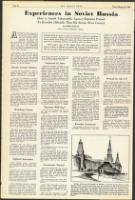
Lenin's Tomb on Red Square
Moscow, as drawn on the spot by Frank
Harms, Detroit architect and artist, who was in Russia in. 1931 with the group of
architects and engineers who designed 500 factories for the Soviets under the direc-
tion of the Albert Kahn organization. These factories today are engaged in the
manufactUre of munitions. Mr. Barcus, who now is associated with the Detroit City
Planning Commission, spent his leisure - time in Russia making drawings from life.
He brought back 200 illustrations, including the above view of the "Heart of Soviet
Russia."