

THE JEWISH NEWS
7 Page Eight
Friday, OcfoLier 21, 1942
The Place of Federation in War Time
Text of Address Delivered at Annual Meeting of East
Central States Region of Council of Federations and
Welfare Funds, in Cleveland, Oct. 12
By ABRAHAM SRERE
President, Jewish Welfare Federation of Detroit
The responsibility of a central coordinating and plan-
ning agency such as Federation is in a great measure no
different in a war setting than in peace-time. War does not
create any new problems ; it merely accentuates old ones.
Through Federation the community expresses its collective
will and discharges its social obligations in the various
areas of Jewish life at home, in
Palestine, and the world over.
Through Federation the com-
munity creates and maintains
services which aim to serve the
poor, the misguided, the sick,
the aged, the jobless and the
maladjusted. Through it . the
community establishes agencies
for the enhancement of Jewish
life and the protection of its
civil rights. In order to imple-
ment its program, Federation also
has the responsibility of raising
the funds necessary for the main-
tenance of the programs it spon-
sors.
It follows, therefore, that the
agency which looks at the total
community and coordinates its
planning to the best interests of
the whole community in peace-
time should also be the agency
to assume the responsibility dur-
ing war-time. The country's so-
cial welfare program has under-
gone rapid changes under the
influence of war-time conditions
and has created many problems
for the social agencies and for
the community. These problems
are the specific concern of each
agency and service affected di-
rectly, but are the larger con-
cern of the central community
coordinating and planning agency
—Federation.
To meet these problems Fed-
eration must assume the respon-
sibility for planning and
organizing the resources of the
community so that these may be
utilized quickly and efficiently
in meeting the war-time needs
as they arise.
The community planning agency
must encourage and expedite the
adaptation of the existing social
services to the demands and con-
ditions created by the war.
Federation, as the community
organization agency, must insure
a thorough evaluation of all
agencies and services, with a
view to providing the maximum
service, called for in war-time,
in the most economical and ef-
ficient manner. To play their
part in helping the American
people meet these problems,
local social agencies must
achieve a greater measure of
efficiency than ever before.
Changes should be made to meet
the new situations. Weakness in
administration, overlapping and
lack of coordination, which may
have been condoned in peace-time
should not be tolerated in war-
time. It is the responsibility of
every community to examine its
own program and achieve such
reorganization as will contribute
to the common goal of winning
the war.
The community planning agency
must mobilize resources to meet new
needs resulting from the war effort
and must coordinate the activities
of the Jewish community in these
fields with those of the general com-
munity.
Many Of the war needs on the
civilian front are being met by
governmental and quasi-govern-
mental agencies, either already
in existence or newly created to
deal with these problems. The
Red Cross, USO and Office of
Civilian Defense are all oper-
ating in this field—each devoting
itself to the specific program or
programs which it is best equip-
ped to handle. Such problems as
civilian defense, the provision of
leisure - time activities for the
members of the armed forces,
evacuation of children and the
mobilization of manpower to
carry out the manifold war serv-
ices of these and other agencies
are being met by them. But
there are many areas of unmet
need in which private agencies
have to function and provide the
required services, as the follow-
ing examples indicate:
(a) In this period of emerg-
ency many forces operate to
bring mothers of young children
into employment away from
home. Provisions of adequate
day facilities for children of wo-
men war workers is an im-
mediate problem in many com-
munities. Jewish social agencies
have a task to perform in de-
termining the need for such
facilities, and in ascertaining
whether this need should be met,
as a specific Jewish obligation,
or whether it should be treated
as a general community program
in which the Jewish community
may participate and offer its
assistance.
(b) The large influx of war
workers into many industrial
communities has resulted in a
critical housing shortage. In the
main this is not a specific Jew-
ish problem. However, many
defense workers and civilian
employees of the governmental
departments are Jewish and they
find it especially difficult to ob-
tain living facilities. Whether
we admit it or not, some land-
lords discriminate against pros-
pective Jewish tenants. In this
respect the Jewish community
has a specific obligation. For ex-
ample, the War Department re-
cently approached the Jewish
Welfare Federation of Detroit
requesting asistance in obtaining
living facilities for approximate-
ly 250 Jewish civilian employees
who will be moved from Wash-
ington to Detroit during October.
Federation and its agencies have
a dual war-time responsibility
to exercise in this area—to as-
sist the individual in getting
properly located and to assist
the governmental agencies in ad-
justing their employees so that
they may contribute their max-
imum efficiency to their war
work.
(c). The war has brought many
new responsibilities to the voca-
tional service agencies. To sup-
plement activities of the govern-
mental agencies, local Jewish
vocational services are now be-
ing called upon to serve as war-
training and job-information
centers. There will be greater
reliance on private agencies for
counseling, testing, and place-
ment, and for special services
to the handicapped so that the
United States Employment Ser-
vice may release its resources
for the pressing recruitment
needs of war industry.
With the shrinkage of non-
essential consumer production
and accelerated rationing, a rela-
tively large number of Jewish
workers in the wholesale-retail
distributive trades will have to
be shifted to war plants. These
individuals will need help in
determining their abilities, find-
ing the right training for the
best utilization of these abilities,
and eventually, the right place
on the production front.
In trying to meet the war
needs mentioned above, and
many others, it should be kept
in mind that the entire commun-
ity is also dealing with the same
problems. In planning for war-
time needs, the Jewish commun-
ity must retain proper per-
spective and a sense of balance.
There is a need for coordination
of effort and close cooperation
with the general community.
Careful evaluation and weighing
of proposed war-connected proj-
ects is called for. Federation, as
the community organization
agency, must act as a special
war-efforts instrument in deal-
ing with war-connected problems
which are, or should be, the
special concern of the social serv-
ices. Such problems must be
viewed in relation to the gen-
eral community, the Jewish
community and the specific
agencies which provide the func-
tional services.
The community planning agency
must intensify its efforts to develop
a continuing and lasting interest in
and support for the social services.
There are many distracting
influences operating within a
community in wu-time. The
dramatic sweep ofome of the
war-connected activities, no mat-
ter how valid and essential
they are, should not be allowed
to overwhelm the continuing
year-round services which the
community must maintain and
strengthen in war-time, even
more than in peace-time.
Agencies are faced with many
problems which threaten their
programs. Staff turnover and de-
pletion have made it difficult to
continue operations. But we can-
not afford to take the path of
least resistance. In many in-
stances turn-over may be re-
duced through the provision of
more adequate salaries and it is
the function of the community
to find the necessary means to
accomplish this. Staff depletion
can be alleviated through the
use of volunteer services. The
Office of Civilian Defense has
mobilized thousands of indiv-
iduals who are searching for
opportunities to offer their serv-
ices to the community. The use
of volunteer workers is in keep-
ing with the trend of the times.
Planning for the use of volun-
teers to fill staff shortages and
to man new war-time services.
is the responsibility of the or-
ganized community and its mem-
ber agencies.
To cite a few examples:
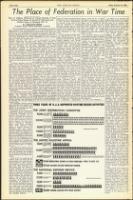
THREE YEARS OF U. J. A.-SUPPORTED WARTIME RESCUE ACTIVITIES
THE JOINT DISTRIBUTION COMMITTEE
refugees emigrated from
Europe to havens In Amer.
kas and Palestine
93,000
.
61)0000
_
aarll
/7
""mug I
lees in Siberia for whom
• -
74 1 7MR
til7====11
medical aid is being sent
•
en r nonsectarian basis
I 441117
60000
relief 0
123,000 'aided
;4=
AW4=70,==
tetint F e ra ni nc: d . , tx 1no
terr od
ul
refugees In Latin America
by readjustment
,program
11
Each symbol represents 10,000 people helped.
t•
needy Jews 'helped I
Switzerland. Sweden. Por-
tugal Spain. North Africa)
Turkey and other neutral
or allied countries
82,000
THE UNITED PALESTINE APPEAL
homeless Jews lairnIgled
to Palestine. bringing the
Jewish population to over
550,000
30,000
Owns o( land purchased
1
1 bringing ra the en:haenr total dolurnYy
of U.P. A.
land to 590,000 dunems'
Where people are Indicated, each symbol represents 3,000!
Where land is Indicated. each symbol represents 3.000 dunams.
-
20 NEViliRICULTURAL COLONIES IN JEWISH HOMiLAND7TOTAL TO DATE 276
400 NEW FACTORIES FOR WAR PRODUCTION PROGRAM
THE NATIONAL REFUGEE SERVICE
31,000
22,500
oxfafidedfininclat remit
6 , 4) 64 Si 64 6' 6) . 44 44 64 44 49
Job and professional place-
ments arranged
10,200 newc i communities
fad rimbol represents 2000 people helped.
omers
-
58,000 ntnreTtYn=
195,000 PERSONS ASSISTED WITH VARIED SERVICES'
Atitt t it
(a) There is no glamour in 1
finding foster-homes for children
but it is one of the most essen-
tial parts of an adequate and
sound child-care program. De-
sirable foster-homes are needed
more, and are more difficult to
find, in war-time. Volunteer ef-
fort should be utilized in help-
ing to meet this problem.
(b)
Health agencies must
continue to operate despite
shortages in medical and nurs-
ing staffs—and efforts must be
made to meet these shortages:
through the recruitment of
physicians who remain in the
community, through volunteer
nurses' aides and in every other
way possible.
There are other programs
which were established to enrich
our cultural life, to protect our
civil liberties and to maintain
and strengthen our group inter-
ests and responsibilities. These,
too, must not be neglected in
war-time.
(c) Providing Jewish education
for our children is one of the
privileges and strengths of the
Jewish community in a democ-
racy. We cannot afford to allow
this program to suffer or to
atrophy through a shift of in-
terest. It requires continuing
support in war-time, as well as
in peace-time.
(d) The disappearance, in large
measure, of overt anti-Semitism,
which follOwed our entrance in-
to the war, should not be allowed
to lull us into complacency. The
war did not eliminate the need
for a vigorous and coordinated
civic - protective program, butt
rather, intensified the need for
the effective relation of the
civic-prbtective program to the
changing conditions and prob-
lems of anti-Semitism during the
war period. While many areas
of activity_ formerly in our
hands have become the direct
concern of the governmental
agencies, there are other areas
in which we ourselves must
continue to operate, and, in some
instances, intensify our efforts.
(e)
In a few communities,
welfare funds have already join-
ed, and in others, may join, War
Chests. Fund-raising has provid-
ed the Jewish community with
an annual dramatic occurance,
an event super-charged with
communal interest and activity.
The attention of the community
during this period has been
focused on specific Jewish wel-
fare causes and programs. The
War Chest, being a general
community venture, will divert
a great deal of this concentrated
attention. But, there is need for
maintaining a continuing year-
round program of community
education and interpretation as
an aid in furthering the specific
Jewish community interest.
The problem of maintaining
the continuing interest of the
Jewish groups, in communities
which will campaign independ-
ently of the War Chest, is not
lessened because of this fact.
War activities of all kinds are
calling upon all members of
the community and rightly so—
to give their services in pro-
moting the major cause of all
Americans — winning the war.
These communities; as well as
War Chest communities, must
think in terms of an educational
program which will maintain in-
terest in Jewish institutions and
causes and prepare the commun-
ity for the task ahead—post-war
reconstruction of Jewish life
abroad and a great development
of the Jewish community at
home.
Social work has evolved as
an integral part of American
democratic life. Today, our so-
cial welfare program is an im-
portant weapon in winning the
war and in assuring a full meas-
ure of well-being to the common
man. It has 'become an indis-
pensable tool in shaping our
community thinking and action
and in maintaining and stvength-
ening Jewish community life.
In war-time, even more than in
peace-time, we- must give it our
full support, so that it may
continue to function as a ;Maw,
symbol of our democratic tra-
dition.