

American ,'Jewish Periodical al
Friday, June 8, 1951
DETROIT JEWISH CHRONICLE
Page 4
Detroit Jewish Chronicle
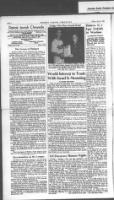
Dodger Star Buys Israeli Bond
Published Weekly by the Jewish Chronicle Publishing Co., Inc.
WOodward 1-1040
900 Lawyers' Building, Detroit 26, Michigan
SUBSCRIPTION
$3.00 Per Year. Single Copies, 10c; Foreign. $5.00 Per Year
Entered as Second-class matter March 3, 1916, at the Post Office at
Detroit, Mich., under the Act of March 3, 1879
By GERHARDT NEUMANN
, VISION AND FULFILL-
MENT. TILE FIRST 25 YEARS
OF THE HEBREW UNIVER-
SITY. By Lotta Levensohn.
(Greystone Press, New York,
190 pp., $2.75).
SEYMOUR TILCHIN
Publisher
GERHARDT NEUMANN
NORMAN KOLIN
Editor
Advertising Manager
Friday, June 8, 1951
Sivan 4, 5711
The Lesson of Shabuot
Shabuot, which will be celebrated this Sunday, is
the festival of the Law. On that day, according to Jewish
tradition, Moses came down from Mount Sinai to hand
the Ten Commandments to the children of Israel.
There is an interesting Talmudic legend in connection
with this event. The Israelites, the Talmud reports, were
reluctant to accept the Ten Commandments, whereupon
Moses, full of sacred ire, threatened to have Mount Sinai
come down upon all of them and kill them unless they
accepted the Law of the Lord.
The symbolism of this legend offers food for thought.
It reminds us of the fact that law is not written into the
hearts and minds of man as something that follows un-
mistakedly from reasoning and experience but has to be
impressed upon people's minds and has to be enforced
from day to day.
It also reminds us that people very often do not
recognize the values they are offered, especially when it
comes to moral values, the intangibles which most people,
strangely enough, believe should be decided and acted
upon individually.
No people has ever accepted moral law solely upon
the basis of its worth. Always there has been combined
with the general agreement that the law is just and
necessary, the feeling that transgression would be im-
mediately followed by punishment.
Modern thinkers attempted to substitute for this
fear basis that of reason. Man was told that he should
follow moral law because it was to his own interest to
do it.
While he may deceive himself that it was out of pure
idealism that he followed the law, it generally was
understood by more profound thinkers that self-interest
lay behind his acquiescence. No longer the self-interest
of avoiding divine punishment, but rather the knowledge
that unless he adhered to the law he would himself be the
victim of the crime, war, pillage and murder that is a
part of contempt for the law.
Thus 18th and 19th century intelligentsia often went
to religious services to help strengthen the respect for
the law which they wished to see in the "lower orders."
This attitude and the general breakdown of respect
for and adherence to moral law did not really affect the
Jews until the enlightenment broke upon them, first in
western Europe and later in eastern Europe.
But even those Jews who escaped the new learning,
were often caught in the effects of it when they came to
America. Plagued by the general American easy-going
tolerance or indifference to religion and moral law, Jews•
have become bound up in the disillusionment of the
thinking people who have awakened to find their lives
without direction and meaning, and even in physical
danger of destruction by bacterial warfare and atomic
weapons.
If we examine the causes of the distintegration of
morality we see clearly that we are lacking, figuratively
speaking, a Moses to threaten mankind with the fall of
Moupt Sinai. Too many have abandoned all pretense
of accepting a divine source of enforcement of the law.
And without such enforcement there is nothing to
fall back upon, for reason has failed us.
But man's mind is fertile and his needs have always
in the past given rise to a solution of one kind or
another. Our needs today are either a return to the old
values or the establishment of new ones which we all can
accept.
This is the lesson of Shabuot, which stands as fresh
today as it did 3,000 years ago at the foot of Mount Sinai.
,
Discrimination on the Campus
The fight of the liberal elements in the University
of Michigan against the discrimination practices of the
fraternities has been short-lived. Dr. Alexander G.
Ruthven, retiring president of U. of M., ruled this week
that fraternities were voluntary associations which may
decide for themselves whom to accept or not accept.
The univdrsity's stand, it seems, is inconsistent with
its practice of exercising a close supervision over the
internal life of the fraternities. If Ruthven's reasoning
is correct, the university will have to discontinue setting
the dues for fraternities, enforcing rules for initiation
and many other things.
It also may be asked if Ruthven's ruling is in con-
sonance with the teaching philosophy of the university
which is one of equality and democracy.
There exists a public interest in the membership
standards of the fraternities because of their widespread
and deep-going influence on most students on the campus.
The example set by them inevitably becomes a pattern
of life to be followed by the students in their later years.
The fight agairist discrimination on the campus must
not be abandoned. It is here where the future leaders of
America will learn to distinguish between democracy
and arbitrary rule.
Hebrew U.'s
Epic Unfolds
in Wartime
The Hebrew University in Jeru-
salem celebrated its 25th anni-
versary last year, but its roots go
much deeper. The idea of the
university goes as far back as
1880 when Dr. Leon Mandelstam
—the first Jew to have been
graduated from a Russian uni-
versity—published a volume of
poetry in German, the proceeds
of which were to go "to a lle-
brew university in Jerwalem."
11•111111•111111
Prof. Hermann Zvi Schapira,
Cal Abrams, left-fielder of the Brooklyn Dodgers, who has
the famous mathematician at Ilei-
one of the highest batting averages in the National League,
delberg who was the father of
buys an Israeli bond from Emil Baar, Brooklyn judge, who is
the Jewish National Fund, also
also chairman of the Brooklyn division of the Greater New
became a proponent for a Ile-
York bond drive committee.
brew university.
It was, however, too early for
such an institution. Even Herz]
and Nordau considered the idea
premature. But by 1901, the cul-
tural Zionists, under the lead-
ership of Chaim Weizmann, again
brought up the matter, because
it became increasingly difficult
By ELIAIIU BEN-IIORIN
for Jewish students to get ad-
When one reads the Israel press, one is impressed by the mittance to European universi-
great strides mad.: by the young state in the development of its ties operating under the quota
foreign trade. Trade agreements, barter agreements, imports and
system.
exports now tie the state of Israel with almost every country in
The history of the Hebrew
the world.
University remained one of talk-
What is more, some industrial nations have shown great in-
ing and dreaming, but it turned
terest in the maximum development of trade relations with Israel.
Within the last month alone, an Anglo-Israel Chamber of Com- to action as soon as Allenby en-
tered Jerusalem in 1918. Only a
merce was founded in Tel Aviv; and the Belgian ambassador—
few months later, Dr. Weizmann
speaking at a luncheon in a Tel Aviv club—announced that he
urged that the cornerstone be
expected increasing investments by Belgian capital in Israel, be-
laid for the university, and Al-
cause he sees great possibilities for the development of trade be- lenby wrote about Weizmann as
tween the two countries.
follows:
At least one Middle Eastern country has been looking for an
"Here was a man who believed
epportunity to trade with Israel.
The Tel Aviv-Jafia Chamber of Commerce has received a letter and his faith helped me in my
will to do my job. It was an act
from the Afghanistan Chamber of Commerce in Kabul, stating:
"As the development of our nation requires friendly contacts of faith in Palestine."
The cornerstone was laid on
with businessmen in other lands, we are now writing to you in
July 24, 1918.
order to establish such contact... ."
"Jews know," Weizmann said
Other Moslem lands, Turkey and Iran, are already represented at this ceremony, "that when our
in Israel, both on the diplomatic and trade levels.
we
Trade between -America and Israel, on the other hand, is far mind is given full play, when
below the level which it can reasonably be expected to reach in have a center for the develop-
the very near future. The same is true of American private invest- ment of Jewish consciousness,
ments in Israel's industries. . then coincidentally we attain the
World Interest in Trade
With Israel Is Mounting
These investments are substantial in terms of Israel's total fulfillment of our material needs."
The university started out in
economy, but they are small compared to America's ability to December, 1924, with the Insti-
invest.
tute of Jewish Studies and was
It almost seems that the strong pro-Israel sentiment of the officially opened on April 1, 1925.
American people—Jews and non-Jews alike—has constituted an It grew slowly but systematically.
obstacle to sober trade relations between America and Israel. This In the first years it was the
may sound paradoxical, but it is not. •
chemical and geographical depart-
The overflow of sentiment has hindered the application of the ments that were brought into be-
business horse-sense for which Americans are so justly famous ing.
Mathematics followed in
1927, humanities in 1928, physics
throughout the world.
America has just recently awakened to the trade and business in 1930, biology in 1931, medicine
possibilities offered by Israel. This awakening is an extremely in 1939 _and agriculture in 1940.
The university has had a great
valuable by-product of the Israel bond issue.
As a result of its promotion efforts, the bond organization has significance for the Yishuv. Medi-
received numerous inquiries from all parts of the United States, cal research helped combat the
Canada and South America. Big firms and individual traders are problems of malaria, typhoid, re-
asking about the possibility of importing from Israel, exporting to lapsing fever and other diseases
Israel and opening branches of their industries in that country. common to the Near East. The
A man or a woman buying an Israel bond expresses a realiza- transformation of the Palestine
tion that Israel is not only a worthy object of emotional and swamps into fertile soil could not
philanthropic support, but also the place for a sound investmeht. have been accomplished without
The bond issue is paving the way for increased private investments, the cooperation of the university's
and an intensive growth of trade between America and Israel. scientists.
The Arab-Israeli war affected
This major by-product of the Israel bond campaign will be a
real blessing for Israel, and will help bring about a closer rappoche- the operations of the university
ment between the twe democracies. seriously but could not kill it.
The road to Mount Scopus was
cut off. Nevertheless the work
went on. The convoys fought
their way through. After April
, it y ' s activi-
13, 1948, the un Ners
The
final
paragraph
of
the
LONDON — (Special) — Th tr
ties had to be transferred to the
Human Rights Commission of article states that "in the exer-
city of Jerusalem.
the United Nations concluded its cise of any functions which the
In order to avoid the complete
state
assumes
in
the
field
of
edu-
session at Geneva after having
destruction of the university
cation
it
shall
have
respect
for
made decisions about the inclu-
pf parents to ensure buildings and the Hadassah Hos-
sion of a number of articles re- the liberty
the
religious
education of their pital, the Mount Scopus area was
ferring to economic, social and
children
in
conformity
with their declared a demilitarized zone un-
cultural rights into the draft
der UN supervision.
own convictions."
covenant on human rights.
Ever since the war, the uni-
The
question
of
the
individual
article,
dealing
with
edu-
One
versity has been living in exile.
right
of
petition
in
the
case
of
"that
cational problems, states
Offices, laboratories, institutes and
education shall encourage the violation of the covenant has not department are scattered all over
disposed of. It
full development of the human yet been finally
Jerusalem—but they are func-
personality, the strengthening of is expected that either the Eco-
tioning.
nomic
and
Social
Council
of
the
respect for human rights and
As a bridge between the east
fundamental freedoms and the United Nations will deal with it
and west, the university has ren-
suppression of all incitement to at its- next session in August,
It is hoped that some way will dered invaluable service. It main-
racial and other hatred.
be
found by which the majority tains a close contact with all cul-
"It shall promote understand-
ing, tolerance and friendship of governments will vote for the tural centers of the world and
among all nations, racial, ethnic granting of the right of petition, invites outstanding scholars to
Jerusalem to exchange ideas with
or religious groups, and shall which is of utmost importance
Jewish scholars.
to
individuals
and
non-govern-
the
Unit-
further the activities of
For the Jewish people as a
ed Nations for the maintenance ment:A organizations so that not
of peace and enable all persons only states would be able to deal whole, the Hebrew University
center
to participate effectively in a with complaints, jr the case of will, Fgrpa ,day become a
Jewish
culture.
of
a
new
violation
of
human
rights.
the
society.*
UN Discusses Human Rights
free