

4
DETROIT JEWISH CHRONICLE ond The Legal Clironicle
Detroit Jewish Chronicle
and THE LEGAL CHRONICLE
Published Weekly by Jewish Chronicle Publishing Cr , Inc.
JACOB H. SCHAKNE
JACOB MARGOLIS
Pres.-Gen. Mgr
Ediro
General Offices and Publication Bldg., 525 Woodward Ave.
Telephone: CAdillac 1049 Cable Address: Chronicle
Subscription in Advance
$3.00 Per Year
To insure publication, all correspondence and news matter
must reach this office by Tuesday evening of each week.
When mailing notices, kindly use one side of paper only.
The Dbrroit Jewish Chronicle invites correspondence on sub-
jects of interest to the Jewish people, but disclaims respon•
sibility for an endorsement of views expressed by its writers
Enterea as Second-class matter March 3, 1916, at the Post•
office at Detroit, Mich, under the Act of March 3, 1879.
Sabbath Readings for Rosh Hodesh, Adar 1
Pentateuchal portion—Exodus 21.1-24.18;
Numbers 28.9-15.
Prophetical portion—Isaiah 66.1-24.
FEBRUARY 5. 1943
SHEBAT 30, 5703
You Don't Believe That, Do You?
While Marshal Goering was deliver-
ing his speech on the 10th anniversary
of the appointment of Adolf Hitler as
Chancellor of the German Reich, a voice
repeatedly broke in and said, "You don't
believe that, do you?" Certainly Goering
did not believe that the calamitous de-
feat at Stalingrad was an heroic victory,
nor did he believe that his Fuehrer was
omniscient. The importance of the inter-
ruptions was not that it may have made
Goering more cautious, but the fact that
there are men and women in Germany
who are so well organized and have so
much courage that they would dare to
break into the speech of Goering on such
a momentous occasion as the 10th anni-
versary of the rise to power of the Na-
tional Socialist Party.
The Gestapo must have known that
there was much disaffection in the Reich
which probably accounts for the failure
of Adolf Hitler to make his speech in
person. Whatever the reason may be, the
speech or proclamation was not for home
consumption. It was beamed at Britain
and the United States, and it was an at-
tempt to frighten Britain and the United
States with the bogey of Bolshevism.
This bogey did scare Britain and France,
particularly Britain, in the early days of
Nazism, but since the Nazis marched into
Russia on June 22, 1941, every attempt
to frighten the United Nations has failed
miserably.
No doubt there are many timid souls
that are frightened by the menace of
Bolshevism and could be 'persuaded to
accept the protection that a Nazi dam
would afford, but the men in charge of
affairs of the United Nations now know
that Nazism as a cure is so terrible that
the disease called Bolshevism, if we may
call it that, certainly cannot be nearly
as maleficient and devastating as the cure.
We have learned that this "beneficient"
cure called Nazism, which took in the
pre-war French and British statesmen, has
caused more human misery, suffering and
death in its 10 years of existence than
has any plague that has visited our planet
in the recorded history of mankind. We
now know that it had a planned program
of subjugation, domination and exter-
mination. If this could be accomplished
by peaceful means, good and well, and if
not, then naked, brutal force without
stint and without limit was to be used.
On the other hand, the external policy
of Bolshevism, with few exceptions was a
policy of ideological penetration. The only
war of aggression in which the Bolsheviks
have engaged was that against Finland.
They invaded Poland after the Nazis had
invaded that unhappy land and annexed
by force Latvia, Esthonia and Lithuania.
There are few people today who would
not justify their Finnish, Polish and Bal-
tic adventures as defensive measures
against the Nazi aggressors.
The record to date shows definitely and
clearly that the Bolsheviks had no ag-
gressive designs upon their neighbors.
Had not the Nazi hordes invaded the
countries lying between Germany and
Russia it is reasonably certain that the
Bolsheviks would have continued their
program of ideological penetration.
German realists knew on Jan. 30, 1933,
that Nazism meant aggressive war, and
onthat fatal day the prediction was
written on the walls of Berlin. Knowl-
edgable people knew that Russia was
arming, but it was believed that it was
defensive purposes only.
This Nazi attempt to drive a wedge
between Russia and Britain and the
United States will no doubt fail, but it
would be a good thing for the peace of
mind of our timid fellow citizens if Russia
would publicly declare her territorial
policy.
February 5, 1943
PLAIN TALK
•
by AL SEGAL
Post-War America
Very much has been said and written
about post-war Europe and Asia, but
very little has been said about post-war
United States.
There are many boards, committees
and organizations hard at work on com-
prehensive plans and programs for post-
war America, but very little detailed in-
formation is being released as to what
they are planning and programming. The
vast majority of our people may be of
the opinion that the immediate task of
producing war goods and defeating the
Axis is all that should be considered now,
but we believe that this view is a short-
sighted one. In a society such as ours,
with a complex economy, based upon
science and engineering, it would be wise
to utilize our scientific and engineering
planning and procedures to help solve
the many and complex economic and so-
cial problems that will no doubt face us
when the peace comes.
Those who believe that we are going
back to business as usual after this war
is over are in for a rude awakening. To
these people the Office of War Produc-
tion and the Office of Price Control and
all other agencies of planning and con-
trol are creations of war and will pass
with its ending. We doubt that this will
happen, and for very good reasons. Let us
take the matter of unexpended income
that is accumulating in the form of war
bonds and stamps. It has been estimated
that at the end of1943 there will be
more than 30 billion dollars of such ac-
cumulated unexpended income, and there
will be over 20 billion dollars of durable
goods and housing needed which could
not be purchased because the war stopped
their production. It will take time, a mini-
mum of two years, to retool and get back
into production of many of these goods.
If there is no price control there would
be such a mad rush to buy the available
goods that inflation would be a more
serious danger than it has been to date.
Prices must be controlled, a ceiling and
a floor must be maintained, otherwise
there is likely to be economic chaos.
Then, too, the job of orderly place-
ment of demobilized soldiers and the vast
army of war workers must be planned
in advance. Severance pay for men in the
armed forces until they are absorbed by
industry must not be neglected. These
are but a few of the many problems that
will inevitably face us, and to fail to make
plans now would be the sheerest folly.
Of one thing we may all be fairly cer-
tain and that is that post-war United
States will not be a return to laissez faire.
The day of each one for himself, even
though the devil take the hindmost is
no longer part of the credo, is gone.
The job we have to do is so large that
the wisdom, skill and ingenuity of scien-
tists, engineers, workers, industrialists,
financiers and statesmen will be taxed
to the utmost, and only with their united
efforts and good will can we hope to
change over from a war to a peace econ-
omy with a minimum of friction and dis-
location.
Of Rabbis
SADDENS your correspond- ostracized, yes literally ostracized,
I some
ent's pool. old heart to hear put into Cherem (ex-communica-
ent's
of the rabbinical brethren tion). They must be denied ad-
calling names against their fel-
low-servants at the altar of Is-
rael.
Your correspondent, froM early
boyhood, was taught to look up
to rabbis for light and leading in
the ways of his life and now in
his ripe years he comes to this
grievious disappointment in some
of them. Yet he is a charitable
fellow who doesn't condemn ev-
erybody in the house because
some of the boys throw stones;
so he intends to hold fast to
his oldtime faith in rabbis.
The matter has to do with the
96 Reform rabbis who organized
the Council for American Juda-
ism to oppose the idea of a Jew-
ish state yet to be friendly to
the cause of making Palestine a
happy home for dislocated Jews
and to emphasize a purely reli-
gious concept of Judaism.
From the tumult of revilement
that has ensued you might guess
that these 96 rabbis had been
caught in moral turpitude unbe-
coming to rabbis when all they
have done is to exercise the
democratic right of expressing an
opinion.
Your correspondent has been
horribly shocked to read the in-
temperate denunciations by their
rabbinical brethren in some of the
Jewish press. If rabbis exist for
the purpose of leading the broth-
erhood of man to the mountain-
top they should make a start by
loving each other or, at least,
by tolerating one another.
Of the various denunciations he
has read, your correspondent has
clipped one to put in his collec-
tion of antiques with the horse-
hair sofa and the ancient copper
kettle; though in the flavor of
its antiquity it surpasses both
the sofa and the kettle. In fact,
it croaks like an authentic voice
out of the Middle Ages.
It is the letter of an Indiana
rabbi printer in the Jewish Post
of Indianapolis. (His name shall
be charitably withheld). After dis-
cussing the "treason" of the 96
rabbis, he says:
.
1 I I
MUST be punished.
T Their punishment
must be
HEY
meted out by those whom they
would affect, the Jewish people.
These Protest-rabbine• must be
mittance into the councils of Is-
rael, they must be ostracized so-
cially in all their communities
by all right thinking Jews. It is
no longer a question of treason.
That they have betrayed Israel
and therefore they must be eject-
ed from Israel. That they have
denied the Promised Land of the
eternal Bible they are therefore
no longer rabbis in Israel."
(The Universal Jewish Ency-
clopedia reports that cherem was
"the great ban which could only
be dissolved by complete repent-
ance . . . No one, except mem-
bers of their immediate family,
could have anything to do with
those who had been excommuni-
cated . . . In modern times the
employment of excommunication
in Judaism has become entirely
obsolete.")
Yes, this Indiana manifesto of
excommunication certainly is a
museum piece. It is one sample
of the flood of excoriation that
in words less explicit has ban-
ished the 96 rabbis from the
house of Israel.
Your correspondent recalls the
apocryphal story about Abraham
in which God Himself is seen to
be much more compassionate with
dissident opinion than some rab-
bis who are ordained to be His
spokesmen.
It is related that one day to-
ward dusk a stranger came by
Abraham's tent in the desert and
Abraham asked him in for the
night. When he had been fed,
the stranger raised his eyes to
give thanks unto his gods for
the food and shelter he had found
in the desert.
Now, when Abraham heard him
praying to deity other than the
One and Only God whom Abra-
ham himself had discovered, he
was exceedingly wroth and drove
the stranger from his tent into
the dark wilderness.
Awhile later Abraham heard a
voice out of the wind in the
desert and knew it was the voice
of God: "Abraham! Abraham!
Thou has driven the stranger
from thy tent into the night."
Abraham replied yes, that was
exactly what he had done . . .
"And why shouldn't I? He wor-
shipped a God other than Thee
and for that reason I sent him
See SEGAL—Page 13
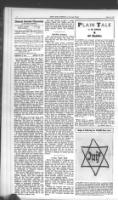
Badge of Suffering for 150,000 More .Jews
A New "Red" Hunt
Martin Dies, member of Congress from
Texas, is determined to purify the gov-
ernment, by removing every one on the
payroll who has ever had or uttered an
opinion that does not square with the
platform of the major political parties of
40 years ago. We sometimes wonder
whether Mr. Dies knows that one is not
necessarily a Communist because he or
she thinks that evolution as a process
affects societies, cultures, economic sys-
tems and even political parties.
It is really regrettable that the investi-
gation of subversive activities should be
made by a man who believes that even
Attorney General Biddle is somewhat
suspect.
Perhaps the Congress that votes for
the continuation of the investigation of
subversive activities believes that a little
gaiety is needed in these grim times and
that the Dies Committee furnishes that
gaiety.
V.'ith Hitler's seizure of unoccupied France. an additional 150,000
Jews will lime to wear this yellow Star of De. id, a photograph of which
has reached the Joint Distribution Cos iiii ince. Reports from abroad
state t h at the Nazi Nuremberg anti-Jewish taus
are about to be applied
in unoccupied France. Until Hitler marched into that area, the Joint
Distribution Committee
ince had carried on a large-scale progress, of relief
and emigration assistance On behalf of 70.000 Jew
WI refugees there.
Thong's the J.D.C., es a II Anseriea n organization, cannot continue to
operate in s••upied territory, local Jewish committee% in France are
parrying 01; relief work by burrowing what they need on the spot. The
J.D.U. has promised to repay the loans after the star.