

14
DETROIT JEWISH CHRONICLE and the Legal Chronicle
January 2, 1942
Father to Thousands
Michigan Author Wins Country-Wide
Praise for His Latest Jewish Novel
Hadassah Appoints New York Neurosurgeon to Post
in Its Palestine Medical Center: Dr. Henry
Wigderson Flying to Holy Land
Robert Gessner, Formerly of Escanaba, Hailed for His
"This Is My Home"; Is a Variation From Earlier
"Some of My Best Friends Are Jews"
NEW YORK.—Hadassah, the
Women's Zionist Organization of
America, announced that it has
appointed Dr. Henry Wigderson,
35, instructor in surgery at New
York University, to a newly-
created post as head neurosur-
geon in the Rothschild-Hadassah-
University Hospital which is a
part of the group's medical cen-
te• situated on Mt. Scopus, out-
side of Jerusalem, Palestine.
Together with his wife, Doro-
thy Marks Wigderson, 29, who
has collaborated with her hus-
band in neurological research
and holds a master of arts de-
gree in speech pathology from
Columbia University. Dr. Wig-
derson will begin a 22,000 mile
air journey to the Holy Land
on Oct. 24. The trip will be by
way of Hawaii, Australia, India
and Iraq.
In addition to heading the
neuro-surgical department in the
hospital, Dr. Wigderson will also
work with Hadassah's war emer-
gency committee • which is co-
operating with British and Jew-
ish medical authorities "to safe-
guard the Palestine population
form health hazards which al-
ways accompany war," a state-
ment issued from Hadassah na-
tional headquarters, 1819 Broad-
way, said.
To strengthen the Jewish Na-
tional Home in Palestine, to make
possible the immigration of ad-
Much water has gone over the
dam since 1936, and many ideas
have changed in Live years of
blood and sweat and toil. What
was objectionable at the end of
four years of Ilitlerism is accept-
ance as pure in some quarters,
and the simon-pure of that day
now possesses a stench.
By the same token, many Jew-
ish ideas have changed, and "some
of our best friends" have since
become our worst enemies—and
vice versa.
Similarly, what was trivial then
is important today; and the re-
verse.
These do not necessarily apply
entirely to Robert Gessner, bril-
liant writer who hails from the
Upper Peninsula of Michigan.
But they have some bearing on
his case, as it has shown trans-
formations from his book "Some
of My Best Friends Are Jews,"
to his latest novel, "Here Is My
Home." The latter was just pub-
lished by the Alliance Book Cor-
poration, 212 Fifth Ave., New
York.
Son of Prominent Zionist
The author is the son of the
prominent Zionist leader, Herman
Gessner of Escanaba, Mich. He
is at present on the faculty of
New York University, is the
author of several important
works, is an able poet and has
made his mark as a novelist.
That his latest work, "This Is
My Home," is going over with a
bang, is indicated by favorable
reviews and by letters, among
which is one by Rev. F. A. Mac-
Callum, minister of the Walnut
Street Presbyterian Church in
Philadelphia. Rev. MacCallum
wrote to Mr. Gessner:
"I know that it is a serious
defect in my mentality but I read
relatively few novels. This is
not due to any original limitation
for once upon a time it was not
true. It is to be explained as
Darwin explained his lost interest
in poetry. However, the adven-
turous and romantic elements in
my personality are not altogether
atrophied as a careful reading
of your "Here Is My Home" has
proved. During the past year I
have read half a dozen of the
notable works of fiction, includ-
ing "Grapes of Wrath, "Native
Son," "How Green Is My Valley,"
and am fairly familiar with the
works of Huxley, Cronin, Maug-
han and Priestley.
"I mention this only as a back-
ground to tell you of the deep
appreciation I feel for your work
in "Here Is My Home" which has
held by unflagging interest on
every page. Because of the basic
truth in human relations that it
presents, I wish that some means
could be found to draw it to the
attention of the widest possible
public. No man can read it with-
out feeling ashamed of his intol-
erance and his racial and relig-
ious animosities. In telling the
story of Bernard Straus and Mary
Bolitho, you have attained a high
artistic level. The value of the
story lies in its objectivity and
the absence of moralizing. There
is no propaganda other than that
which is inherent in an honest
record of fact which is, of course,
legitimate. In this respect I count
it higher art than Steinbeck's
"Grapes of Wrath."
"These are my impressions and
I give them for what they are
worth, for I am in no sense of
the word a literary critic yet
there was a time when I ex;
petted that this would be the field
in which my work would be
done."
Robert Gessner's background is
important. He acquired fame
early when he emerged as a cham-
pion of the cause of the Indians
in his first novels, "Massacre" and
"Broken Arrow." Later in "Some
of My Best Friends Are Jews,"
he took an anti-Zionist stand and
was markedly pro-Soviet. He was
the subject of country-wide con-
troversy in which he was both
defended and condemned.
Earlier Theme Modified
"This Is My Home" is in a
sense a modification of that early
theme of 1936. He is not as un-
sympathetic to Zionism, although
he winds up with a resolution for
his hero to fight the battle for
the Jew right here in this coun-
try. Not that such a conclusion
Is necessary; but the Ku Klux
Klan, Coughlinism, the various
other manifestations ot anti-Senn-,
tism have had their effects.
The story is an excellent one.
It is especially good—and authori-
tative—when Gessner deals with
the pioneering activities in the
northern territory and the activi-
ties of those who denuded the
country of trees for profit. It is
the story of Bernard Straus who
comes to Chippewa City with the
pioneers, marries a Gentile, raises
his children in the community,
builds up a business, fights for
political and social reforms, at-
tempts to stop the tree-denuding
process.
His father-in-law, who never
forgave him his marriage, is the
leader in the movement that
caused him his troubles. The Ku
Klux Klan stepped in, made him
a tar-and-feather victim and
brought about the changes in the
entire family's thinking. The
younger son, as a result of the
horrifying anti-Semitic experi-
ences, was prepared to go to
Palestine. He gets to New York,
visits the Jewish sections and at
the last moment gives up the
steamship ticket, returns to his
native city to hurdle over the
difficulties created by intolerance.
"This Is My Home" is the im-
plied answer he arrives at.
Dr. Samuel Wolfenstein, be-
loved superintendent of the
Cleveland Jewish Orphan Home,
the first of the philanthropic
agencies founded by Bnai Brith,
from, 1878 to 1913, whose cen-
tennial was celebrated on Dec.
10, by the thousands of gradu-
ates of the Home.
Jews as Pioneers
Robert Gessner's book is a
magnificent story in many re-
spects. For instance, there is the
old Jewish mother's affirmation to
her future daughter-in-law, "The
Jewish people have always been
pioneering . . . " Then there is
the reaction to "the first Jew
you ever saw" in the wilds of
lumberland.
Actually, there is a good ac-
count of Jews as pioneers. Also,
there is an excellent record of
inter-faith activities when hon-
estly approached, and the Straus
intermarriage works out well.
The Gentile wife's interest in the
Bible and Jewish history denotes
a tolerance that is not strange,
and the manner in which it is
described is good.
An entire community's reactions
to a Jew and his Christian wife
are reflected in the story, which
also reveals the inner struggles
in both religions. Of course, the
children's problems are there, and
the fact that the father comes
very close to Zionism is a direct
result of these conflicts.
The rise of a rabble-rousing
priest—the counterpart of Cough-
lin—indicates how Gessner was
affected by the new wave of in-
tolerance. Of course, there is the
conclusion of the need for inter-
relating all racial and religious
groups in the melting pot of
America, and the adherents to
the American way of life are the
heroes—often they are the mar-
tyrs in the struggle for decency
in Chippewa City.
Robert Gessner has written a
good American-Jewish story, even
if the approach to the Zionist
angle is still somewhat strange
to the position of his own father
and to realities within Zionism
and in Palestine. "This Is My
Home" is a fine contribution to
American-Jewish novels.
ditional refugees and to sustain
the morale of "a community
which is the backbone of pro-
British strength in the Middle
East," there was spent in Pales-
tine by the national funds sup-
ported by the Jews of America
the sum of $7,586,411.40 from
Oct. 1, 1940, to Sept. 1, 1941,
it was announced by Charles
Rosenbloom of Pittsburgh, treas-
urer of the United Palestine Ap-
peal, American Jewry's central
instrument for the upbuilding
of Palestine.
In this eleven-month period,
there was an average monthly
immigration into Palestine of ap-
proximately 1,000 Jews, half of
them registered immigrants and
the other half refugees without
certificates. The total Jewish
population of Palestine is now
said to have risen to 550,000.
The issuance of the report by
the United Palestine Appeal,
whose national chairman is Dr.
Abba Hillel Silver of Cleveland,
coincided with the launching in
Palestine by the Jewish Agency
for Palestine, which receives its
funds from America through the
United Palestine Appeal, of a
drive to recruit 10,000 additional
Palestine Jews into the British
Army of the Middle East. Over
10,000 Jews of Palestine are now
with the British forces, many
of them having served in the
North African, Greek and Mid-
dle Eastern campaigns.
Hadassah "Parcels for Pal- CONTRIBUTIONS Tef THE
JEWISH HOME FOR AGED
estine" Meeting Jan. 13
Featuring the work of the Pal-
estine Supplies Committee, the
next meeting of the Detroit Chap-
ter of Hadassah will be held at
2 o'clock, Tuesday, Jan. 13, in the
social hall of the Shaarey Zedek.
"Parcels for Palestine" is the
slogan of the meeting to which
members are asked to bring those
things which are most needed
such as sheets, pillow cases, tow-
els of all types, sweaters and
garments of all types—anything
new which can be bought or made,
according to Mrs. Saul J. Benyas
and Mrs. Morris Wayne, local
chairmen.
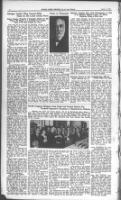
Jewish Congress Delegates from South and Central America Are
Tendered Impressive Reception at Manischewitz Bakeries
Delegates from South and Central America visit the B. Manischewitz Matzo Bakery in
Jersey City. Those present were : From Argentina, Dr. Jacob Hellman, M. Rogalsky, editor of Yid-
dishe Zeitung, David Grossman. Tillia Grossman and Dr. Moses Goldman; from Colombia, Dr.
Salvador Rosenthal : from Cuba, E. Aronofsky; from Uruguay, David Resnick; from Peru,
Dr. Wek-
sellman: from American Jewish Congress, Mrs. Schnieberg, Miss Leona Schwartz, Mrs. Dworkin
and Mr. Posansky.
The following have made con-
tributions to the Home for Aged:
August family, donation; Mrs.
Emil Baron, in honor of Bar
Mitzvah of Ruthven Simons;
Harold Biller, in memory of
mother, Hansah; Daniel Birn-
baum, Wyandotte, Mich., in mem-
ory of brother, Norbert Birn-
baum; Jack J. Brown, donation;
Mrs. Etta E. Cohn, Brookline,
Mass., in memory of husband,
Louis M. Cohn, and father,
Isaac Elbinger; Louis Cooper,
Chicago, Ill., in memory of moth-
er, Bella Cooper; Rose and Leon
Friedman, donation; Gertrude
Glaser, in memory of David
Rayman; Mrs. Hurwitz, dona-
tion; Mrs. J. Imerman, in mem-
ory of brother, Morris Baum-
garth; Geo. L. Kahn, Auburn,
Mich., in memory of brother,
Itzhok Kahn; Mrs. Lillian Kaye,
in memory of David Rayman;
Dr. Albert Krohn, in memory of
parents, Moses and Theresa
Krohn; Izy Levy, donation; Mrs.
Etta Morris, in memory of moth-
er, Annie; Mr. and Airs Geo. M.
Roberts, in memory of William
Elson; Mrs. B. Sarasohn, dona-
tion; Mrs. Dora Shimberg, in
memory of mother, Rayzel; Mrs.
Jacobb Simon and family, Pon-
tiac, Mich., in memory of Ben
Robinson; Mrs. Minnie Stein-
berg, in memory of husband,
Jacob H. Steinberg; Mrs. Mollie
S. Stern, in memory of husband,
Jacob H. Steinberg; Mrs. Mollie
S. Stern, in memory of sister,
Sarah Rosenzweig; Jacob E.
Stocker, in memory of wife,
Pauline Stocker; Mrs. Eveelyn
Theil, Hunter, N. Y., in mem-
ory of mother, Yeetke; Mrs.
Sarah Wolf, donation.
Jewish Fund-Raisin g Up 2.8%,
Council Report Shows
Delegates from South and Cen- arose to greet the guests and
tral American countries who at- to introduce the important speak-
tended the Hemisphere Conven- ers of the afternoon.
tion called recently by the World
Mr. Goldberg introduced Mr.
Jewish Congress in Baltimore, Regalsky, delegate from Argen-
were tendered a colorful and im- tina, and editor of the important
pressive reception at the Jersey newspaper "Die Yiddische Zei-
City plant of the B. Manische- tung," published in Buenos Aires.
witz Company. Transported in a Speaking for the rest of the
specially chartered bus, from delegates, Mr. Regalsky told of
New York, the delegates were the fame of the Manischewitz
welcomed in Jersey City by the name throughout South and Cen-
Manischewitz brothers and by tral America.
Rabbi Ilochstein, chief dietary
A warm message was delivered
supervisor of the huge Manische-
by Mr. Katz, secretary-treasurer
witz Matzo Bakery.
Rabbi Hirsch Manischewitz of Local 170, who spoke for the
first conducted the guests on a employees of the company. He
was unstinting in his praise of
tour of the entire plant.
After the tour, the delegates the high-minded labor relations
were invited to luncheon in the which prevail between employers
spacious dining hall of the plant. and employees at the Manische-
The hall was elaborately deco- witz company.
The celebrated journalist and
rated, Jewish and American flags
adorning the walls, and in the Yiddish columnist, Mordecai Dan-
center, a colorful array of the zis, also addressed the gathering
flags of South and Central Amer- briefly, adding his tribute to the
ican Republics whose representa- Manischewitz firm, with which he
tives were present. The luncheon has had close association for
was served amid a happy spirit many years.
of festivity and Jewish fellow-
Max Manischewitz then deliv-
ship, after which the noted jour- ered a greeting to the assembled
nalist and Zionist leader, Abra- delegates and guests. He spoke
ham Goldberg, as toastmaster, of the inspiration and the grati-
tulle which he and his brothers
felt at the privilege of being
able to meet with their Jewish
brethren of neighboring Amer-
icas, and to extend the hospital-
ity of the firm to the representa-
tives of South and Central Amer-
ican Jewry. He ended his remarks
with the fervent hope that all
would soon witness the downfall
of Hitler and Hitlerism.
Final speaker on the program
was Rabbi Hirsch Manischewitz.
"What is of paramount interest
and importance to me at this his-
toric moment," asserted Rabbi
Manischewitz, "is the tragic
plight of our Jewish brethren
across the seas." He stressed the
importance of unifying and co-
ordinating all the efforts and en-
ergies of the Jewish people, and
hailed the Pan-American Jewish
Congress just concluded in Bal-
timore as a vitally significant
step in this direction.
Mr. Goldberg brought the im-
pressive afternoon to a close
by calling upon Rabbi Segal of
Jersey City to lead the saying of
Grace. Cantor Kantaroff rendered
appropriate selections of litur-
gical and folk music.
NEW YORK (JPS) — A com-
parison of the amounts raised by
68 American Jewish communi-
ties in 1941 with those in 1940
shows an increase in giving of
2.8 per cent, it was stated by the
Council of Jewish Federations and
Welfare Funds in a preliminary
report on the sums obtained dur-
ing the first 9 months of 1941,
when a total of $15,895,697 was
registered in 132 cities in cam-
paigns for local and non-local
needs. The Council estimated that
the approximately $16,000,000 fig-
ure represented 60 per cent of the
total to be raised during the cal-
endar year 1941.
Nazis Close University Doors
When Anti-Semitis m Protested
GENEVA. (JPS)—Students of
Holland still have guts — which
explains why the Nazi Commis-
sioner for the Netherlands order-
ed the closing of the ancient Uni-
versity of Leyden. Arthur Seyss-
Inquart had dismissed a Jewish
professor, one of the most dis-
tinguished scholars of Holland,
which action immediately pro-
voked a strike among the student
body. In retaliation, the sturdy
Dutchmen will be deprived of
their university training.