

A lVaitill Prick Palatial Carter
CSJI/TOM ATM:I -
couctxtun ao, moo
aIf
THE JEWISH CHRONICLE
V A t.; E. 1. I V E
( A Description of the City.)
The modern city of Jerusalem prac-
tically covers the site of the ancient
city. Excavations, however, have
shown that the old city,exrendctl far-
ther to the south; while to the north
and particularly to tne west, the mod-
ern city far exceeds the ancient one,
whole settlements lying beyond the
walls of the medieval city. The west-
ern city wall coincides with the line
of the original wall; the northern wall .
is held by some to be identical in its
course with the ancient third wall:
and by others with the second. The
eastern wall follows the course of the
eastern Temple enclosure. The pres-
cut wall is 320.; feet high, and forms
an irregular quadrangular enciente
miles in extent. It is pierced by
eight gates: Jaffa, Zion, 1)und, St.
Stephen's, Herod, Damascus, New and
Golden. the last named being sealed.
1
"do*
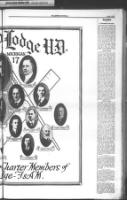
-MICHIGAN
Within the Walls.
Within the walls the city is di-
% ided into four quarters; the Chris-
tian, the Nloslent, the Jewish and the
Armenian. David street, running east
and west from the Jaffa gate to the
Temple place and Damascus street,
with its continuation, Bazaar street.
which starts from the Damascus gate
and runs north and south, form the
boundary lines for these quarters.
The Christian quarter is in the north-
western corner of the city; the Mos-
lem, in the northeastern and eastern
parts including the Temple place; the
Jewish in the southern part, on the
eastern slope of the traditional Mount
Zion; and the Armenian, in the south-
western part. In recent years the
Moslem quarter has been invaded be
the Jews; and outside of the wall
along the Jaffa and Damascus roads,
are numerous colonies of Jews. 'Hie
homes of the better class, as well as
the foreign consulates, the more im-
portant hospitals, schools and hotels,
are also in this extra mural quarter.
Here are located the Anglo-Palestine
Bank, the Palestine Bureau and the
offices of other Zionist institutions.
The Nurses' Settlement of Iladassah.
the Women's Zionist Organization is
within the city walls. \Valli!' the
walls the streets are narrow, crooked
and steep. The style of the
architecture is typical, the houses con-
sisting of a series of low, square, tlat-
domed rooms, built about an open
court, which generally contains a cis-
tern for gathering water. An oca-
sional latticed balcony is seen; and
almost all roofs are provided with a
balustrade. ()inside the walls the
streets are wider and better.
10
P/OR
150,000 Jews There.
MAX H.WEINBERG 322
JUN/OR DEACON
NE
JUN
lo t
CASPER OPPENHEIN
JOSEPH F FEIRER 32 °
TYLER
___,)
A .1.BLI/MENEAU 32?
srtivART
bi
l
ROBERT PLOTTLER
iiPlE/418ERG
,harterNottherg
g -csYsA.211
Jerusalem is now reached by rail
from Jaffa. The station is twenty
minutes' ride southwest of the city, in
the plain of Rephaim, near the Ger-
man colony of the Templars. Trans-
portation within the city is by means
of horse, camel, or donkey, only few
streets being practicable for wheeled
conveyances. Certain streets which
are very much crowded have low iron
bars across them to prevent camels
from entering, their large loads caus-
ing much confusion and damage.
NVithotit the walls modern carriages
are in use. The present Jewish popu-
lation, that is if there is any truth 10
the report that the "Finks caused a
wholesale evacuation, is about 150,000.
Up to 1837 the number of I l'WS iu
the Holy City was very small; and
of these the great majority were
Sephardim. In previous centuries
Ashkenazim has preferred to settle in
the Galilean cities. The earthquake
at Sided and Tiberias in 1837 caused
many to mine southward; and this
gave the tirst impetus to the growth
of the Jewish colony in Jerusalem.
The next great movement toward
Jerusalem occurred in connection
with the persecutions in Russia;
and since then the growth of the com-
munity has been extraordinary. There
are about 250 places of prayer for the
Jerusalem Jews, about seventy of
which are in independent buildings.
The famous 'Wailing-Place is inter-
esting from every point of view,
Every Friday afternoon and after
mooting service on Sabbaths and holy
days the Jews assemble in a pictur-
esque crowd to bewail their departed'
glory. This is the great show-place
of the Jerusalem Jewry as the Tem-
ple place is for the Moslems, and the
Church of the holy Sepulcher for the
Christians.
The Jews of Rolland just concluded
a series of conferences held by the
various consistories and organizations
for the purpose of defining the Jewish
demands to he presented to the peace
conference. All Jewish parties its
Holland participated in these confer-
ences and the final gathering tomtit-
bated a series of demands which WU...•
Made public by a great meeting at
Nmsterdam.
From Bohemia and Moravia the in-
formation regarding the position of
the Jews is very unsatisfactory. The
anti-Semitism of the people is grow-
ing, and the Jews are suhjected to in-
sults and persecution of a shameful
character. The Jewish leaders in Vi-
enna are directing their attention to
the scandalous exploits of the masses
against the Jews.
Vienna papers announce that hun-
dreds of Jewish fugitives from Jeru-
salem have arrived in Vienna. They
give a terrible account of Jewish suf-
ferings prior to the British occupa-
tion. Two-thirds of the population
were starving. Several 'thousands
were evacuated and were on the road
to Galilee without food and exposed
to the cold.