

7
THE JEWISH CHRONICLE
Happy New Year, Gerty!"
By Kate Friedmann
"Yes," eagerly, "but in my cigar
shop we talk Polish, Russian, Jew-
ish—but English, no. Home they
talk only little, so"—with a final
flourish of the little hand, "I go
to night-school. I learn hurry up."
"When the war-drum throbs no longer
and the battle flags are furled,
In the Parliament of man, the Federa-
tion of the world;
"Then the common sense of most shall
hold a fretful realm in awe,
And the kindly earth shall slumber, lap-
ped in universal law."
—Tennyson.
"I know you will," said Kroner.
"Ile sure to come tomorrow night
ti-J1 I will bring you another
book." Gerty's dimple flashed
gratitude. '['hey had reached the
car-line. She hurried forward.
G
ERTY sat very straight
and still, her dark eyes
fixed adoringly on the
speaker, a tall, slender,
grey-eyed youth, earnest in mien,
impressive in bearing, with a ring
of sincerity in his vibrant tones.
It is true she didn't understand
every word he uttered, but what
matter? His gestures, his elo-
quence, his earnestness were
enough.
Then suddenly, she gasped and
pressed her hand to her heart,
vainly attempting to strangle in
infancy a recurrence of the pain
that had seized her that morning
when the foreman had unexpect-
edly reproved her for "loafing."
She groped for some invisible
support, failed to find it, and slid
quietly down in her seat. No one
noticed. The speaker was near-
ing his climax. He flung the
words "life," "liberty" and "hap-
piness" with reckless abandon in
the face of his enthusiastic audi-
ence and concluded amidst thun-
dering applause. Thrilled and
elated his listeners dispersed.
Harry Kroner, the orator, with
wilted collar and damp face, pre-
pared to follow. A little huddled
figure in the corner attracted his
attention. Very often his audi-
ence, composed mainly of Rus-
sian immigrants, were moved, but
few wholly overcome. He walked
over and gently touched the girl's
arm. She stirred, sat up hastily,
and, finding the room strangely
quiet and empty, turned a pair of
frightened, wondering eyes on
Kroner.
"You finish?" she questioned
timidly.
"Yes," was the puzzled an-
swer, "didn't you know?"
"I—I—no. I get a sticking
pain here," she pointed a tiny
hand to her heart—"that's all."
Her eyes begged forgiveness for
inadvertance. She stood up very
straight—all the five feet of her.
"I go now," she said simply.
Something in the pinched little
face made Kroner fumble with a
perfectly unoffending collar. "I'll
walk to the car with you if you
want me to," he said. A sudden
smile lighted up her face. A dar-
"Thank you," she said simply.
"(
;ocd-night."
"Good-night," he answered.
Kroner watched the little figure
reach for a strap, miss it, make
another attempt ; then the car
turned, and Kroner, smiling rem-
iniscently, retraced his steps. Only
six years ago he, too, had wanted
to "learn English hurry up." What
wonderful eyes !
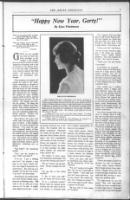
MISS KATE FRIEDMANN
Miss Friedniann bids fair to bring honor to the Jewish community of
Detroit as a short story writer of considerable merit. She recently completed
a course on the technique of the short story at the summer school of the Uni-
versity of Michigan, and gave evidence of talent that prompted her instructors
to advise her • to continue in her studies. She
beco me a regular student
at Ann Arbor at the opening of the school year in October. Miss Friedmann's.
ability was first expressed in her contributions to "The Triangle," the student
magaz.ine of Cass high School. She received a gold medal for the best
short story of the year.
"A Happy New Year, Gerty," is her first college attempt. It received
high praise from the head of her department at the university and was used
as a model for class room discussion.
A brilliant future is predicted for Miss Friedmann, the attainment of
which is the earnest wish of the Jewish community of Detroit.
ing dimple forced its way to her
cheek. She trembled with de-
lighted excitement. Tomorrow
she would tell the girl's at the
shop that Harry Kroner, the for-
eigner who had accomplished
such wonders in only six years—
Kroner, the organizer of clubs,
the settlement worker, the speak-
er at mass meetings, the night-
school teacher, the strike-arbi-
trator, Kroner the—
The subject of future noon-
hour discussions interrupted, "Do
you get that sticking pain often?"
"No, no," hastily and apologet-
ically. Kroner changed the sub-
ject.
"Do you like to hear about
America ?"
"I like to hear—you—talk,"
was the frank and fervent reply.
"It is a wonderful country,"
Kroner went on, lapsing uncon-
sciously into the spirit of his re-
cent oration, "a wonderful land,
•
full of golden oppo . rtunities, the
home of a free people."
Gerty didn't answer. Gerty's
America was Division street, in
the heart of the Ghetto, between
a synagogue and a garage. Her
golden opportunities in the cigar
factory were limited to a speci-
fied number beyond which she, a
union worker, could not dare. Her
freedom she exercised at night in
a choice between the fleischige
dishes and last week's ironing.
"Don't you agree with me?"
he questioned, now dimly realiz-
ing the incongruity of his last
statement.
•'
"Yes, yes," anxious to be aftee-
able, "it is so, but I don't. talk so
much English. I here only two
year, but I learn quick now. I go
to your school." She smiled hap-
pily. "See," holding up a book, "I
read twenty pages myself." Kron-
er glanced at the book.
"Do you want to learn quick-
ly?" he asked.
Gerty smiled too, a radiant,
tremulous smile. a happy tear
stole furtively down the olive
cheek ; her eyes glowed with the
dawning hope of better things.
Harry Kroner had noticed her!
"I will bring you another book,"
he had said and smiled his frank,
hearty smile. Mechanically she
alighted at the proper corner. A
young voice, breathless and im-
patient, aroused her.
"Gee, Gerty, already twice I say
'Dave is waiting, Dave is wait-
ing,' and you only look at me and
don't say nothing:" Gerty shivered
back to realities. Dave was wait-
ing! Dave with his fringe of curly
hair around a bald spot, rubber-
collared and asthmatic; was wait-
ing, as he always waited. She
could see him now seated uncom-
fortably and unhappily on the
bench in front of her uncle's
butcher-shop, slightly undersized
and considerably. overweight,
breathing of his profession and
panting for breath. She could hear
him as if at a great distance. Di-
vision Street, when it did not con-
verse in Yiddish, did so in Divis-
ion Street English, a picturesque
jargon interspersed with foreign
words and phrases that baffled
translation.
"What's the matter so late?" he
wheezed, by way of greeting,
"Louie, Sadie, twenty minutes
they're horrie already from night-
school." Silently Gerty took her
accustomed place beside him. The
smile had fled, leaving no trace.
Dave was speaking again.
"To night-school you go," he
panted. Bch, itch night-school.
English you know enough for me.
No more night-school. Tomorrow
we go to the Co-operative. Kosher
."